Dakor is a small town in Kheda district, about eighty kilometres from Ahmedabad, and for most of the year it is exactly what that description suggests: a busy local temple town with a big tank, a lot of prasad shops and a steady flow of pilgrims. Then, several times a year and most spectacularly at the Falgun full moon, the highways leading to it fill with people walking, and the town takes in a crowd measured in the hundreds of thousands.
At the centre is the Ranchhodrai temple, an eighteenth-century structure housing an image of Krishna as Ranchhodrai — the one who left the battlefield — and one of the most important Vaishnava shrines in Gujarat. It is not on many foreign visitors' itineraries and it should be on more, both for the temple itself and because the walking pilgrimage to it is one of the great sights of the region.
The temple, and the story of the idol
The present temple was built in 1772 by Gopalrao Jagannath Tambvekar, a Maratha noble, and it is a substantial and handsome eighteenth-century building — a large central shrine with a dome and spire, an assembly hall, subsidiary structures and a broad paved compound, all on a scale designed for crowds. It sits beside the Gomti tank, which is central to the pilgrimage: bathing in it is part of the observance for many visitors, and the ghats around it are busy through the day.
The story attached to the idol is the reason the place exists, and Gujarat tells it with relish. Bhakta Bodana, a devotee from Dakor, is said to have travelled repeatedly to Dwarka to worship Krishna, and in old age, unable to keep making the journey, to have been granted the deity's own promise to come with him. The image was brought from Dwarka to Dakor; the Dwarka priests pursued; and by the version most commonly told, a settlement was reached in which they were compensated in gold equal to the idol's weight — which Bodana's wife's nose-ring alone sufficed to balance.
Whatever one makes of the narrative, its function is clear: it establishes Dakor as a legitimate seat of the Dwarka deity and therefore as a destination in its own right, which is precisely what it became. The image in the sanctum is dark stone, richly dressed and ornamented, and darshan is organised in the practical, high-volume way of any major Indian shrine — expect queues, cloakrooms and restrictions on phones and cameras.
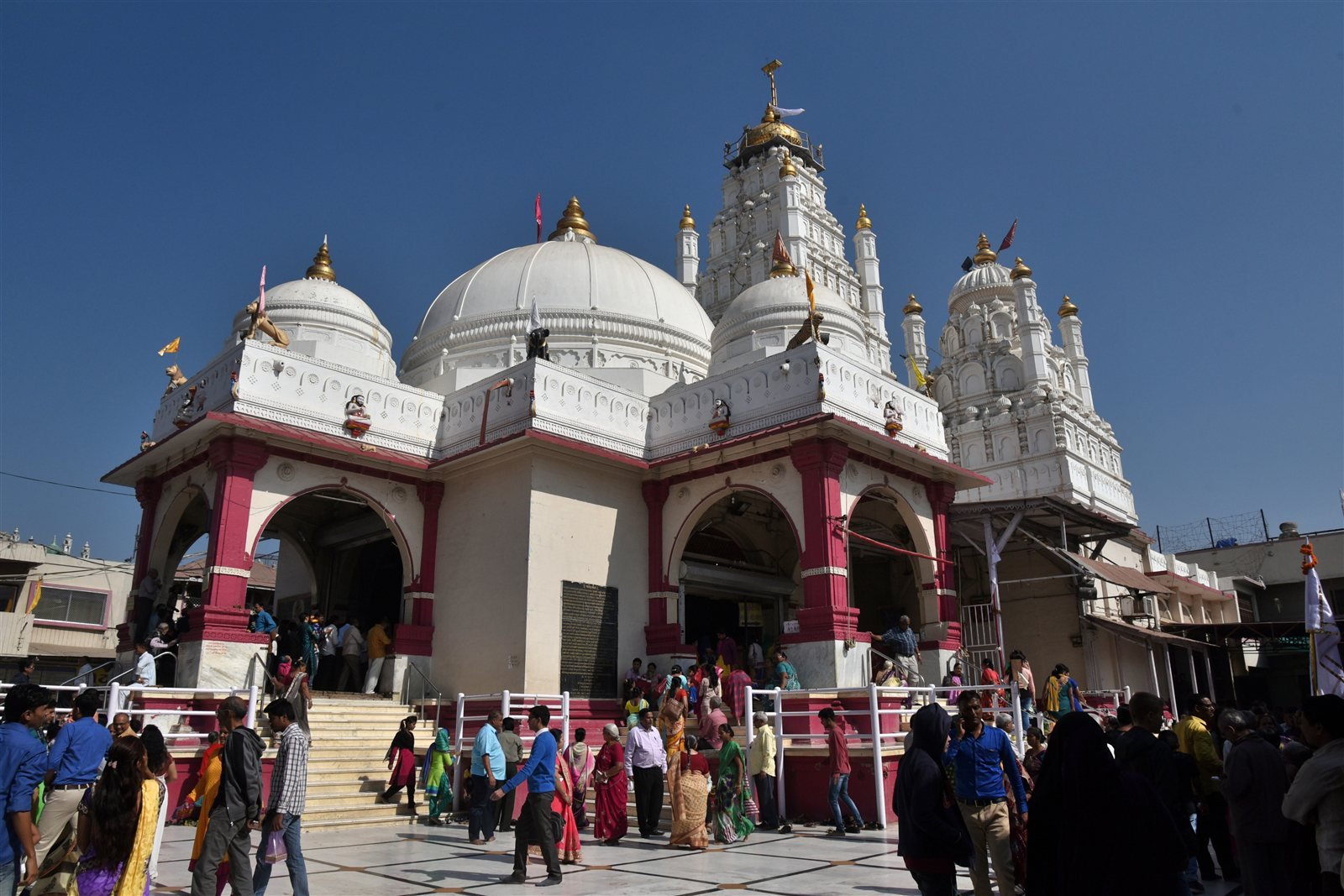
A great eighteenth-century Krishna temple in a small Kheda town, and one of Gujarat's biggest walking pilgrimages.
The walking pilgrimage
The thing that makes Dakor extraordinary is the padyatra. On the major occasions — above all Falgun Purnima, the full moon that falls around Holi in February or March, and also Kartik and Sharad Purnima — very large numbers of pilgrims walk to Dakor from Ahmedabad, Nadiad, Vadodara and towns across central Gujarat, in organised groups, carrying flags and singing, over one or several days.
Along the highways for days beforehand, volunteer camps hand out water, food and foot treatment to people walking eighty kilometres to a small town in Kheda
Along the routes, volunteer camps — sevas run by trusts, community groups and local families — set up to provide water, tea, food, foot massage and medical attention, and the roadsides for days beforehand become a continuous line of hospitality. This is one of the most striking expressions of organised religious voluntarism in western India, and even from a car window it is remarkable. Attendance figures reported for the main melas run well into the hundreds of thousands.
For a visitor, the choice is stark. Come for the mela and you see something genuinely extraordinary, in conditions of extreme crowding, with roads congested or closed to ordinary traffic and accommodation gone for a wide radius. Come on an ordinary weekday and you see a fine eighteenth-century temple in a quiet town in forty minutes. Both are legitimate. The one thing not to do is arrive for the mela by accident, which happens to travellers driving between Ahmedabad and Vadodara at the wrong time of year.
Charotar, and what else is here
Dakor sits in the Charotar, the fertile, prosperous, densely populated tract of Kheda and Anand districts that has produced a disproportionate share of Gujarat's migrants, businessmen and political figures. It is not a landscape of dramatic sights, but it repays a day for anyone interested in how rural Gujarat actually works, and it has a scatter of genuinely good things in it.
Nadiad, about 25 km away, is a substantial old town with the Santram Mandir at its centre and a long association with education and publishing. Anand, further south, is the home of Amul and the cooperative dairy movement, with a museum and tours that are more interesting than they sound. The region also holds a set of neglected stepwells — the Batris Kotha Vav at Kapadvanj is the standout, an eleventh-century Solanki structure with an associated kund, and there are others at Mahudha and elsewhere. Vadodara, with Laxmi Vilas Palace and its museums, is around 70 km from Dakor.
Practicalities
Dakor is roughly 80 km from Ahmedabad and about 70 km from Vadodara, both a little over an hour and a half by road, and it sits close to the main highway between them. It has a railway station with local services, and Nadiad and Anand are larger railheads on the main Mumbai–Delhi line nearby. Buses run frequently from Ahmedabad, Nadiad and Vadodara, and the temple is walkable from the station and bus stand.
October to March is the comfortable season, with the Falgun Purnima mela usually falling in February or March. Accommodation in Dakor is pilgrim-oriented — dharamshalas, trust guesthouses and simple hotels — and gone entirely during the melas; Nadiad and Anand have basic hotels, and Ahmedabad or Vadodara are the sensible comfortable bases. Do check the mela dates against your travel plans in either direction, because the effect on regional traffic is substantial.
If you go
- Decide deliberately about the melas: Falgun Purnima around Holi is extraordinary and overwhelming; an ordinary weekday is a quiet forty minutes.
- Check mela dates before driving between Ahmedabad and Vadodara in February or March, when highway traffic is badly affected.
- Expect cloakrooms, security and restrictions on phones and cameras at the temple, as at any major shrine.
- Combine Dakor with Nadiad's Santram Mandir, Anand's Amul museum and the Kapadvanj stepwell for a proper Charotar day.
- Base yourself in Ahmedabad or Vadodara; Dakor's own accommodation is pilgrim-standard and disappears during the fairs.
Dakor is one of Gujarat's great pilgrimage towns and it barely registers with outside visitors. An eighteenth-century Krishna temple built by a Maratha noble, a tank the pilgrims bathe in, a founding story involving a devotee, a nose-ring and a deity who agreed to move house — and, several times a year, hundreds of thousands of people walking eighty kilometres to get there past roadside camps handing out food. Choose your date deliberately, and give the Charotar around it a day.