Best time
October to March
Aarti
Three times daily; check current timings
Good for
Pilgrimage, coastal sunsets, history
Nearest base
Somnath / Veraval (7 km)
Somnath is the first of the twelve Jyotirlingas, the most important Shiva shrines in Hinduism, and it stands on the Saurashtra coast with the Arabian Sea breaking directly below it. It is also the most rebuilt temple in India. Destroyed and raised again repeatedly across a thousand years of raids and reprisals, the present structure dates from 1951, when it was reconstructed after Independence at the initiative of Sardar Vallabhbhai Patel and K. M. Munshi — which makes Somnath simultaneously an ancient pilgrimage site and a modern national statement.
For visitors, it is a straightforward and rewarding stop: a large, well-run temple complex on a dramatic shoreline, three daily aartis, an evening light-and-sound show, a good museum and a cluster of associated sites within a few kilometres. This guide covers timings and rules, what to see, where to stay, and how Somnath fits with Gir and Diu.
Why Somnath is worth the stop
For the setting, first. The temple stands on a low headland with the sea immediately below the eastern wall, and there is a pillar in the compound — the Baan Stambh, or arrow pillar — carrying an inscription to the effect that there is no land in a straight line from this point to the South Pole. Whether or not that survives strict scrutiny, standing at the sea wall with spray coming over it and the shikhara above you is genuinely stirring, and it is why Somnath photographs so well.
And for the history, which is unavoidable and worth engaging with honestly. The temple's repeated destruction — most famously by Mahmud of Ghazni in the eleventh century, and several times afterwards — and its repeated rebuilding have made it one of the most politically charged sites in India. The 1951 reconstruction in the Chalukya style was a deliberate act of national symbolism. Understanding that layer makes the visit considerably more interesting than treating it as simply another large temple.
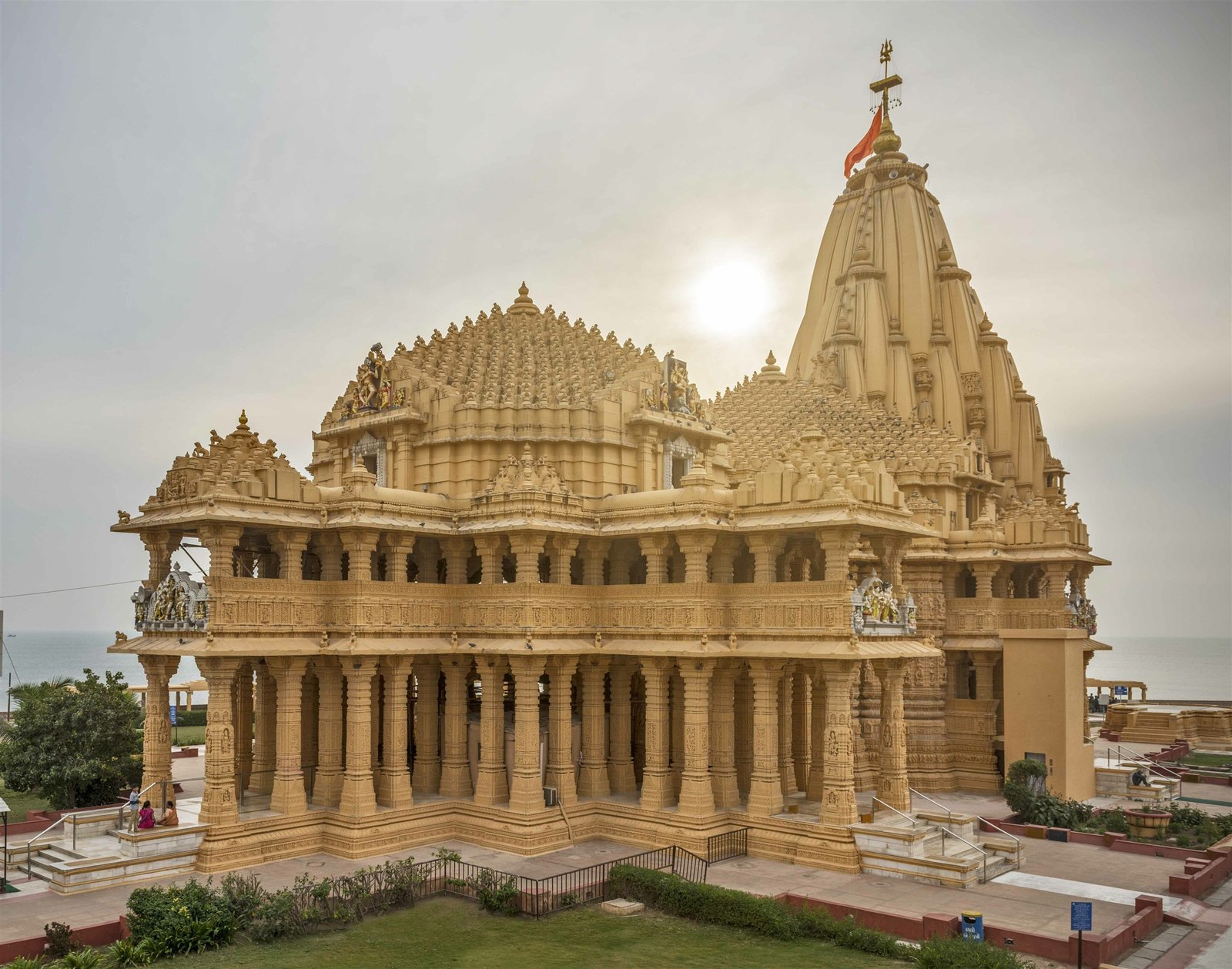
Rebuilt for the last time in 1951, on a shore with nothing between it and Antarctica.
How to plan the visit
- Time your arrival around an aartiThere are three aartis daily and they are the best moments in the temple. Check current timings locally on arrival, as they shift seasonally, and get there early for a decent position.
- Leave phones and bags at the cloakroomSecurity is tight and mobile phones, cameras and bags are generally not permitted inside. There are free cloakroom facilities; plan for the queue.
- Walk the sea wall and find the Baan StambhThe eastern side of the complex, with the sea below and the arrow pillar marking the unbroken line south, is the part people remember.
- Stay for the light-and-sound showAn evening projection show on the temple's history runs in the complex. It is well done, it fills in the story of the rebuildings, and it is a good use of an hour after dinner.
- Do the Prabhas Patan museumA short walk away, it holds sculpture and architectural fragments salvaged from earlier versions of the temple — the physical evidence of everything the show describes.
- Add Bhalka Tirth and Triveni SangamA few kilometres off: Bhalka, where Krishna is said to have been struck by the hunter's arrow, and the confluence of three rivers with the sea. Both are quick, both are locally significant.
How to get there
Veraval, 7 km away, is the transport hub: a railway station with services from Ahmedabad, Rajkot and beyond, and the nearest town of size. Somnath itself has a station with some direct trains. The nearest airports are Diu, Rajkot and Porbandar, with Rajkot the most useful for connections; Ahmedabad is around 400 km by road.
Buses and shared taxis run constantly between Veraval and Somnath, and auto-rickshaws cover the last stretch cheaply. Most travellers arrive as part of a Saurashtra driving route, and Somnath's position makes that easy: Gir National Park is about 45 km away, Junagadh around 80 km, Diu roughly 90 km, and Dwarka a longer haul up the coast. A hired car is the most flexible way to string those together.
Where to stay
There is a great deal of accommodation in Somnath, almost all of it pitched at pilgrims: trust-run dharamshalas and guesthouses, simple hotels, and a smaller number of comfortable mid-range properties, including sea-facing options and a Gujarat Tourism hotel. Staying in Somnath itself is much the better choice, because it lets you attend an early aarti and the evening show without a commute.
Veraval, 7 km away, is a working fishing port with cheaper and more basic hotels and is a reasonable fallback when Somnath is full. Booking ahead matters around Mahashivratri, the Kartik full moon, Shravan and the main holiday periods, when the town is extremely busy. Food is overwhelmingly vegetarian in and around the temple area; Veraval, being a fishing town, is a different story.
Best time to visit
October to March is the comfortable window: warm days, cool sea breezes and pleasant evenings for the light-and-sound show. December and January are the most popular and also the coolest. The coast keeps the worst edge off the heat, but April to June is still hot and humid, and the monsoon brings heavy rain and rough seas, though the temple against a stormy sky is a sight in itself.
Festival timing is the bigger consideration. Mahashivratri, usually in February or March, is the great Somnath occasion and brings enormous crowds; Shravan, the monsoon month sacred to Shiva, is busy throughout; and the Kartik full moon draws a large fair. Those dates are extraordinary if the crowds are what you want and difficult if they are not. For an unhurried visit, pick an ordinary weekday in November or February.
Practical tips
- Check aarti timings on arrival rather than relying on published schedules, and arrive well before to get a position.
- Plan for the cloakroom: phones, cameras and bags are generally not allowed inside the temple.
- Dress modestly and expect airport-style security screening at the entrance.
- Stay in Somnath rather than Veraval so you can do an early aarti and the evening show comfortably.
- Combine with Gir (45 km) and Diu (90 km) for the classic Saurashtra loop.
Frequently asked questions
What is special about Somnath temple?
It is the first of the twelve Jyotirlingas, the most sacred Shiva shrines, and one of the most rebuilt temples in India — destroyed and reconstructed repeatedly, most recently in 1951.
Are phones allowed in Somnath temple?
Generally no. Mobile phones, cameras and bags must be left at the cloakroom facilities outside, and security screening is thorough.
How far is Somnath from Gir National Park?
About 45 km, an easy hour by road, which is why the two are almost always visited together.
What is the Baan Stambh at Somnath?
The arrow pillar on the temple's sea-facing side, carrying an inscription stating that no land lies in a straight line between this point and the South Pole.
When is the best time to visit Somnath?
October to March. Mahashivratri and the month of Shravan are spectacular but extremely crowded; an ordinary weekday in November or February is easiest.
Somnath rewards a little preparation. Arrive in time for an aarti, leave your phone at the cloakroom without resenting it, walk out to the sea wall and the arrow pillar where the Arabian Sea comes over the stone, spend an hour in the Prabhas Patan museum with the fragments of the temples that stood here before, and come back after dinner for the light-and-sound show. Then drive forty-five minutes to Gir and look for lions.