Gujarat Explorer

Home › Chhota Udaipur › Pithora Wall Art

TRIBAL ART · RATHWA · LIVING TRADITION

Pithora Wall Art

One of India's most extraordinary living art traditions — the Pithora murals of the Rathwa Adivasi of Chhota Udaipur: large-scale ceremonial wall paintings depicting the deity-king Babo Pithoro, his white horse, and the full court of the tribal cosmos, created in a sacred ceremony that marks the home as a place of blessing.

AT A GLANCE Quick Facts
📍 DISTRICT Chhota Udaipur
🏷️ TYPE Tribal wall art
🗺️ REGION Eastern Gujarat
🧭 CATEGORY Hidden Gem
☀️ BEST TIME Oct – Mar
🎟️ ENTRY Open access
⏱️ DURATION 1–2 hrs
💡 IDEAL FOR Explorers
ABOUT THE PLACE

The mural tradition of the Rathwa tribal world

Pithora wall art is the defining visual tradition of the Rathwa Adivasi of Chhota Udaipur district — a ceremonial mural painting that covers the inner walls of a tribal home, commissioned in specific circumstances (illness in the family, a wedding, a vow fulfilled) from a specialist artist called a lakhara, who paints in a single ritual ceremony.

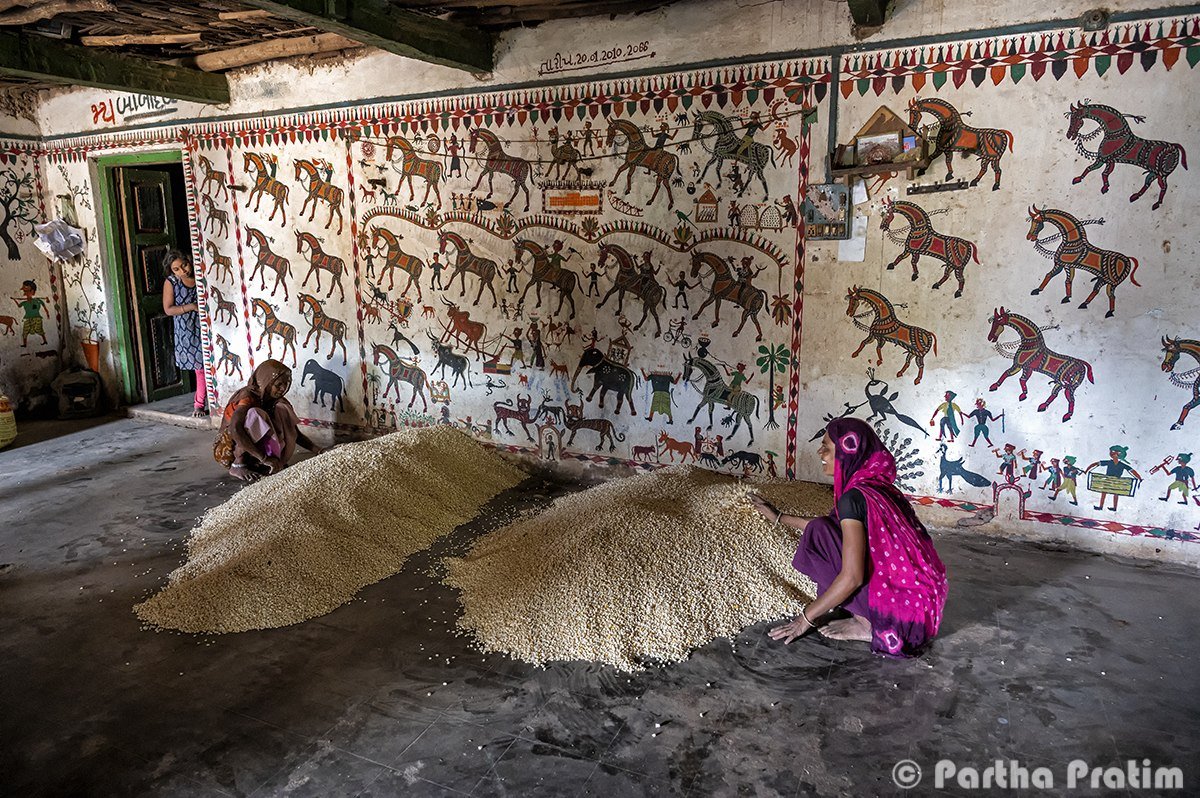
The central figure of every Pithora mural is Babo Pithoro, the supreme deity of the Rathwa — depicted on a white horse, leading a procession of his brother, wife, courtiers, celestial animals, the sun, moon, and a cosmos of sacred beings. Each painting is a complete cosmological map, narrated in a specific visual language that has been passed down through generations of lakhara artists.

The colours of the original tradition were derived from natural mineral pigments: red from sindoor, yellow from turmeric, white from lime, black from charcoal. Contemporary paintings often use acrylic, but the compositional vocabulary and the narrative grammar remain intact. The best place to see Pithora murals is in the villages of the Kawant and Naswadi talukas — but always with a guide and explicit community permission. The mural, once painted, becomes a sacred object in the home.

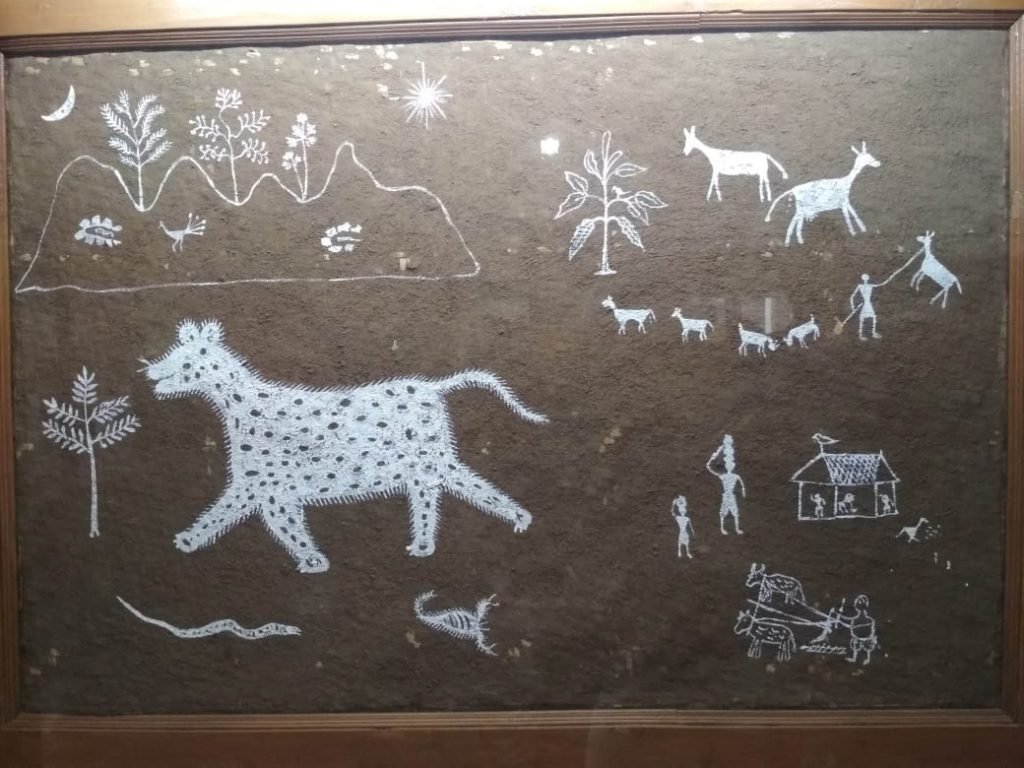
Pithora mural art — Chhota Udaipur. Source: Wikimedia Commons.

HISTORY

From a riverside experiment to the road to freedom

Pithora mural, Chhota Udaipur. Wikimedia Commons.

Tribal antiquity

Rathwa mural tradition begins.

Lakhara role

Sacred artist-ritualist.

Ceremonial commission

Illness, wedding, vow.

Today

Active — with acrylic adaptations.

WHY VISIT

Reasons to make the time

🎨

Living art

Still commissioned.

🐴

White horse

Pithoro on horseback.

🌏

Cosmology

A complete world.

🙏

Sacred

Ritual, not decoration.

📸

Visual

Extraordinary imagery.

🤝

Community

Village tradition.

HIGHLIGHTS

What to look for inside

PITHORA ART

Rathwa mural

Babo Pithoro.

THINGS TO DO

How to spend an hour or two

01

Visit with a guide

Essential.

02

Find a freshly-painted home

The lakhara's work.

03

Identify Babo Pithoro

On the white horse.

04

Count the elements

Sun, moon, animals.

05

Ask about the commission

What prompted it?

06

Never photograph without asking

Sacred object.

Pithora mural detail. Wikimedia Commons.

ARCHITECTURE & SETTING

The Pithora visual language

A Pithora mural fills three walls of a room in a single continuous composition. Babo Pithoro always appears at the centre of the main wall, mounted on a white horse; his brother on a black horse rides beside him.

The painting includes the sun and moon in the upper field, a village with trees, animals and ritual objects in the lower field, and the full divine court of Pithoro’s universe filling every remaining space. The lakhara artist works from memory — the composition is learned, not sketched — completing the mural in a ritual session that is itself a form of worship. (Village visits require a guide; photograph only with explicit permission.)

Ceremonial murals covering three interior walls

Central figure: Babo Pithoro on a white horse

Original pigments: sindoor, turmeric, lime, charcoal

Painted in one session by a specialist lakhara artist

BEST TIME TO VISIT

When to go

WINTEROct – Feb★★★★★

Best conditions and festivals.

MONSOONJul – Sep★★★☆☆

Lush and green; monsoon mood.

SUMMERMar – May★★☆☆☆

Hot; early morning best.

⏰ October to February is ideal — festivals and clear skies.

PLANNING ESSENTIALS

Timings & entry

🕗OPENING HOURSOpen access
  • Village murals are inside private tribal homes
  • Always visit with a local guide
  • Seek explicit community permission first
  • Allow 1–2 hours for an unhurried visit
🎟️ENTRYNo formal ticket
  • No entry ticket — these are living homes
  • Offer a respectful contribution to the host family
  • Photography only with explicit permission
  • Approach the tradition as sacred, not a sight
HOW TO REACH

Getting there

✈️

By Air

Vadodara airport (~100 km).

🚆

By Rail

Bodeli / Chhota Udaipur.

🚗

By Road

NH-56 from Vadodara.

NEARBY DISTANCES
Kawant taluka villages · Naswadi villages — 25 km · Chhota Udaipur — 35 km · Vadodara — 100 km
PHOTOGRAPHY GUIDE

Shooting Pithora art

PERMISSION FIRST

Sacred murals inside living homes — never photograph without explicit consent

🙏

Ask first

Always seek the host family's explicit permission before raising a camera.

🖼️

What to shoot

The central Babo Pithoro on his white horse, the sun and moon, and the crowded divine court.

🎨

Respect the colour

Capture the natural pigments — sindoor red, turmeric yellow, lime white — in soft daylight.

🤝

Honour the ritual

Remember the mural is a sacred object, not decoration; keep your visit quiet and unstaged.

TRAVEL TIPS

Know before you go

1Always visit with a knowledgeable local guide who can introduce you to the community.
2Seek explicit permission before entering a home or photographing a mural.
3Treat the painting as a sacred object — it is worship, not decoration.
4Offer a respectful contribution to the host family for their hospitality.
5Come between October and March, when the weather is cool and festivals are on.
6Ask about the occasion behind the mural — illness, a wedding or a vow fulfilled.
7Learn to read the composition: Babo Pithoro, his brother, the sun, moon and animals.
8Keep your voice down and your visit unhurried; this is someone's living home.
NEARBY FOOD

Where to eat around the ashram

THALI

Gujarati Thali

Comfort home cooking.

TRIBAL

Rathwa food

Forest produce & millet.

BAJRA

Bajra roti

Tribal staple.

🍽️GOOD TO KNOW

Forest & millet flavours

Expect simple, hearty tribal fare — bajra roti, forest produce and Adivasi forest honey.

FREQUENTLY ASKED

Pithora Wall Art FAQ

Can I see Pithora art?

Yes — with a guide in the tribal villages.

What does the art show?

Babo Pithoro on a white horse, with his divine court.

Is photography allowed?

Only with explicit community permission.

Where to find it?

Kawant, Naswadi and surrounding villages.

Is it still practiced?

Yes — an active, living tradition.

What is a lakhara?

The specialist ritual artist who paints Pithora murals.

WHERE TO STAY

Find your stay in Gujarat

Compare live prices across the big booking sites and reserve in a few taps. Booking happens securely on the partner's site — we may earn a small commission at no extra cost to you.

📍 DestinationAnywhere in Gujarat 📅 Check-inAdd date 📅 Check-outAdd date 👥 Guests2 adults Search Hotels
🏨SAMPLE
Heritage Haveli
★ 4.5  ·  800 reviews
Book Now
🏨SAMPLE
Lakeside Resort
★ 4.6  ·  1140 reviews
Book Now
🏨SAMPLE
City Boutique
★ 4.7  ·  1480 reviews
Book Now
Affiliate links: prices and availability are shown by our partners. You pay the same price; we may earn a commission that helps keep Gujarat Explorer free.

SHOP THE REGION

Bring home Gujarat — & travel essentials

Hand-picked crafts and trip gear, available on Amazon.

🧵
Patola Silk Scarf
View on Amazon
🪔
Kutch Embroidery
View on Amazon
🎒
Travel Backpack 40L
View on Amazon
🍪
Gujarati Snack Box
View on Amazon
As an Amazon Associate, Gujarat Explorer earns from qualifying purchases. Product prices and availability are accurate as of the date/time shown on Amazon and are subject to change.
🚕
Book a cab anywhere in Gujarat
Airport transfers, day trips & intercity rides — reserve a comfortable cab, or just ask us on WhatsApp.
Enquiries are passed to independent, licensed local operators. Gujarat Explorer is a facilitator, not the transport provider.