Best time
December to March
Ideal duration
2-3 days
Good for
Wildlife, safari, birding
Nearest airport
Rajkot / Diu
Gir is the last refuge of the Asiatic lion, a subspecies that once ranged from Greece to India and now survives only in this dry deciduous forest in the Saurashtra region of Gujarat. The park and its surrounding sanctuary cover a broad sweep of teak, acacia and open grassland cut by seasonal rivers. After decades of careful protection the lion population has climbed steadily, and while sightings are never guaranteed, your odds here are genuinely good, which is something you cannot say of most big-cat parks.
The base for almost everyone is Sasan Gir, a small town on the park edge with the safari booking office, lodges and the interpretation centre. Safaris run in open gypsies on fixed routes through assigned zones, with a naturalist and driver. Beyond the lions, Gir is quietly rich: leopards, striped hyena, jackal, marsh crocodiles in the rivers, spotted deer and sambar in numbers, and more than three hundred bird species. Come with patience and a decent pair of binoculars.
Why go to Gir
This is the one place in the world where you can watch a wild lion in Asia, and that alone makes the trip. But Gir rewards more than a single-species tick. The forest is beautiful in its own understated way, all pale grass and bare teak in the dry months, and the wildlife density is high enough that even an average drive turns up deer, peacocks, crocodiles and raptors. The conservation story is genuinely uplifting: a population brought back from the edge and now sharing space with local herders and their cattle. For anyone who cares about wildlife, Gir is one of India's essential parks.
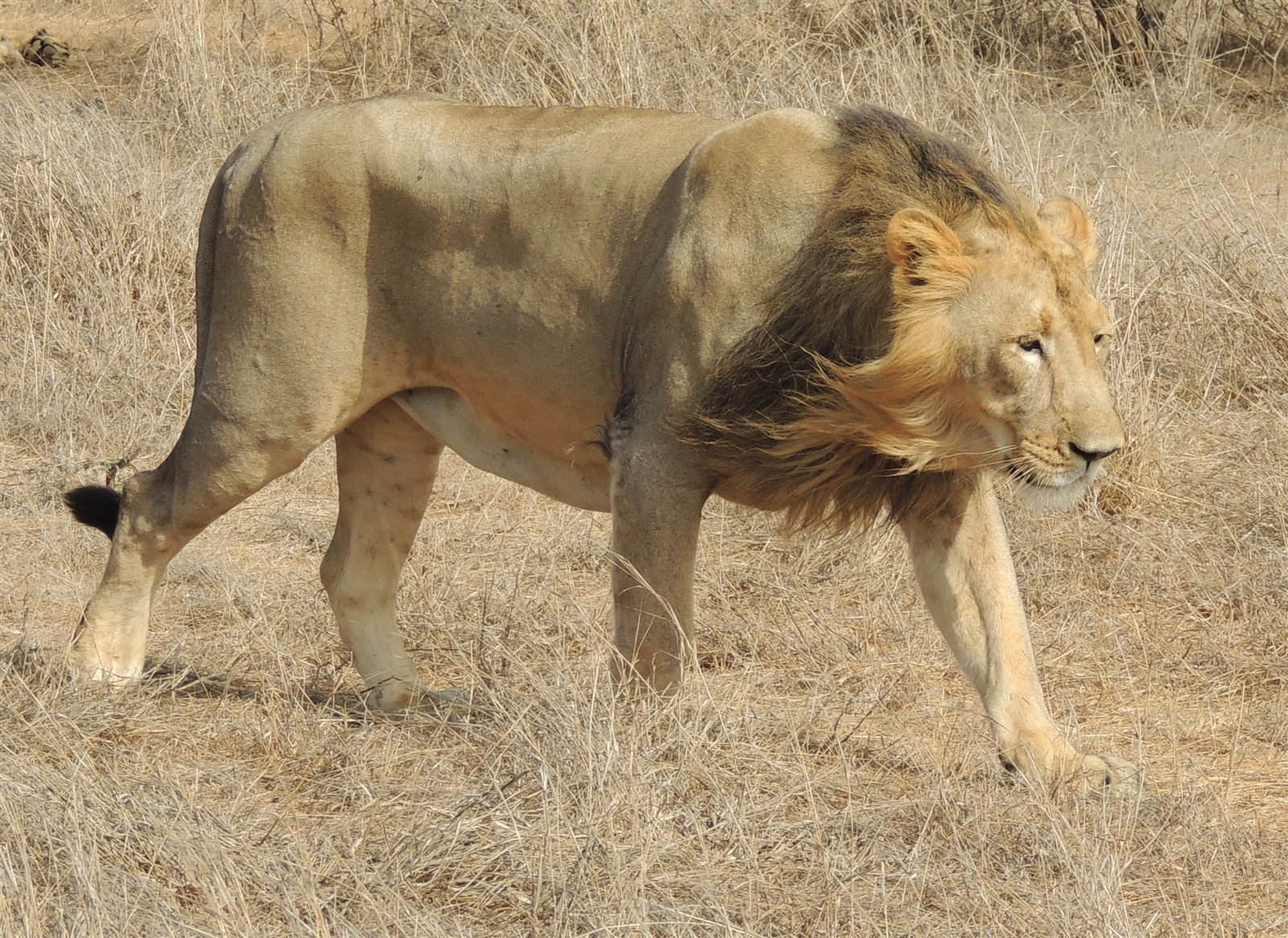
Dry teak forest and open grassland make up the classic Gir habitat the lions patrol.
Top things to do
- Take a core-zone jeep safariThe main event: a shared open gypsy on a permit-controlled route through the forest, morning or afternoon, with a guide and tracker.
- Visit Devalia Interpretation ZoneA fenced enclosure near Sasan where sightings of lions and other animals are near-certain, useful if your permits fall through.
- Go birdwatchingGir hosts over 300 species. Kamleshwar Dam and the riverbeds are good for waterbirds, raptors and the crested serpent eagle.
- See the marsh crocodilesThe Hiran river and dam areas hold a healthy population of muggers, often basking on the banks in the sun.
- Learn the conservation storyThe interpretation centre in Sasan Gir explains the lion recovery, the Maldhari herders and how the park is managed.
How to get there
Sasan Gir does not have its own airport, so most travellers fly into Rajkot (about 160 km, three to four hours by road) or Diu (about 110 km), with Ahmedabad as a larger long-distance option roughly 340 km away. There is a railway station at Sasan Gir on a metre-gauge line with limited connections, and better rail links at Junagadh and Veraval nearby. By road the park connects easily to Junagadh, Somnath and Diu, so many people fold Gir into a wider Saurashtra loop. A hired car is the simplest way to reach and move around the region.
Where to stay
Sasan Gir has the widest choice, from basic guesthouses and the government-run lodge to comfortable mid-range resorts on the approach roads. A cluster of higher-end jungle lodges sits a short drive out, offering pools, guided walks and their own naturalists, which suits families and first-time safari-goers. Budget travellers can find simple rooms in Sasan town within walking distance of the booking office. Wherever you stay, pick something reasonably close to the park gate so you are not making a long pre-dawn drive to catch the morning safari, and book early in peak winter season.
Best time to visit
The park is open from roughly mid-October to mid-June and closes during the monsoon, from around 16 June to mid-October, for breeding season. Winter, from December to March, is the most pleasant time to be out in an open jeep, with cool mornings and comfortable days. As the dry season deepens into April and May the heat becomes intense but sightings often improve, because animals gather at the shrinking waterholes and the thinning cover makes them easier to spot. Aim for December to March for comfort, or the hot months if a sighting matters more than the temperature.
Practical tips
- Book safari permits online well in advance; slots are limited and sell out fast in winter and on holidays.
- Sightings are never guaranteed. Do two or three safaris to improve your odds rather than pinning everything on one drive.
- Wear muted colours, carry binoculars, and keep your voice down inside the park.
- Mornings are usually cold in an open gypsy, so bring a warm layer even if the afternoon is hot.
- Respect the rules: no getting out of the vehicle, no feeding, and let the guide manage how close you approach.
Frequently asked questions
Are you guaranteed to see a lion?
No park can guarantee a wild sighting, but Gir has a healthy, growing population and good odds. Doing more than one safari, or visiting Devalia, greatly improves your chances.
How do safari permits work?
Permits for the core zone are booked online in advance through the official portal, for a fixed date, time and vehicle. Book early, especially for winter weekends and holidays.
What is the difference between Gir and Devalia?
The core zone is open forest where sightings take luck. Devalia is a smaller fenced interpretation zone where animals are almost always seen, ideal as a backup.
When is Gir closed?
The park shuts during the monsoon, roughly from mid-June to mid-October, for the breeding season. Plan your visit for the open winter and spring months.
A Gir safari asks for a little patience and rewards it generously. Give yourself two or three drives, keep your expectations honest, and enjoy the whole cast of the forest rather than fixating on lions alone. When a big male does finally step out of the grass and hold you in that unbothered stare, you will understand why this small corner of Gujarat matters so much to conservation, and why so many wildlife travellers keep coming back.