Best time
November to March
Ideal duration
1 to 2 days
Good for
Wildlife, birding, photography
Nearest airport
Ahmedabad (about 3 hours)
The Little Rann of Kutch is a place that refuses to sit still in your memory. For half the year it is a bone-dry sheet of cracked earth and crystallised salt, stretching flat to a horizon that shimmers with heat. For the other half, the monsoon floods it into a shallow inland sea. This seasonal seesaw has produced one of the strangest and most rewarding landscapes in India, and it is the only place on Earth where you can watch the Indian wild ass run free.
Spread across roughly 5,000 square kilometres in northern Gujarat, the Wild Ass Sanctuary protects the khur, a handsome tan-and-cream relative of the horse that once roamed far wider across Asia. Today the population lives almost entirely here. But the Rann is not a one-animal show. Rising from the flats are hundreds of small grassy islands called bets, and around them gather nilgai, blackbuck, desert foxes and a cast of birds so large it can genuinely overwhelm a first-time visitor. Most people arrive from the villages of Dasada and Zainabad, which have quietly become the gateway to the whole sanctuary.
Why go to the Little Rann
You go for the wild ass, and then you stay for everything else. A morning safari here rarely delivers a single sighting; it delivers a slow accumulation of them. A distant herd of khur breaks into a gallop, dust trailing behind. A cloud of lesser flamingos lifts off a salt pan and turns pink against the sky. A short-eared owl blinks from a low bush. The flatness of the terrain means visibility is enormous, so animals reveal themselves at a distance and you watch them without disturbing them. It is also one of the few Indian wildernesses where the human story sits openly alongside the wild one, in the shape of the agariya salt farmers who work the pans.
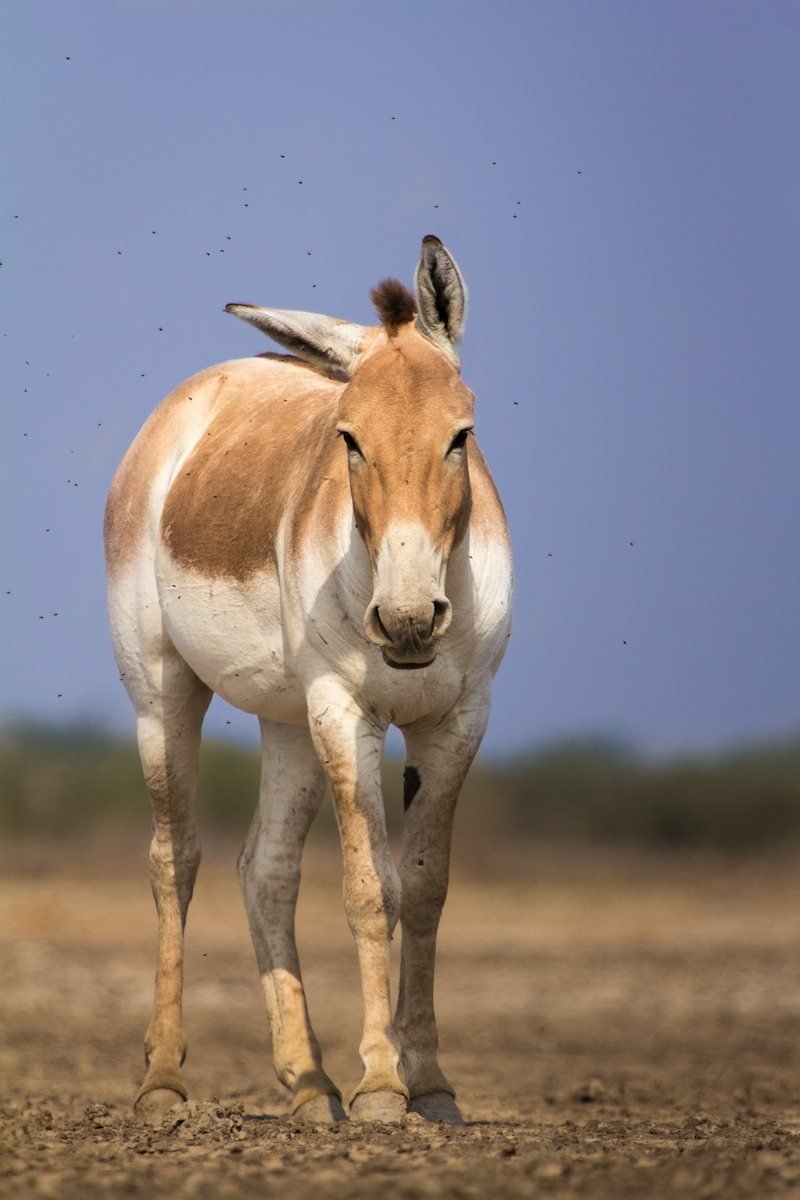
A herd of khur, the Indian wild ass, kicks up dust across the cracked salt flats of the Little Rann.
Top things to do
- Take a morning jeep safariHead out at first light with a local naturalist. The soft angled sun, cooler air and active wildlife make dawn the single best window for spotting khur herds and hunting raptors.
- Track the wild assAsk your guide to find a resident herd. Watching the khur run, with foals keeping pace, is the sanctuary's signature moment and worth the whole trip.
- Go birding around the wetlandsIn a good winter you can log flamingos, cranes, pelicans, storks, harriers and countless waders. Bring binoculars; the birds are numerous but often spread wide.
- Meet the agariya salt workersThe families who farm salt in the desert live months at a time on the pans. A respectful visit, arranged through your lodge, is a humbling look at one of India's hardest livelihoods.
- Stay out for the sunsetAs light drops, the salt crust glows amber and the empty horizon feels enormous. It is one of the great uncomplicated pleasures of the Rann.
How to get there
The usual approach is from Ahmedabad, roughly three hours by road to the safari villages of Dasada or Zainabad on the sanctuary's eastern edge. Ahmedabad has the nearest major airport and good rail links, so most travellers fly or take a train there and continue by hired car. From the west, Bhuj is another option if you are combining the Little Rann with the Great Rann and White Desert. There is no public transport into the sanctuary itself, so all safaris are run in jeeps arranged by the local lodges, who also hold the required forest permits.
Where to stay
Accommodation clusters around Dasada and Zainabad, ranging from simple safari camps with traditional round bhunga-style huts to more comfortable eco-lodges. Most places work on a package basis that bundles rooms, meals and daily jeep safaris with a naturalist, which is genuinely the easiest way to visit because they handle permits and routes. Book ahead in peak winter, since bed numbers are limited and weekends fill up. If you prefer a town base, Ahmedabad is drivable for a long day trip, though staying inside the sanctuary rewards you with those precious early and late hours.
Best time to visit
Come between November and March. The floodwaters have receded, the salt flats are firm enough for jeeps, temperatures are pleasant, and the migratory birds are in full residence. December and January are the coolest and the most reliable for flamingos and cranes. Avoid the monsoon months, when much of the Rann is under water and the sanctuary is effectively closed, and steer clear of April to June, when daytime heat on the shadeless flats becomes genuinely punishing.
Practical tips
- Carry sunglasses, a hat and strong sunblock; the salt reflects light fiercely and there is almost no shade.
- Bring binoculars and a zoom lens. Animals are often distant, and the flat terrain means you watch rather than approach.
- Layer up for morning safaris. Winter dawns on the flats can be surprisingly cold before the sun climbs.
- Let your lodge handle permits and guides. Independent driving inside the sanctuary is not practical or permitted.
- Keep a respectful distance from the agariya families and always ask before photographing people.
Frequently asked questions
What is the wild ass called locally?
The Indian wild ass is known as the khur. It is a subspecies of the Asiatic wild ass and survives in the wild almost exclusively in and around the Little Rann of Kutch.
Is the Little Rann the same as the White Desert?
No. The famous White Desert and Rann Utsav are in the Great Rann of Kutch to the north. The Little Rann is a separate, smaller ecosystem to the south known mainly for wildlife.
Can I see flamingos here?
Yes, in a good winter the wetlands host large numbers of flamingos along with cranes, pelicans and many waders. Sightings depend on water levels, so numbers vary year to year.
How many safaris should I plan?
Two, if you can. A morning and an evening drive on different routes give you the best chance of khur herds, raptors and waterbirds without rushing.
The Little Rann asks for a little patience and rewards it generously. Give it a full day, let the flatness work on you, and you will come away with the rare feeling of having watched a truly wild animal live an undisturbed life. Few corners of India offer that so honestly.