
I did not expect to spend a whole morning watching two men argue gently over a thread, but that is what Gujarat textiles will do to you. I was in Patan, in a low workshop that smelled of dye and warm wood, watching a patola sari come together at roughly the pace of a glacier, and I could not look away.
Gujarat has a way of turning cloth into something closer to memory. Every region has its own hands, its own colours, its own stubborn refusal to speed up. By the end of my week I had stopped thinking of these as souvenirs and started thinking of them as the last visible end of a very long rope of knowledge.
Patan patola, the maths woven into silk
Among all the Gujarat textiles, the double-ikat patola of Patan is the one that stops people in their tracks, and once you understand how it is made, you see why. The pattern is not printed or embroidered onto the finished cloth. It is dyed into the individual threads, both the warp and the weft, before a single line is woven, so that the design only appears when the two sets of pre-dyed threads are aligned on the loom with almost unbelievable precision.
Get one thread out of place and the pattern blurs. The families who still do this in Patan, and there are only a handful left, work from memory and counting, tying and dyeing and re-tying each bundle of silk through several colours. A single sari can take four to six months and cost more than a small motorbike. Watching it, you stop begrudging the price. You start wondering how anyone attempts it at all.
A double-ikat patola on the loom in Patan, where a single sari can take months.
Bandhani, colour tied by fingertip
If patola is mathematics, bandhani is patience of a different kind. This is the tie-dye of Gujarat, and in Kutch and Jamnagar you can watch women pinch up thousands of tiny points of cloth and bind each one with thread before the fabric goes into the dye. Every bound point resists the colour and stays pale, so the finished odhani blooms with dots, hundreds or thousands of them, arranged into fields and borders and the classic red-and-white of a wedding.
You stop thinking of these as souvenirs and start thinking of them as memory.
The fingertips do the whole job, and the good artisans have nails filed to a point or a small metal ring to help. I tried it for about ten minutes under the amused eye of a Kutchi craftswoman and produced perhaps four lumpy knots to her forty. When you next see a bandhani that seems expensive, remember that someone tied every one of those dots by hand, one at a time, and then untied them again after the dye had set.
Mashru, ajrakh and the rest of the loom
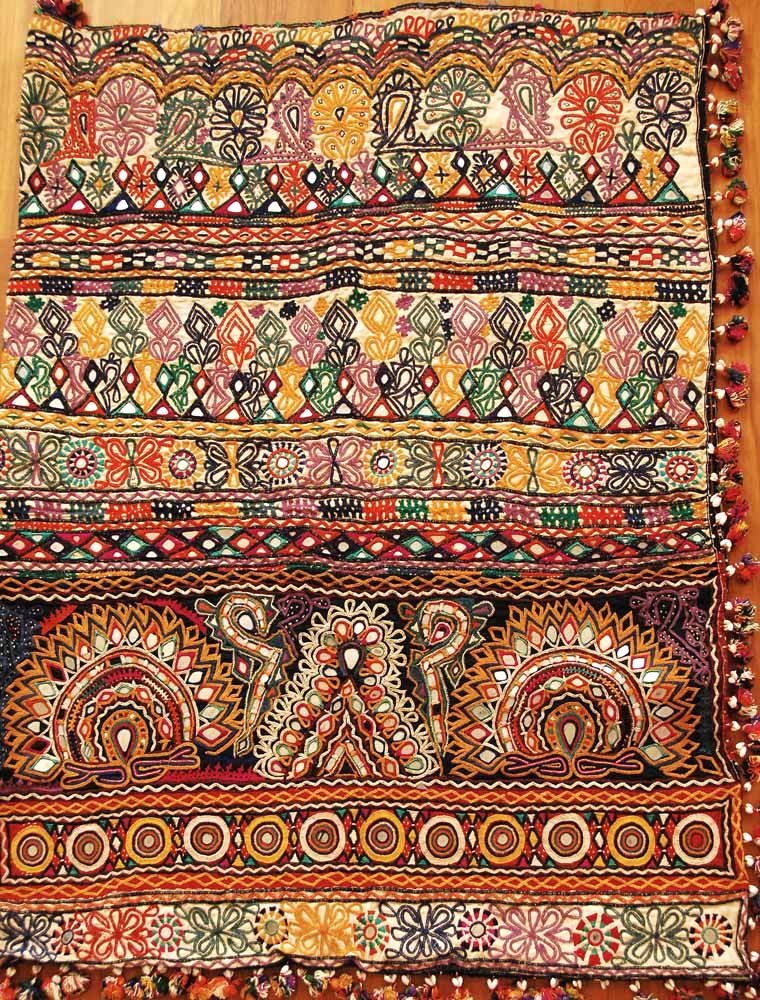
Beyond the two famous names, Gujarat keeps weaving. Mashru is a satin-striped cloth, silk on the outside and cotton against the skin, invented for a time when religious custom discouraged pure silk touching the body, and it is having a quiet revival around Patan. Ajrakh block-printing in Kutch layers deep indigos and madder reds through many resist-and-dye stages. There is Tangaliya weaving, Rabari embroidery, the whole dense vocabulary of a state that never stopped making things by hand. You could spend a month here and only scratch the surface.
If you go
- In Patan, visit the Patola Heritage house to watch double-ikat weaving and see the technique explained properly.
- For bandhani, head to Bhuj, Mandvi or Jamnagar, and buy from artisan cooperatives rather than roadside stalls.
- Ask before photographing anyone at work; most weavers are gracious, but it is their livelihood, not a display.
- Expect real patola and fine bandhani to be expensive, and be wary of cheap "patola-style" prints sold as the genuine thing.
- Combine a textile trip with Kutch during the winter Rann season, when many craft villages are easiest to reach.
What I carried home from Gujarat was not really the cloth, though I did buy a bandhani odhani I will probably never dare to wear. It was the sense of time folded into every piece, the months of a patola, the thousands of tied knots in a single scarf. In a world that makes fabric by the mile in seconds, these workshops are a quiet argument for the opposite, and they are worth going out of your way to see while the hands that know how are still at the loom.