Most travellers skip Surat, and I understand why. It is a working city on the Tapi river in southern Gujarat, not a postcard, and its fame rests on two very unglamorous-sounding trades: cutting diamonds and weaving synthetic cloth. But spend a day here and the sheer scale gets under your skin. A huge share of the world's diamonds are polished in this one city, and its power looms turn out fabric by the ocean. Surat does not perform for tourists; it just works, at a volume that is hard to picture until you stand in it.
I came because I wanted to see where things actually get made, and Surat delivers that in full. The rhythm of the place is set by the polishing units, the wholesale markets and the shifts of workers who keep both running. It is loud, dense and fast. Then, in the evening, the whole city seems to exhale and drive out to the beach at Dumas to eat. That daily arc, hard graft by day and street food by dusk, is the real Surat, and I found it more memorable than a dozen prettier towns.
The city that cuts the world's diamonds
Surat's diamond trade is enormous. Rough stones arrive from across the world and leave as polished gems, cut and shaped in thousands of workshops by an army of skilled hands. The industry has its own gravity here; entire neighbourhoods live by it, and the recently built diamond bourse, a vast trading complex, gave the trade a single monumental home. You cannot exactly wander into a working polishing unit off the street, but the presence of the industry is everywhere, in the traffic of workers, the security, the quiet talk of carats and cuts.
If you want to understand it, arrange a visit through a proper contact or a tour operator rather than turning up cold; these are secure, serious workplaces. What stayed with me was the human detail, the concentration on a young cutter's face, a tiny stone held to a spinning wheel, the way a rough pebble becomes something that will end up on a hand on the other side of the planet. It reframes what a diamond is: not magic, but painstaking labour, most of it done right here.
Bolts of synthetic fabric stack the aisles of a wholesale textile market in Surat.
Zari, looms and the textile markets
Surat's other empire is cloth. The city has an old heritage of zari, the fine gold and silver thread embroidery once prized by royalty, and that craft tradition sits alongside a modern synthetic-textile machine of staggering size. Wholesale markets stack bolts of fabric to the ceiling, buyers haggle in narrow lanes, and handcarts thread through the crush carrying rolls taller than the men pushing them. Walking those aisles is a full-body experience of colour, noise and commerce.
Surat does not sell you a view; it sells the world its diamonds and its fabric, and lets you watch it happen.
You can buy here, of course, and prices for saris, dress material and synthetic silks are keen, though the markets are geared to wholesale rather than the single tourist. I mostly came to look. If you want the zari heritage specifically, ask around for the workshops and older establishments that still do the metallic-thread work by hand, because that craft is the thread, literally, connecting Surat's royal past to its industrial present.
Evenings at Dumas beach
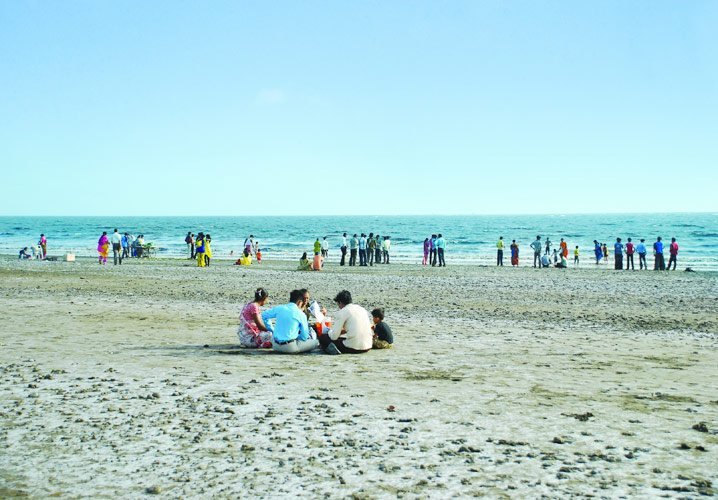
When the workday ends, Surat heads for Dumas, a beach of dark sand about 20 km southwest of the centre. Do not come for swimming; come for the food street that lines the approach. As the light goes, stalls fire up and the air fills with the smell of frying. This is the place to eat locho, a soft steamed snack drenched in butter and spices that Surat is genuinely famous for, along with bhajias, ponk in season and every kind of chaat. I ate too much, watched the tide go out over the flats, and decided this was the perfect end to a Surat day.
If you go
- Surat has its own airport and is a major rail stop on the Mumbai-Ahmedabad line, so access is easy.
- Arrange any diamond-unit visit in advance through a tour operator; you cannot just walk in.
- Hit the textile markets in the morning and expect wholesale energy rather than tourist polish.
- Save the evening for Dumas beach and eat the local locho and surti street food there.
- Winter is the comfortable season; the city is hot and humid for much of the year.
I left Surat with buttery fingers and a new respect for a city that makes rather than poses. There is no famous monument to tick off here, and that is oddly freeing. What you get instead is the honest sight of the world's diamonds and fabric being cut and woven by real people, followed by a beachside feast as the reward. If you like your travel with the machinery showing, give Surat a day. It will not charm you; it will impress you.