The Uttarayan kite festival is the only day of the year when I have been told off, in the friendliest possible way, for looking down at the street instead of up at the sky. I was standing on a terrace in the old city of Ahmedabad, tea in hand, and a boy of about ten grabbed my sleeve and pointed straight up. He did not have the English and I did not have the Gujarati, but the message was clear: the action is up there, not down here.
I had come expecting a pretty spectacle, a few kites, some sweets. What I got instead was closer to a citywide sport played across ten thousand roofs at once, loud and competitive and strangely tender, all of it stitched together by nothing thicker than a length of coated string.
What Uttarayan actually marks
Uttarayan falls on the fourteenth of January and marks the sun beginning its northward turn, the point in the calendar when winter loosens its grip. In most of India the same day is Makar Sankranti; in Gujarat it became a kite festival, and nobody I asked could quite tell me when or why the string took over from the ritual. What is certain is that the whole state treats the two days as a holiday, and the sky over Ahmedabad, Surat and Vadodara turns into a moving mosaic of paper.
The kites themselves are small, light diamonds of tissue on a thin bamboo spine, and they cost next to nothing. The real money and the real obsession go into the manja, the string, which is coated in a paste of finely ground glass and rice glue. This is what makes Uttarayan a contest rather than a stroll. You are not flying to admire your kite. You are flying to cut somebody else out of the sky.
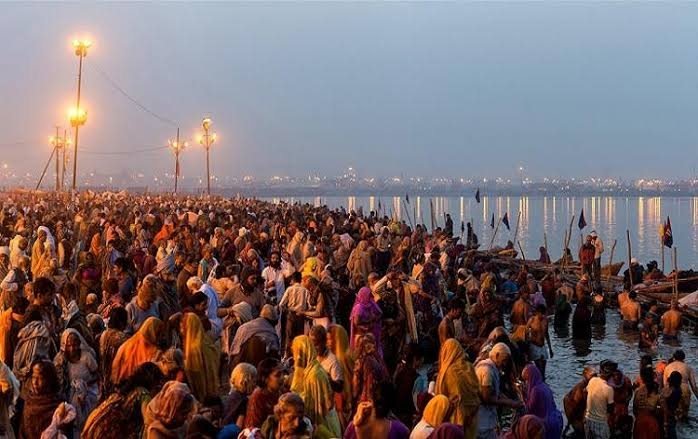
Rooftops fill before breakfast on the fourteenth of January in Ahmedabad.
A duel fought at arm's length
By mid-morning the rhythm settles in. You feel a tug, someone's line has crossed yours, and then it becomes a quiet negotiation of tension and slack. Let out too fast and you lose; hold too tight and your own string snaps. When a line finally parts, a shout of "kaypo chhe" goes up from whichever roof landed the cut, and the loose kite drifts away to be chased by children through the lanes below.
You are not flying to admire your kite; you are flying to cut somebody out of the sky.
It is far more physical than it sounds. By afternoon my fingers were nicked in three places from the glass string, which every local had warned me about and I had, of course, ignored. The families around me flew in shifts, one person on the reel, one guiding the line, a third simply watching the rival roofs and calling out threats. Nobody kept score. The point was the game itself, endlessly restarted.
When the kites become lanterns
The part nobody photographs well is the night. As the light drops, the paper kites give way to tukkals, white box lanterns carried up on the same strings, and the sky fills with slow floating points of fire. From a high roof you can see them for miles, hundreds of them, drifting over the city like embers that forgot to fall. Somewhere below, the smell of undhiyu and warm jaggery chikki works its way up the stairwell, and for an hour the competition pauses and everyone just looks.
If you go
- Go for the fourteenth of January, and arrive in Ahmedabad a day early; hotels in the old city book out weeks ahead.
- Get onto a rooftop. Many guesthouses in the walled city and around Sabarmati offer terrace access, which is the only real way to see it.
- Wear sunglasses and a cap, and put a plaster or two in your pocket. The glass string will find your fingers.
- Try the food stalls for undhiyu, the winter mixed-vegetable dish, and til-chikki sesame brittle sold everywhere that week.
- Look up the International Kite Festival at the Sabarmati riverfront if you want giant display kites rather than the neighbourhood duels.
I left Ahmedabad with sore fingers, a crick in my neck, and a small paper kite I never managed to fly properly. What stayed with me was not the spectacle but the sociability of it, the way an entire city agreed, for two days, to spend its waking hours looking upward together. Uttarayan is not something you watch. It is something you are handed a reel and told to join.
More stories
Dates, rituals and where to stand for the best view are on our Uttarayan kite festival page.