Best time
Year-round; winter for undhiyu
Ideal duration
Ongoing, city by city
Good for
Vegetarians, snackers, sweet tooths
Region
All of Gujarat
Gujarati food surprises first-timers with one thing above all: the touch of sweetness that runs through even the savoury dishes. A dal might carry jaggery, a vegetable curry a hint of sugar. Once you stop fighting it, you notice how the sweetness balances chilli, salt and sour to make a cuisine that is far more layered than its reputation as simple vegetarian fare suggests. This is one of India's great vegetarian food cultures, refined over centuries by a largely Jain and Hindu population that turned meat-free cooking into an art.
The other thing to know is the sheer breadth of snacking. Gujaratis have a whole category of savoury nibbles called farsan, eaten at breakfast, teatime and beyond, and a street-food scene that changes character from city to city. This guide walks you through the thali, the essential dishes, the snacks and sweets, and where each city does its own thing best, so you can eat well from Kutch to Surat.
The flavour logic of Gujarat
Gujarati cooking chases a balance of sweet, salty, spicy and sour in nearly every meal, often within a single dish. Jaggery and sugar soften the heat of green chilli and ginger; kokum, lime or tamarind bring sourness; and a final tempering of mustard seed, curry leaf and asafoetida ties it together. Regional accents matter too. Kathiawadi food from Saurashtra is spicier and more rustic; Surti food from Surat is richer and famous for indulgence; and the cuisine leans harder into sweetness in the central belt. Almost all of it is vegetarian, which makes Gujarat one of the easiest places in India to eat meat-free superbly.
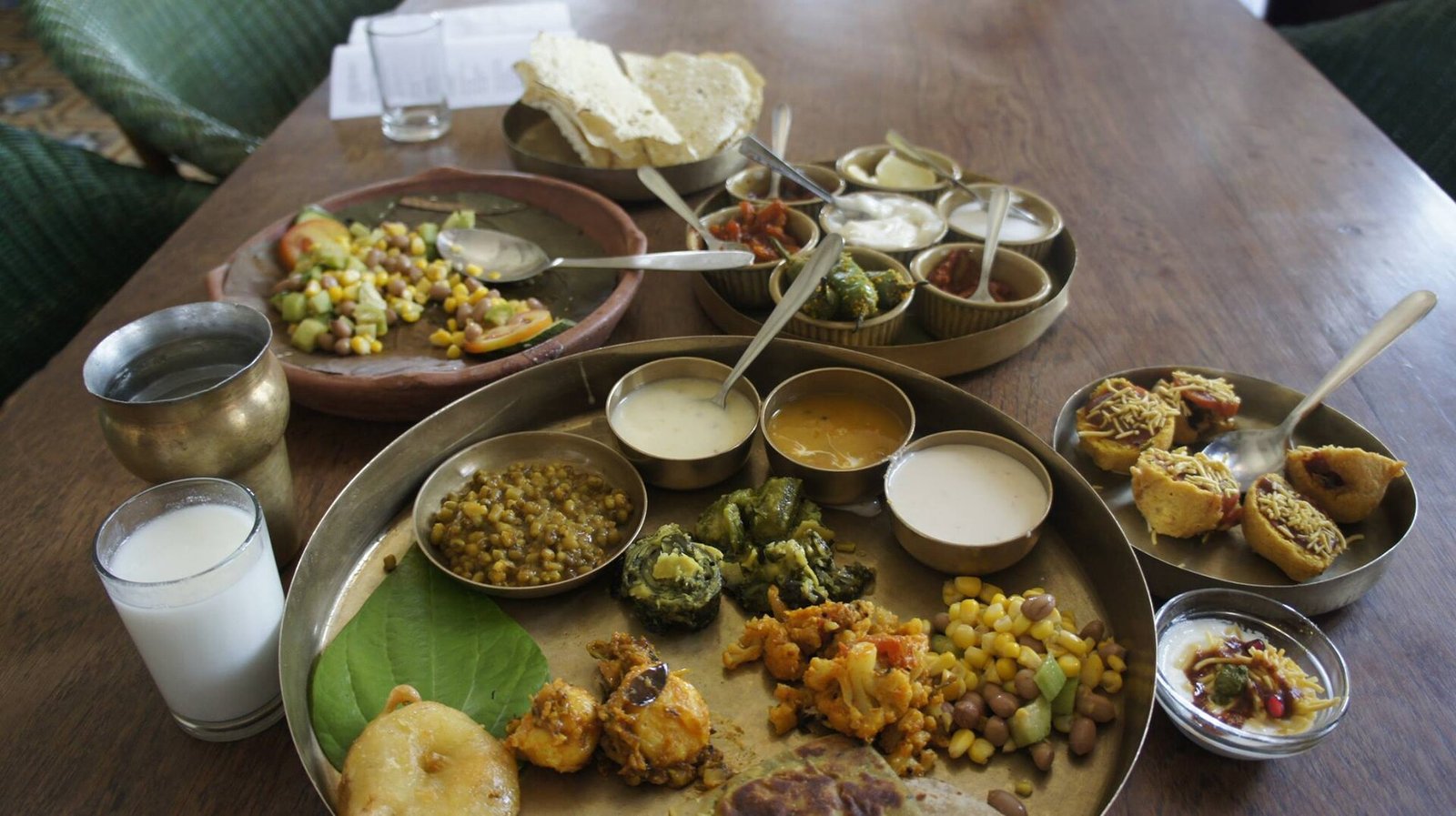
A classic Gujarati thali, an unlimited spread of curries, farsan, breads, rice and sweets on a single platter.
What to eat across Gujarat
- The Gujarati thaliThe definitive meal: an unlimited platter with several sabzis (vegetable curries), dal or kadhi, rice, hot rotli and puris, farsan, pickles, chutneys, salad and a sweet, all refilled until you surrender. Sit down hungry at a thali house in Ahmedabad or Vadodara and eat until the servers stop asking.
- Farsan (dhokla, khandvi, fafda)The snack family that defines Gujarati eating. Steamed, spongy dhokla; delicate rolled khandvi; crisp fafda served with fried chilli and papaya sambharo. Light, savoury and endlessly moreish, these are eaten morning to evening and are the perfect introduction to the cuisine.
- UndhiyuThe great winter dish, a slow-cooked medley of seasonal vegetables, beans, potatoes and fenugreek dumplings (muthia), traditionally cooked in earthen pots. Rich, complex and only truly in season in the cooler months, often eaten with puris. Seek it out around the Uttarayan kite festival in January.
- Street food by cityEach city has a signature. Ahmedabad's Manek Chowk turns into a night food market of sandwiches, dosas and kulfi; Surat is legendary for locho, khaman and ghari; Vadodara loves its sev usal and bhakharwadi. Eating the streets city by city is half the adventure.
- Sweets and farsan shopsFrom syrupy jalebi and fafda eaten together on festival mornings, to Surat's ghari, to mohanthal, basundi and shrikhand, Gujarat's sweets deserve their own itinerary. The mithai and farsan shops of any town are where locals stock up, and where you should too.
How to eat your way around
You do not travel far for Gujarati food; it finds you in every town. But the cities each reward a dedicated meal. In Ahmedabad, do a proper unlimited thali at a well-known thali house at lunch, then graze Manek Chowk late at night. In Surat, come specifically hungry for locho, khaman, undhiyu and ghari, ideally with a local to steer you to the right stalls. Vadodara balances classic thalis with lively street corners. Rajkot and the Kathiawad towns serve the spicier country-style food with garlic chutney and bajra rotla. Move between these cities by train or car, and treat each stop as a distinct meal on the map.
Where to base yourself for food
Ahmedabad is the best single base for eating, combining heritage thali restaurants, the Manek Chowk night market and easy access to farsan and sweet shops across the old city. Surat is the essential second stop for anyone serious about food, unmatched for snacks and indulgence, and worth an overnight purely to eat across a full day and evening. Vadodara suits a more relaxed food stop with good thalis and street food. Wherever you stay, look for busy, unfussy places full of local families rather than tourist-facing spots; in Gujarat the crowd is the surest sign of a good kitchen.
Best time to eat
Gujarati food is a year-round pleasure, but the calendar shapes the menu. Undhiyu is a winter speciality, at its peak from December to January around the Uttarayan kite festival, when the whole state seems to be cooking it. Festival mornings bring fresh jalebi and fafda, and Navratri fills the streets with fasting-friendly snacks. Summer favours cooling foods like chaas (buttermilk), shrikhand and aamras (mango pulp) when Gujarat's prized mangoes arrive. Come in winter for the fullest spread and the seasonal specialities at their best.
Practical tips
- Arrive hungry at a thali. It is unlimited and the servers will keep refilling, so pace yourself and gesture clearly when you have had enough.
- Embrace the sweetness rather than resisting it. The sugar in savoury dishes is intentional and balances the spice; give it a few bites before judging.
- Eat farsan for breakfast like the locals do, with masala chai. Dhokla, fafda and khaman are morning foods here, not just snacks.
- Gujarat is a dry state with no alcohol, so pair meals with chaas, sugarcane juice, soda or masala chai instead.
- For street food, choose the busiest stalls with high turnover and freshly cooked, hot items. In Surat especially, ask locals which vendor is the original for a given dish.
Frequently asked questions
Why is Gujarati food sweet?
A touch of sugar or jaggery is added to many savoury dishes to balance salt, sour and the heat of chilli. The result is a layered flavour rather than dessert-like sweetness, and it defines the regional style.
Is it easy to eat vegetarian in Gujarat?
Extremely. Gujarat has one of India's richest vegetarian food cultures, and the vast majority of restaurants and street stalls are purely vegetarian, so meat-free travellers are spoilt for choice.
What is a Gujarati thali?
An unlimited platter served with multiple vegetable curries, dal or kadhi, rice, fresh breads, farsan snacks, pickles, chutneys and a sweet, with dishes refilled until you are full. It is the definitive Gujarati meal.
Which city has the best street food in Gujarat?
Surat is widely regarded as the street-food capital for snacks like locho, khaman and ghari, while Ahmedabad's Manek Chowk night market is the most famous single spot. Both are essential.
To eat in Gujarat is to accept that a meal can be sweet, salty, spicy and sour all at once, and to enjoy it more for the contradiction. Sit down to an unlimited thali, snack your way through a plate of farsan, chase down undhiyu in winter and locho in Surat, and you will find one of India's most distinctive and generous food cultures, almost entirely meat-free and endlessly happy to feed you.