Most of Gujarat's wildlife reputation rests on a single animal in a single forest. Gir has the lions, and the lions have the queue. Two hours north-east of Gir's crowds, in the flat Bhal country between Bhavnagar and the Gulf of Khambhat, there is a national park of open golden grassland where you can spend a morning without passing another vehicle, watching a spiral-horned antelope run at sixty kilometres an hour across ground with nothing on it taller than your knee.
Velavadar Blackbuck National Park is only about 34 square kilometres, and it is one of the most distinctive protected areas in India — not a forest at all but a savanna, a landscape India has almost entirely lost. It holds the country's largest population of blackbuck, a resident population of Indian wolves, and in winter one of the biggest communal roosts of migratory harriers anywhere on earth. It is also, by any reasonable measure, badly under-visited.
A grassland, not a jungle
The first thing that strikes you at Velavadar is how much sky there is. The park sits on the Bhal, a flat alluvial plain of black cotton soil that floods in the monsoon and dries to a pale gold in winter, dotted with saline patches and low thorn. There is no canopy, no undergrowth, no waiting for something to step out from behind a tree. You see the animals from a long way off, and they see you, and the whole encounter has a different quality from forest wildlife watching — more like being on an African plain than in an Indian park.
That openness is why the blackbuck thrive here. A blackbuck's only real defence is speed on flat ground, and the males, with their long corkscrew horns and their striking two-tone coats that darken to near-black as they mature, are built for exactly this landscape. Herds of a hundred or more gather in the cool hours, and during the rut the dominant males hold small territories and posture at each other with their heads thrown back. India's blackbuck were shot and squeezed to the edge across the twentieth century; the Velavadar herds, protected first by the Maharaja of Bhavnagar as a hunting reserve and then as a national park from 1976, are the reason the species has a stronghold at all.
Sharing the grass are nilgai, wild boar, jungle cat, jackal, and the animal serious visitors hope for hardest: the Indian wolf. Velavadar is one of the more reliable places in the country to see one, usually at dawn or dusk, moving low and unhurried through the grass. Striped hyena are present too, and much harder to catch.
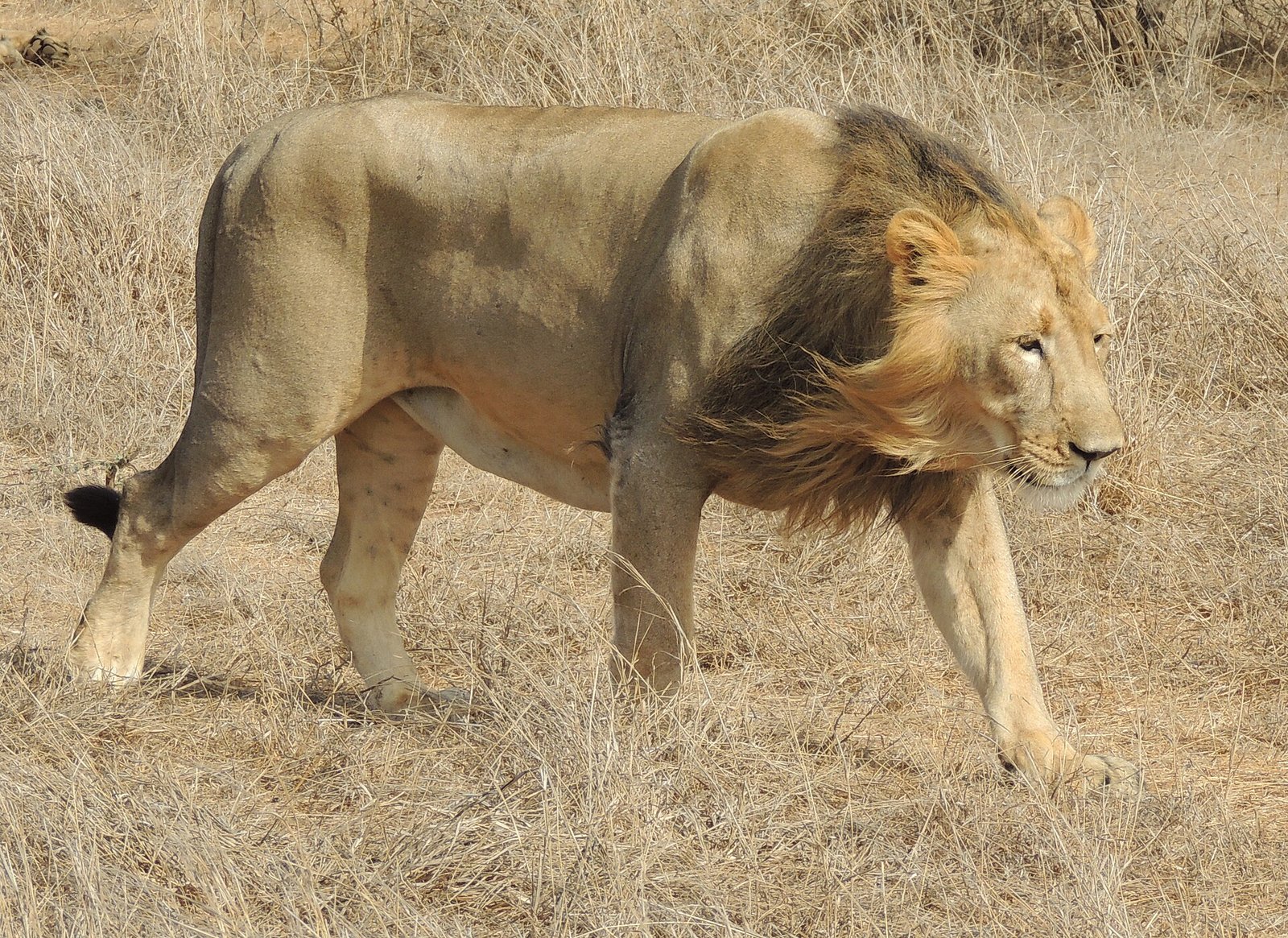
Velavadar protects the largest population of blackbuck in India — and one of the world's great harrier roosts.
The harriers, and an hour before dusk
Velavadar's other claim is ornithological, and it is a big one. Each winter, montagu's and pallid harriers — slim, long-winged raptors that breed across Central Asia — migrate south and gather here to sleep. They hunt the surrounding grasslands by day and then, in the last hour of light, begin drifting in low from every direction to settle communally in the grass. On a good evening in December or January the count runs into many hundreds, and the roost is regarded as one of the largest of its kind in the world.
In the last hour of light the harriers come in low from every direction and settle in the grass by the hundred — one of the largest roosts on earth
It is a strange and quiet spectacle. There is no noise to speak of, just a steady arrival of birds sliding in across the gold, tilting, dropping, vanishing into the grass. You need to be in the right part of the park at the right time, which means going with someone who knows where the roost has settled that season, and you need to be prepared to sit still and watch the light go. Bring binoculars; without them you will see shapes rather than birds.
Velavadar has a monsoon speciality too. The lesser florican, a small, rare bustard, comes to the Bhal grasslands to breed when the rains arrive, and the males perform an absurd, wonderful display — leaping vertically out of the tall grass again and again to advertise themselves. It happens roughly from July to September, when much of the park's regular season is closed, so it takes planning and local advice, but for birders it is one of the great sights in India.
How a visit actually works
Velavadar is straightforward but it is not a packaged safari. There are no shared jeeps circulating on a timetable as at Gir. You enter with a permit from the forest office at the gate, in a vehicle — your own hired car is usually fine, given the park's flat, graded tracks — and a forest guide accompanies you. Morning and evening slots are the productive ones, and the middle of the day is largely a waste of time in an open landscape with no shade.
The park generally follows the standard Gujarat pattern of closing through the monsoon, reopening around the middle of October and running to mid-June, but grassland parks are weather-dependent and dates shift, so confirm locally before you commit. Two sessions — one evening for the harriers and the wolf chance, one early morning for blackbuck at their most active — is the right amount of time. Anything less and you are relying on luck.
Getting there, and what to pair it with
The park lies roughly 65 km from Bhavnagar and about 150 km from Ahmedabad, in the Vallabhipur area of Bhavnagar district. Bhavnagar has the nearest airport and railway station, and a hired car from either Bhavnagar or Ahmedabad is the practical way in; there is no useful public transport to the gate. Accommodation is limited to a forest lodge, a well-known private lodge on the park's edge and a handful of simpler options, so book ahead in the winter months.
Velavadar sits neatly in a Saurashtra itinerary. Palitana and its temple hill are close by, Bhavnagar has Victoria Park and the old port quarter, and the cliffs at Gopnath are an easy detour to the south. Birders often string Velavadar together with Nalsarovar to the north-west and the Little Rann to the north for a serious week of grassland and wetland species. If you are driving between Ahmedabad and Diu or Gir, it costs you very little to build in a night here.
If you go
- Come between November and February for comfortable weather, peak blackbuck activity and the full harrier roost.
- Book two sessions — an evening for the harriers and wolves, an early morning for blackbuck. One visit is not enough.
- Bring binoculars. This is an open grassland where most of the action happens at distance, not a forest with close sightings.
- For the lesser florican's leaping display you need the monsoon, roughly July to September; check access with the forest office well ahead.
- Book the limited accommodation near the park early in winter, and arrange a car — there is no practical public transport to the gate.
Velavadar is the antidote to a queue. It protects a habitat India has almost finished losing, it holds the country's great blackbuck herds and a genuine chance of a wolf, and on a winter evening it delivers a raptor roost that birders travel across continents for. All of that sits two hours from Ahmedabad in a park most visitors to Gujarat have never heard of. Come for a dawn and a dusk, bring binoculars, and let the horizon do the work.