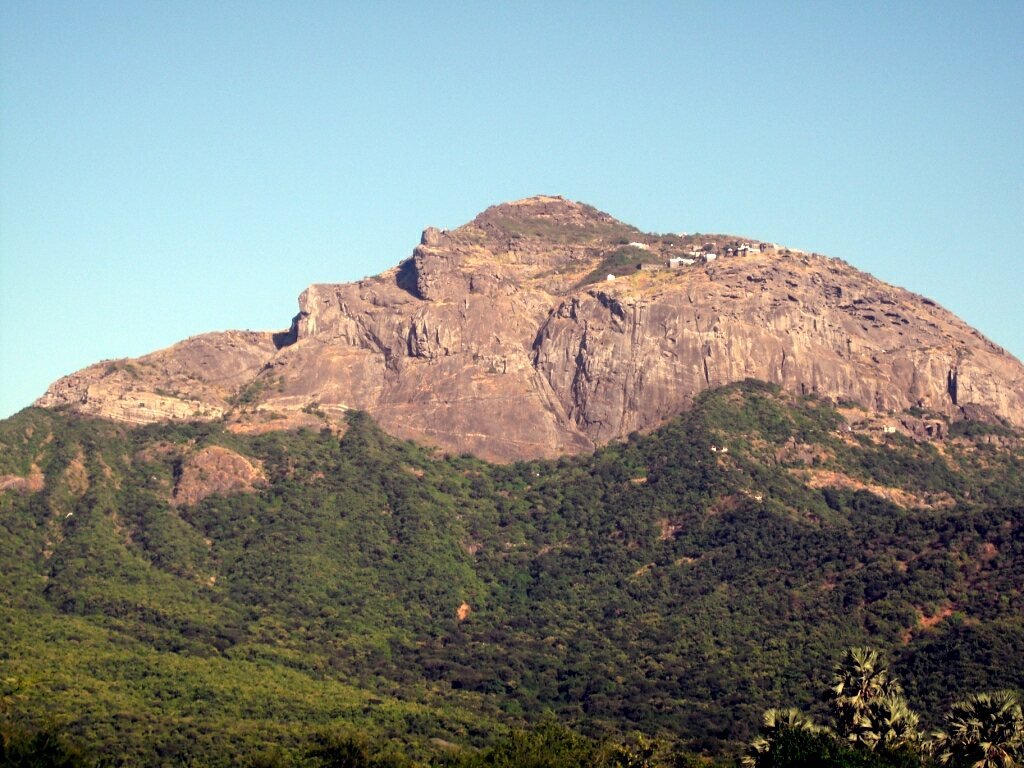
You start climbing in the dark. The steps begin at the edge of Palitana town, and by four in the morning there is already a slow file of people on them: barefoot Jain pilgrims in white, some in their seventies and eighties, a few being carried in slung chairs, everyone moving up through the cold towards a summit you cannot yet see. Three and a half thousand steps and something under two hours later, the path levels out and you are standing in a city of marble that has no citizens at all.
Shatrunjaya, the hill above Palitana in Bhavnagar district, is the holiest place in the Jain world, and it carries close to nine hundred temples in a series of walled enclosures along its ridge. Nobody lives there. By long-standing rule, not a single person — not even a priest — may remain on the hill overnight. At dusk the doors close, the last pilgrims come down, and the temple city is left empty for the gods.
A thousand years of building upward
Jain tradition holds that Rishabhanatha, the first of the twenty-four Tirthankaras, preached his first sermon on this hill, and that twenty-three of the twenty-four attained liberation somewhere in the surrounding region. That belief has drawn pilgrims and patrons here for well over a millennium. The oldest surviving structures date from around the eleventh century, and building went on in waves — destroyed in medieval raids, rebuilt, extended, re-consecrated — right through to the nineteenth century.
The result is not a single monument but an accumulation, and it is arranged in nine fortified compounds known as tuks, each with a principal temple and a crowd of smaller shrines packed around it. The greatest is the temple of Adishwar, Rishabhanatha himself, at the top of the main enclosure. Around it the density is extraordinary: spires against spires, courtyards opening into courtyards, carved marble ceilings, thousands of individual images, and a great many quiet corners where a single pilgrim is sitting alone with a text.
What gives the place its particular character is that everything was funded by merchant piety rather than royal ambition. Jain trading families across Gujarat and Rajasthan endowed temples here over centuries as acts of merit, which is why the hill has no single architectural signature and no dominating axis. It grew the way a market grows — by accretion, each donor adding to the mass.
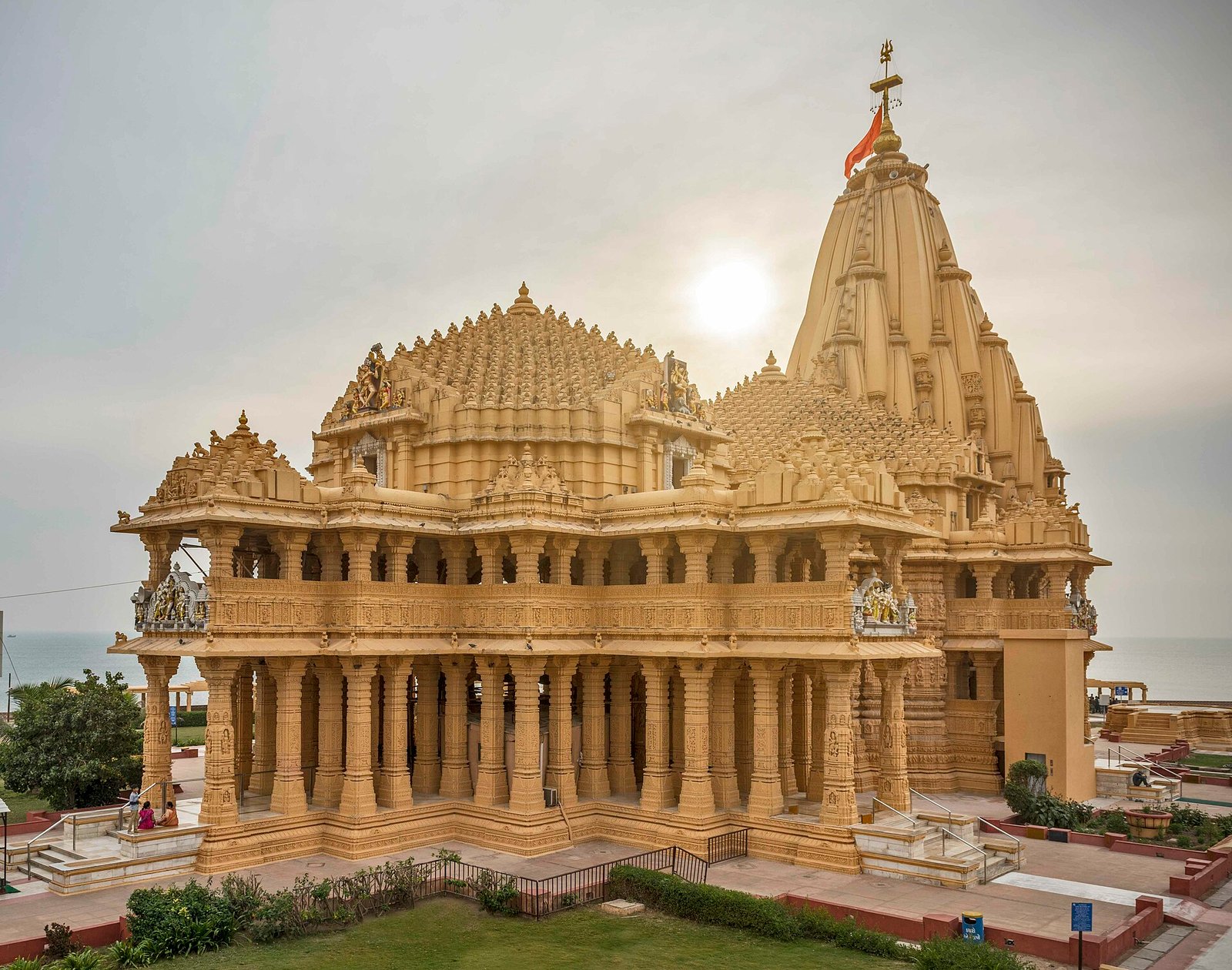
Marble spires crowd the summit of Shatrunjaya — a city built entirely for gods, where no one is allowed to sleep.
The climb, and the rule about the night
The ascent is about 3.5 km and roughly 3,500 steps, cut and paved and provided with the occasional shaded rest point and water stall. Fit walkers manage it in an hour and a quarter; most people take closer to two. It is genuinely hard work but it is not technical, and the steady, unhurried pace of the elderly pilgrims around you is instructive. For those who cannot walk, doli-bearers carry passengers up and down in a slung chair for a negotiated fee — a strenuous business for the bearers and worth paying properly for.
At dusk the last pilgrim leaves and nine hundred temples are locked and left to the gods — nobody, not even a priest, may sleep on Shatrunjaya
Everyone must be off the hill by evening. The rule that no one may stay overnight is unusual even by the standards of Indian sacred sites, and it shapes the entire experience: the pre-dawn start, the sense of a tide of people rising and then withdrawing, the strange knowledge that this dense marble city stands dark and completely empty every single night. It also means there is no accommodation on the summit and no reason to linger past mid-afternoon.
Practicalities follow from the religion. Leather is not permitted — belts, wallets, camera straps and shoes must be left below. Food is not carried up, and eating on the hill is avoided. Photography is restricted inside the main shrines and you should ask before pointing a camera at anyone. None of this is onerous, but arriving unaware of it causes friction at the gate, and the guards have heard every excuse.
The town at the bottom
Palitana itself is a small, dense, overwhelmingly Jain town, full of dharamshalas and bhojanshalas — pilgrim rest houses and dining halls — that exist to feed and shelve the flow of visitors. It is also, since 2014, the place most often cited as the world's first legally vegetarian city, after a campaign by Jain monks led to a ban on the sale of meat and eggs within municipal limits. Whatever you make of the politics, the practical effect for a traveller is a town where the food is simple, strictly vegetarian and, in the pilgrim dining halls, extremely cheap.
The busiest moment of the year is Kartik Purnima, the full moon of the Kartik month in November, when tens of thousands of pilgrims arrive and the steps become a continuous river of people from well before dawn. It is spectacular and it is also, if you are not part of it, a difficult day to visit. Mahavir Jayanti in spring is similarly crowded. For a quieter climb, pick an ordinary weekday between November and February.
Getting there and doing it well
Palitana is about 55 km from Bhavnagar, the nearest city with an airport and good rail connections, and roughly 215 km from Ahmedabad. Buses and shared taxis run frequently from Bhavnagar, and a hired car gives you the flexibility to start before dawn, which matters more here than almost anywhere. Many travellers fold Palitana into a Saurashtra loop with Bhavnagar, the blackbuck grasslands at Velavadar and the coast at Gopnath.
The single best piece of advice is to begin climbing in the dark. You avoid the heat entirely, you reach the top for sunrise over the Saurashtra plain, and you descend before the sun is high. Start at eight instead and you will be climbing three and a half thousand exposed steps in full sun, which turns a moving experience into an endurance test. Carry water, keep your leather at the bottom, and give yourself a full morning rather than trying to squeeze it around other stops.
If you go
- Start the climb before dawn. It is the difference between a sunrise among the spires and 3,500 steps in direct sun.
- Leave all leather at the base — shoes, belts, wallets and camera straps are not permitted on the hill.
- Plan to be off the summit by mid-afternoon; nobody at all is allowed to remain on Shatrunjaya overnight.
- Visit November to February, and avoid Kartik Purnima and Mahavir Jayanti unless you specifically want the mass pilgrimage.
- If you use a doli chair, agree the fee clearly beforehand and pay the bearers generously — it is brutally hard work.
Palitana is one of those places that resists being a sight. You cannot really see Shatrunjaya from a car window or tick it off in forty minutes; you have to climb it, in the dark, alongside people for whom the climb is the point. What waits at the top is nine hundred temples of white marble packed along a ridge above the plains of Saurashtra, and the peculiar, moving fact that every evening the whole city is emptied of human beings and left standing in the dark. Go in winter, go early, and give it a morning.