
Gujarati food is a balance of sweet, salt, sour and heat — best understood over an unlimited thali, then chased through the street-food lanes of Ahmedabad and Surat.
Browse the full food section and our guides to eating your way across the state.
Understanding Gujarati food and the classic thali
Gujarati food is built on a flavour idea that surprises first-timers: a deliberate balance of sweet, salt and sour in almost every dish, often with a pinch of jaggery melted into the dal and a squeeze of lime or a knob of kokum to answer it. The best way to meet the cuisine is the unlimited thali, a round steel platter loaded with small bowls of dal, kadhi, two or three vegetable sabzis, farsan, rice, hot rotli brushed with ghee, pickle, chutney and a sweet, every bowl refilled the moment it empties until you finally wave the server away in surrender.
This is a largely vegetarian kitchen, shaped by a big and influential Jain community that avoids onion, garlic and root vegetables, and it has turned those constraints into invention rather than limitation. The result is a table that leans on lentils, gram flour, yoghurt and clever, layered spicing rather than meat, yet never feels thin. Regional swings are very real: Kathiawadi food from Saurashtra is fierier and more rustic with plenty of chilli and garlic, Surti cooking is richer and sweeter, and the north keeps things lighter and subtler, so no two thalis you eat across the state taste quite the same.
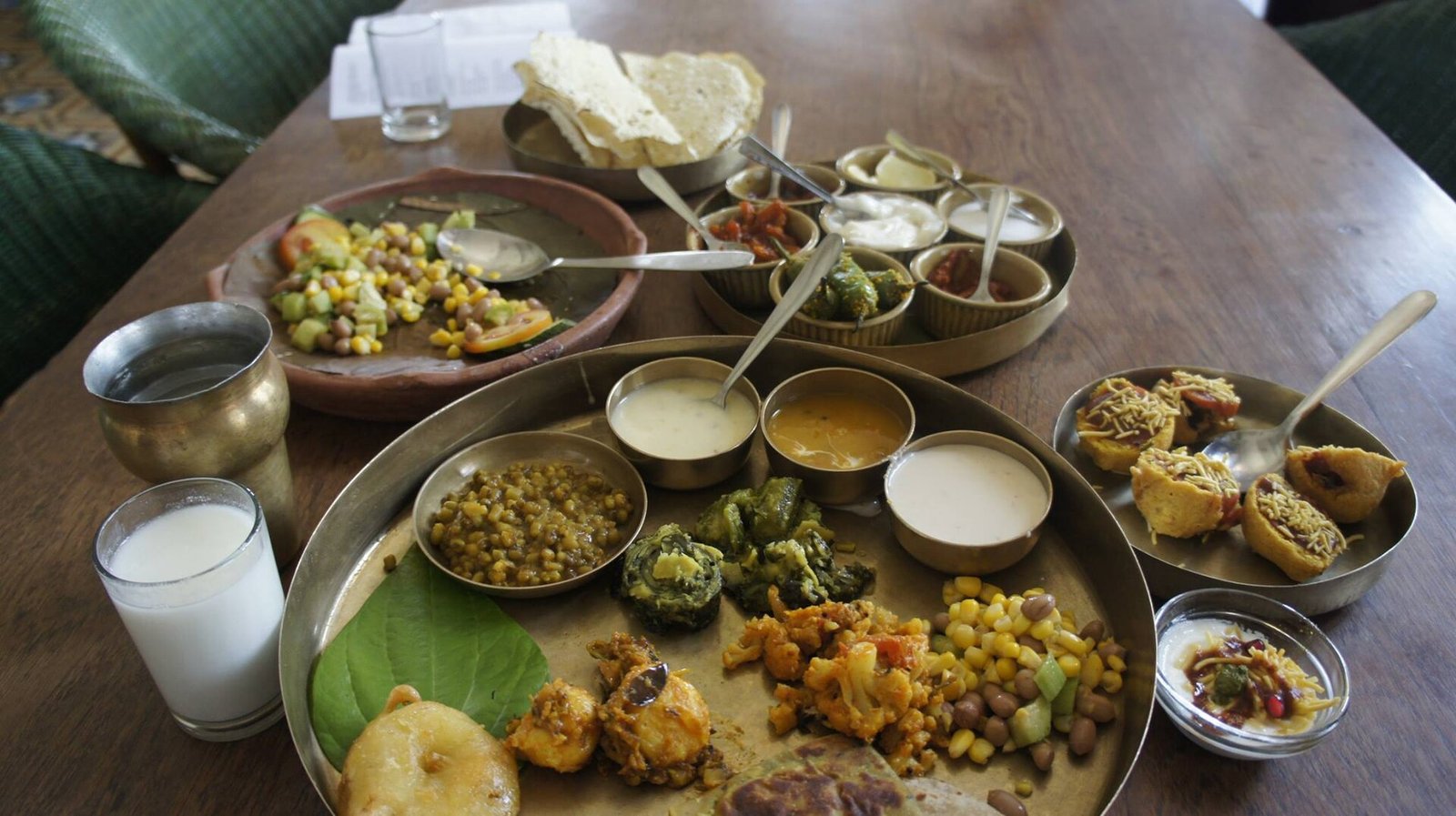
From the unlimited thali to midnight street-food markets.
Farsan, undhiyu and street food by city
Farsan, the whole family of steamed and fried snacks, is where Gujarat truly shows off its skill. Soft, spongy dhokla and the rolled, mustard-tempered spirals of khandvi are made from fermented gram flour, while crisp fafda paired with fried green chillies and sweet jalebi is the classic Sunday-morning breakfast eaten standing at the shop. Winter brings undhiyu, a slow-cooked medley of surti beans, purple yam, small eggplants and fried methi dumplings buried in green spices, traditionally cooked upside down in sealed earthen pots over embers and eaten with hot puris through the Uttarayan season when the vegetables are at their best.
Street food splits neatly by city. Ahmedabad runs on evening chaats, spicy kachoris and the Manek Chowk night market that transforms into a chaotic food circus after the jewellers shut. Surat is famous for pure indulgence, soft steamed locho, ghee-soaked ghari and butter-heavy snacks its people are cheerfully proud to overdo, while Vadodara claims the tangy sev usal and the deep-fried sandwiches of its lively night stalls. Save room for sweets throughout the trip: the ghee-rich mohanthal, the shredded festive ghari and cool, cardamom-scented shrikhand round out a cuisine that simply never forgets its sweet tooth.
Explore Food Trails
Every Dish in Gujarat
A Gujarati Food Guide: The Thali, Farsan and Street Food
A Gujarati food guide to the unlimited thali, farsan like dhokla and khandvi, undhiyu,…
A Beginner’s Guide to the Gujarati Thali
What is in a Gujarati thali, why it tastes a little sweet, where to…
Eating Ahmedabad: Manek Chowk to Law Garden by Night
A first-person Ahmedabad street food guide: midnight feasting at Manek Chowk, the Law Garden…
Surat: Diamonds, Textiles and the Best Street Food in Gujarat
A Surat travel guide to the diamond-and-textile city's street food, riverfront, trading history and…
Eating your way across Gujarat
Gujarati food is built on a deliberate balance of sweet, salt, sour and heat, and the fastest way to understand it is a full thali — a structured meal of dal, kadhi, two or three shaak, a farsan, rotli, rice, a sweet, and the pickles and chutneys around them, served unlimited until you signal that you are finished. Dedicated thali houses operate in Ahmedabad, Vadodara, Surat and Rajkot, and the regional differences are real: Kathiawadi thalis from Saurashtra run spicier and heavier on garlic, chilli and millet bread, while Surti ones lean sweeter and richer.
Farsan — the family of light savoury snacks — is where the cooking is at its most distinctive. Dhokla, khaman, khandvi, patra, muthiya and handvo are steamed rather than fried, sold fresh each morning by farsan shops and generally sold out by noon. Sunday mornings across the state belong to fafda and jalebi eaten together, with fried chillies and shredded raw papaya alongside.
City by city
Ahmedabad runs on its old-city breakfast lanes and on Manek Chowk, which turns from a jewellery market by day into a street-food square late at night. Surat is the most committed eating city in the state, and its specialities are its own — locho eaten with a spoon under melting butter, sev khamani, ghari at Chandni Padva, and ponk, the tender green sorghum available for only a few weeks each winter.
Kutch gives dabeli, the sweet-spicy filled bun created at Mandvi; Saurashtra gives bajra rotlo with white butter, garlic chutney and roasted aubergine; and Bhavnagar is queued at twice daily for its gathiya. Practical points: Gujarat is a dry state with alcohol prohibited, vegetarian food is the overwhelming default and Jain preparations without root vegetables are widely available, and the best guide anywhere is a queue of locals at a shop frying to order.
For the full practical breakdown, read our Gujarat food guide.