
Gujarat's stepwells are among the most extraordinary structures in India — temples turned upside down, carved storeys deep into the earth to reach cool water.
Start with the UNESCO-listed Rani ki Vav and follow the trail to Adalaj and Champaner.
Why Gujarat stepwells were built the way they are
Gujarat stepwells solved a hard problem with astonishing beauty. In a dry region of scorching summers and unreliable monsoons, communities needed water that stayed cool and reachable through the whole year, so they dug deep, inverted the architecture of a temple, and lined the long descent with columned pavilions and carved stone. These vav were never simply wells. They were social spaces where women gathered to draw water and talk in the cool depths, shaded resting points on hot trade routes, and acts of religious merit funded by queens and merchants who wanted their names and generosity remembered for centuries after them.
The greatest of them all is Rani ki Vav at Patan, a UNESCO World Heritage Site built in the eleventh century by Queen Udayamati in memory of her husband, King Bhima I. It plunges seven storeys underground and carries more than 500 principal sculptures and over a thousand smaller ones, including a celebrated series of the ten Vishnu avatars along its walls. Turned upside down, it is essentially a subterranean temple laid on its side, and its appearance on the reverse of the Indian 100-rupee note has quietly made it the public face of the whole stepwell tradition across the country.
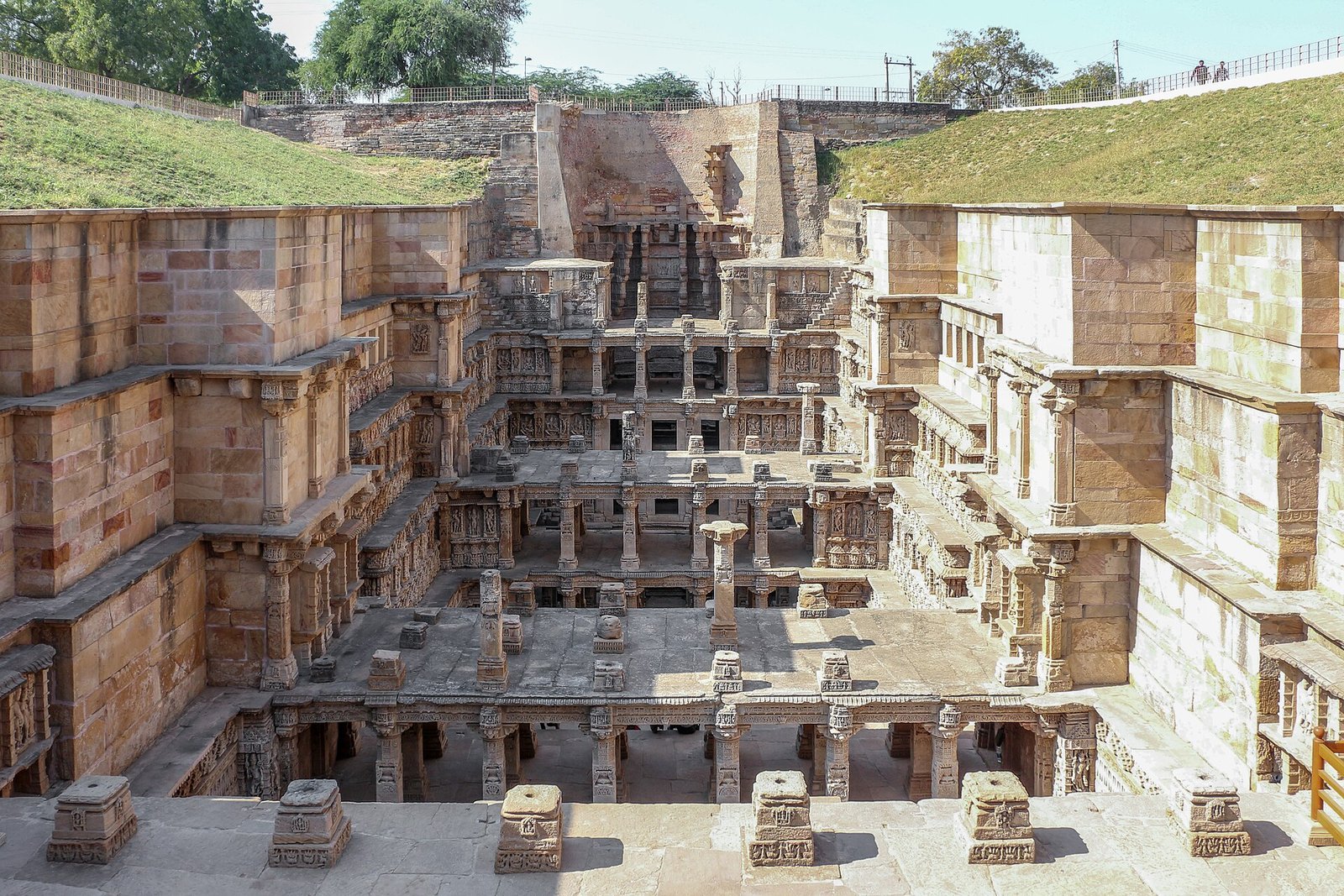
Rani ki Vav, Adalaj and the inverted temples of Gujarat.
From Adalaj to the helical well at Champaner
Closer to Ahmedabad, the Adalaj stepwell shows how Hindu and Islamic design fused into one language. Built in 1499 by Queen Rudabai, its five storeys of octagonal platforms mix floral Islamic motifs with Hindu and Jain iconography, and the intricate pierced stone screens keep the interior several degrees cooler than the surface even at the height of summer, which is why villagers once lingered there through the hottest afternoons. In the city itself, the Dada Harir stepwell near Asarwa, commissioned by a woman of the Sultan's own household, offers a quieter, less-visited version of the same descending drama for those who seek it out.
The tradition ranged far beyond the famous names. At Ghumli in Saurashtra, the enormous Vikia Vav records an earlier, more austere style, and the eleventh-century ruins scattered around it hint at how widespread and everyday the form once was. Champaner adds a rare variation of its own: its helical stepwell spirals down in a tight corkscrew rather than a straight flight of steps, an engineer's flourish tucked inside the World Heritage city. Read together, these structures show a civilisation that turned the simple act of drawing water into architecture, sculpture and quiet daily ritual, all at the same time and in the same breath.
Explore Stepwells
The Stepwells of Gujarat: Descending Into Cool Stone
A Gujarat stepwells guide to Rani ki Vav, Adalaj, Dada Harir, Ghumli and Champaner,…
Patan & Modhera: The Sun Temple and the Queen’s Stepwell
A Patan Modhera guide to the Sun Temple, Surya Kund and UNESCO stepwell Rani…
Champaner-Pavagadh: A Forgotten Capital and a Sacred Hill
A Champaner Pavagadh guide to the UNESCO archaeological park, Jama Masjid, hilltop Kalika Mata…
Stepping Down in Time: Gujarat’s Stepwells
A first-person guide to Gujarat stepwells, from the carved storeys of Rani ki Vav…
How to read a Gujarati stepwell
The vav is Gujarat's signature contribution to Indian architecture, and once its logic is clear the buildings become far more interesting. Every stepwell runs the same grammar: an entrance pavilion at ground level, a long stepped corridor descending through storeys of pillared galleries, and a well shaft at the far end holding the water. Because the structure sinks rather than rises, it defeats the heat — the air at the lowest gallery can be many degrees cooler than the surface — and it gave travellers, traders and villagers shade, water and a place to rest in one building.
The carving concentrates at the landings, where niches hold deities, mother goddesses, dancers and animal friezes, and the deeper levels usually carry the finest work because they were the coolest and most protected. Wells built under the Solankis between the tenth and thirteenth centuries are the most richly sculpted; later Sultanate-era vavs keep the same form but dress it in geometry and calligraphy instead of figures.
Which ones to see
Rani ki Vav at Patan is the summit — a UNESCO World Heritage Site, seven storeys deep, its sculpture preserved in remarkable condition because the Saraswati silted the well over and buried it for centuries. Adalaj, near Ahmedabad, is the most atmospheric and the easiest to reach, its octagonal opening throwing light down five storeys. Dada Harir and the Bai Harir vav in Ahmedabad itself are Sultanate-period and often nearly empty.
Beyond the famous three, the Kundvav and carved torans at Kapadvanj, the spiral Bhammariyo Kuvo at Mahudha, the helical stepwell at Champaner and the rock-cut Adi Kadi Vav and Navghan Kuvo inside Junagadh's Uparkot fort each show a different solution to the same problem. Most are unticketed and uncrowded. Carry a torch, watch worn steps, and go in the morning when light still reaches the lower galleries.
There is a longer write-up in our Gujarat stepwells guide.