
Gujarat's temples range from the sea-facing Somnath and Krishna's Dwarka to the sun-aligned carvings of Modhera and the marble city of Palitana.
Use these guides to plan a pilgrim circuit or simply to understand the architecture.
The great temples in Gujarat and their pilgrim circuits
The temples in Gujarat form some of Hinduism's most important pilgrim routes, and a few names carry weight across all of India. Somnath, on the Saurashtra coast, is the first of the twelve Jyotirlingas of Shiva, a shrine destroyed and rebuilt many times over the centuries whose present form rises straight from the shore, with nothing but the Arabian Sea between it and Antarctica. The evening light-and-sound show projected against the temple walls draws crowds who come as much for the layered history of the place as for the darshan, and the sea wind and crashing surf give the whole site a raw, elemental mood.
Dwarka, further along the same coast, is one of the four Char Dham sites that devout Hindus aim to visit in a lifetime, believed to be the kingdom of Krishna. The Dwarkadhish temple's tall, flag-topped spire is visible from far out to sea, and a short boat and causeway trip leads on to Bet Dwarka island where more shrines cluster. Many pilgrims pair the two coastal temples in a single Saurashtra loop, often adding the Shakti temple at Ambaji in the north and the Nageshwar Jyotirlinga nearby to complete a broader devotional circuit that can fill a rewarding week of travel.
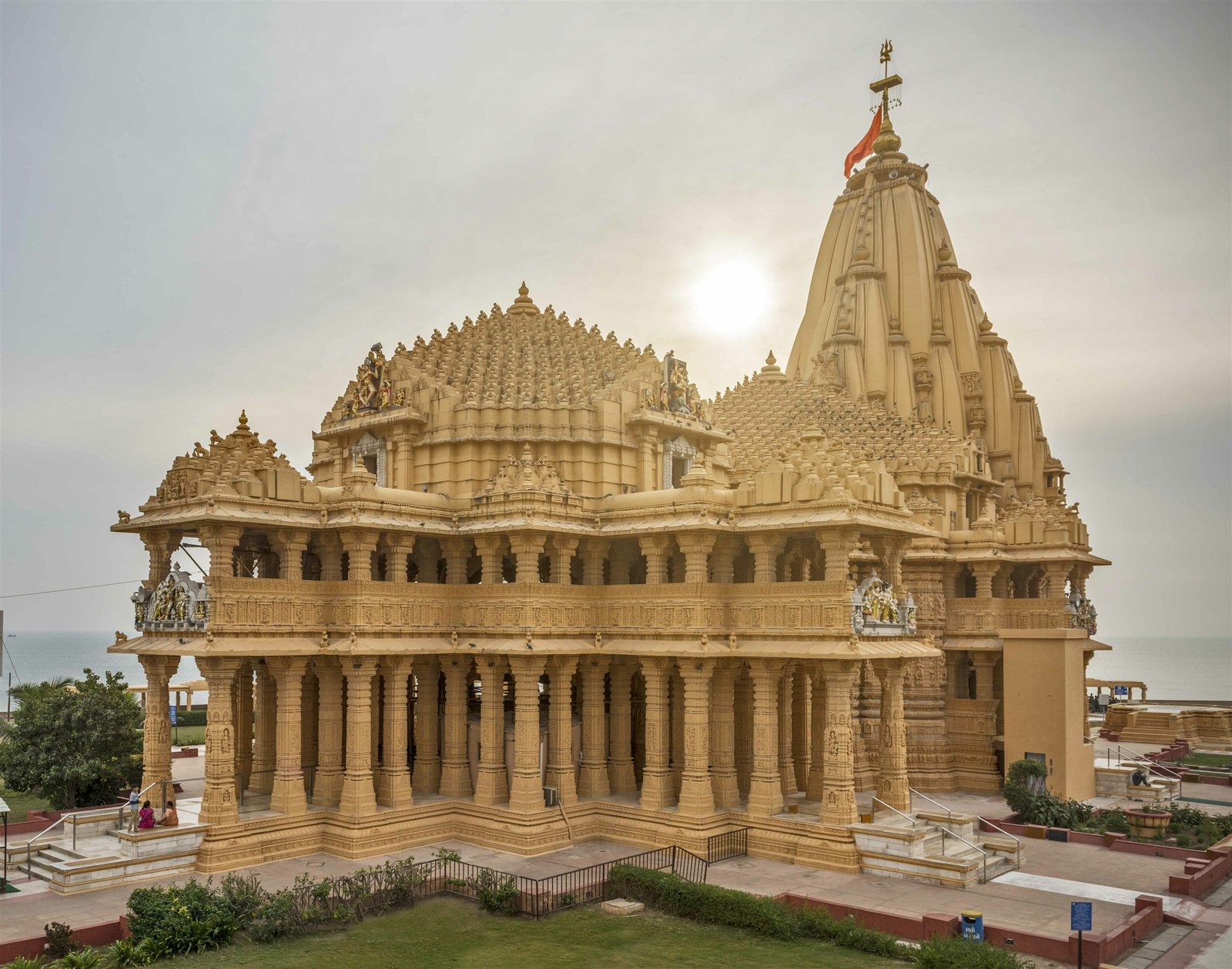
Jyotirlingas, coastal shrines and Solanki-era masterpieces.
Architecture from Modhera to Palitana
Not every great temple here is a living pilgrimage centre; some are masterpieces of stone valued for their craft alone. The eleventh-century Sun Temple at Modhera no longer holds worship, but its equinox-aligned sanctum, pillared sabha mandap and vast stepped tank make it a textbook of Solanki architecture, every surface carved with gods, dancers and floral bands. It is best seen in the early morning, when low sun rakes across the reliefs and fills the tank's geometry with long shadows, and again at the January dance festival when the whole structure is lit against the dark.
Palitana offers something else again. On the Shatrunjaya hills, more than 800 Jain temples crowd the summit in gleaming white marble, reached by a climb of around 3,500 steps that pilgrims make barefoot and fasting through the cool morning. It is one of the holiest Jain sites in the world, and by tradition no one, not even a monk, stays on the hill overnight, so the temples empty at dusk. Between Somnath's coastal power, Dwarka's devotion, Modhera's carved precision and Palitana's marble skyline, the state's temples span the full range of Indian sacred building, from raw pilgrimage to fine art.
Explore Temples
Temples of Gujarat: A Pilgrim’s and Traveller’s Guide
A Gujarat temples guide to Somnath, Dwarka, Palitana, Modhera, Ambaji and Akshardham, with pilgrim…
Dwarka & Somnath: Gujarat’s West-Coast Temple Circuit
A complete Dwarka Somnath guide covering the west-coast temple circuit, aarti timings, Bet Dwarka,…
Patan & Modhera: The Sun Temple and the Queen’s Stepwell
A Patan Modhera guide to the Sun Temple, Surya Kund and UNESCO stepwell Rani…
Somnath at Dusk: The Temple by the Sea
Visiting the Somnath temple at dusk: its history of ruin and rebuilding, the evening…
Dwarka: Standing Where Krishna Ruled the Sea
A first-person Dwarka pilgrimage guide: the Dwarkadhish temple flag, aarti, Gomti ghat and the…
An Evening at Akshardham in Gandhinagar
Visiting Akshardham in Gandhinagar? A first-person guide to the carved sandstone shrine, gardens, evening…
The great temple circuits
Gujarat's temples fall into recognisable circuits, and pilgrims generally travel them as such rather than one by one. The Saurashtra coastal circuit is the most travelled: Somnath, first of Shiva's twelve Jyotirlingas and rebuilt after a millennium of destruction, then Dwarka, one of the four dhams and Krishna's own capital, with Nageshwar's Jyotirlinga, Rukmini Devi's carved shrine, Gopi Talav and Bet Dwarka's island temples between them.
The Shakti circuit runs north to Ambaji, one of the fifty-one Shakti Peeths, where the goddess is worshipped as an inscribed yantra rather than an image, with Gabbar hill's older seat across the valley and the marble Kumbhariya Jain temples nearby. The Jain circuit centres on Palitana, where some nine hundred temples crown the sacred hill of Shatrunjaya, the holiest site in the Jain world, reached by around 3,500 steps and vacated by everyone, priests included, before dusk.
Architecture, and how to visit
For those travelling to look rather than to worship, the Solanki-era temples repay the most attention — the Sun Temple at Modhera, aligned so the equinox sun reaches its sanctum and fronted by the stepped Surya Kund, and the carved Jain groups at Kumbhariya, Taranga and Girnar. The Swaminarayan tradition adds the modern layer, from the historic Gadhada and Vadtal temples to the vast Akshardham complex at Gandhinagar.
Basic etiquette holds everywhere and is worth observing without being asked. Dress modestly with shoulders and knees covered, remove footwear at the entrance, leave leather goods outside Jain temples entirely, and expect phones and cameras to be barred at the major shrines — most provide free lockers at the gates. Festival days bring enormous crowds and hours-long queues; ordinary weekday mornings are quiet almost everywhere. October to March is the comfortable season across the state.
Planning it in detail? See our Gujarat temples guide.