The thing that strikes you at Dandi is how ordinary the beach is. It is flat, tidal, muddy at the edges, unglamorous in every respect — the kind of shoreline you would drive past without a second look. On 6 April 1930, after twenty-four days and about 385 kilometres on foot from Sabarmati Ashram in Ahmedabad, Gandhi walked down to this shore, picked up a lump of natural salt, and by doing so broke the law of the British Empire.
That was the entire point. Salt was chosen precisely because it was mundane and universal — needed by every household in India, its manufacture and sale monopolised and taxed by the colonial state. Choosing it meant the act of defiance was available to absolutely everyone, and within weeks it was being repeated on coastlines all over India. Dandi now has a substantial memorial complex, opened in 2019, and it is one of the most affecting historical visits in Gujarat.
Why salt
The salt laws made it illegal for Indians to produce or collect salt, forcing everyone to buy it from the government at a taxed price — a small imposition individually and an enormous revenue stream in aggregate, falling hardest on the poorest people who needed salt for food preservation and for cattle. Gandhi's genius was in identifying it as the ideal target: legally clear-cut, economically indefensible, morally simple, and physically available on any beach in a country with seven thousand kilometres of coastline.
Critics at the time, including within the Congress, thought it trivial. Jawaharlal Nehru later recorded his own initial puzzlement. What Gandhi understood was that a mass movement needs an act that anyone can perform, that requires no weapons and no organisation, and that puts the state in the position of either ignoring the law or arresting hundreds of thousands of people for picking up mud. The British eventually chose mass arrest — around sixty thousand people were imprisoned in the following months, Gandhi among them.
The march itself was a piece of political theatre executed with great skill. Gandhi set out from Sabarmati on 12 March 1930 with seventy-eight chosen companions, walked south through village after village giving speeches, gathered an enormous following and unprecedented press attention, including from the international newsreels, and arrived at Dandi on the evening of 5 April. On the morning of the sixth, after prayers, he went down to the shore.
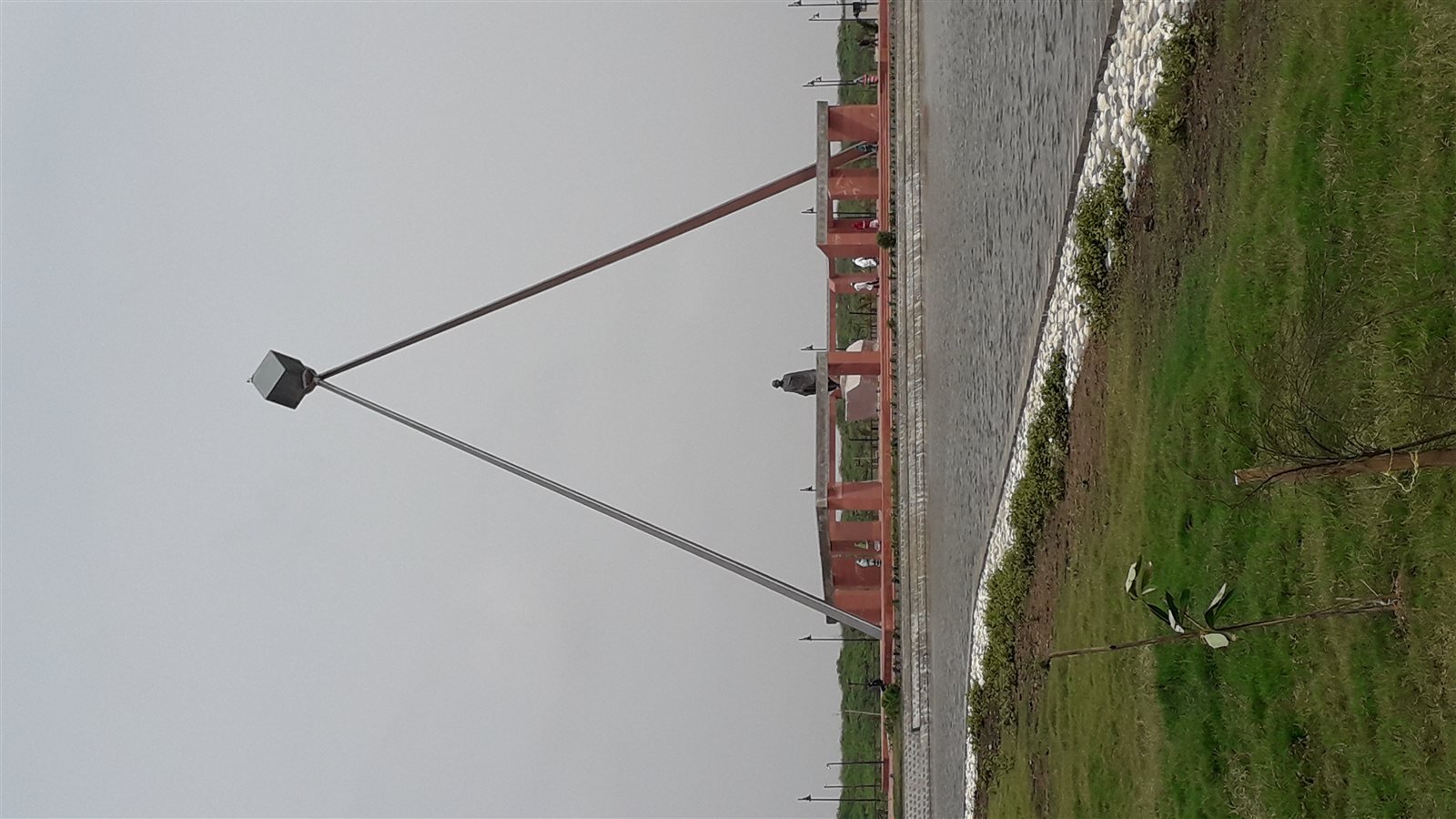
Eighty bronze marchers behind one figure, at the end of a 385-kilometre walk.
What is at Dandi now
For decades the site was marked only modestly. The National Salt Satyagraha Memorial, inaugurated in 2019, changed that comprehensively. It is a designed complex on a substantial scale: a central sculpture of Gandhi, with bronze statues of all eighty marchers who set out with him arranged behind, narrative installations tracing the twenty-four days of the march day by day, murals, and interpretive material on the satyagraha and on the wider civil disobedience movement it triggered.
Eighty individual bronze figures, one for every marcher who set out — the memorial's best decision by a distance
The most effective element is the simplest: solar salt pans on site, where seawater is evaporated in shallow beds and salt crystallises out in front of you. After an hour of reading about salt laws and monopolies, watching salt actually form makes the whole dispute concrete in a way no display board manages. The eighty individual statues are the other strong decision — the marchers are named, not anonymous, and walking behind them is unexpectedly moving.
Nearby is Saifee Villa, the house where Gandhi stayed at Dandi, preserved as a small memorial and worth the short additional stop. And then there is the beach itself, which you should walk down to. The memorial does a good job of the history; the shore does the rest, precisely by being so unremarkable. Standing on flat wet sand looking at the Arabian Sea, it is easy to grasp that the power of the gesture came entirely from its ordinariness.
The other end of the march
Dandi makes most sense if you have seen, or will see, where the march began. Sabarmati Ashram in Ahmedabad is the other bookend — the compound Gandhi left in March 1930, vowing not to return until India was free, a vow he kept, since he never lived there again. It is free, open daily, and its centrepiece, Hriday Kunj, is a bare tiled cottage containing a mat, a low writing desk and a spinning wheel. The two sites, four hundred kilometres apart, are a single story.
Confusingly, the large museum called Dandi Kutir is not at Dandi at all but in Gandhinagar, next to Mahatma Mandir — a pyramid-shaped building housing an extensive multimedia museum on Gandhi's life. It is a good museum and worth visiting, but travellers heading for Dandi expecting to find it there are regularly disappointed. If your itinerary covers both ends of Gujarat, Sabarmati Ashram, Dandi Kutir in Gandhinagar and the Dandi memorial together make a coherent and genuinely substantial Gandhi route.
Practicalities
Dandi is in Navsari district, about 15 km from Navsari town and roughly 50 km from Surat, near Jalalpore. Navsari is on the main Mumbai–Delhi railway line with excellent connections; Surat, 50 km north, has the airport, the widest range of hotels and by a considerable margin the best food in Gujarat. A taxi or hired car from either is the practical way in; local buses are slow and awkward for a half-day visit.
Allow a half-day: ninety minutes to two hours in the memorial complex, plus the beach and Saifee Villa. Come in the morning, and come between October and March — the complex is open, exposed and largely without shade, and this coast is humid outside the cool months. Check the opening hours and any weekly closure day before travelling. Navsari's Parsi quarter is 15 km away and pairs naturally into the same day, as does a run further south towards Tithal and Valsad.
What the march actually achieved
It is worth being precise, because the Salt March is often described loosely as the thing that won independence, which it plainly was not — that came seventeen years later. What it did was change the terms of the argument. It converted the Congress from a body of lawyers passing resolutions into a mass organisation capable of mobilising hundreds of thousands of ordinary people, and it demonstrated that colonial authority could be made to look absurd without a shot being fired. The Round Table Conference and the Gandhi-Irwin Pact of 1931 followed directly from it.
It also internationalised the question. The newsreel footage and press despatches from the march, and from the brutal suppression at Dharasana a few weeks later where satyagrahis walked in ranks into police lathis without resisting, were carried around the world. The American journalist Webb Miller's account of Dharasana in particular did enormous damage to British moral standing. For the first time a very large international audience saw the Indian independence movement on its own terms, and saw the state's response to it.
If you go
- Come in the morning between October and March; the memorial is open and exposed and heats up quickly.
- Allow at least ninety minutes — the day-by-day narrative installations and the eighty statues are the substance of the visit.
- Do not miss the working salt pans, which make the entire dispute concrete, or Saifee Villa nearby.
- Note that the Dandi Kutir museum is in Gandhinagar, not at Dandi — a very common and avoidable confusion.
- Base in Surat for hotels and food, and pair Dandi with Navsari's Parsi quarter 15 km away.
Dandi is a half-day that does something few historical sites manage: it makes a famous act feel small again, and therefore comprehensible. A well-made memorial walks you through the twenty-four days, eighty named bronze figures stand behind Gandhi, salt crystallises in shallow pans in front of you, and then you go down to an entirely unremarkable beach where a man picked up a lump of mud and started something. Come on a winter morning from Surat.