
Gujarat's cities hold some of India's finest civic collections — Baroda's museum and the vast Laxmi Vilas Palace, Rajkot's Watson Museum, and Ahmedabad's design and textile institutions.
These city guides point you to the best of them.
The best museums in Gujarat for art and royal history
The museums in Gujarat trace a path from lavish royal collections to cutting-edge design institutions, and they cover far more ground than most travellers expect. Vadodara, the old Gaekwad capital, is the natural starting point. The Baroda Museum and Picture Gallery, built in the 1890s, holds Mughal miniatures, Tibetan and Egyptian art, a blue whale skeleton and a picture gallery hung with European masters the maharaja bought on his travels abroad. A short drive away, Laxmi Vilas Palace still functions as a royal residence, and its Maharaja Fateh Singh Museum displays the family's superb collection of Raja Ravi Varma paintings inside the palace grounds.
Rajkot anchors the Saurashtra story. The Watson Museum, named after a British political agent of the region, gathers stone sculpture, coins, silverware and colonial-era photographs of the princely states of Kathiawar, alongside a marble statue of Queen Victoria under its dome. It sits in the same city where Mahatma Gandhi spent part of his childhood, and pairs naturally with his family home, now preserved as Kaba Gandhi no Delo, giving a rounded picture of both princely grandeur and the region's role in the freedom movement. Together the two sites make Rajkot a surprisingly rich half-day of history for anyone passing through.
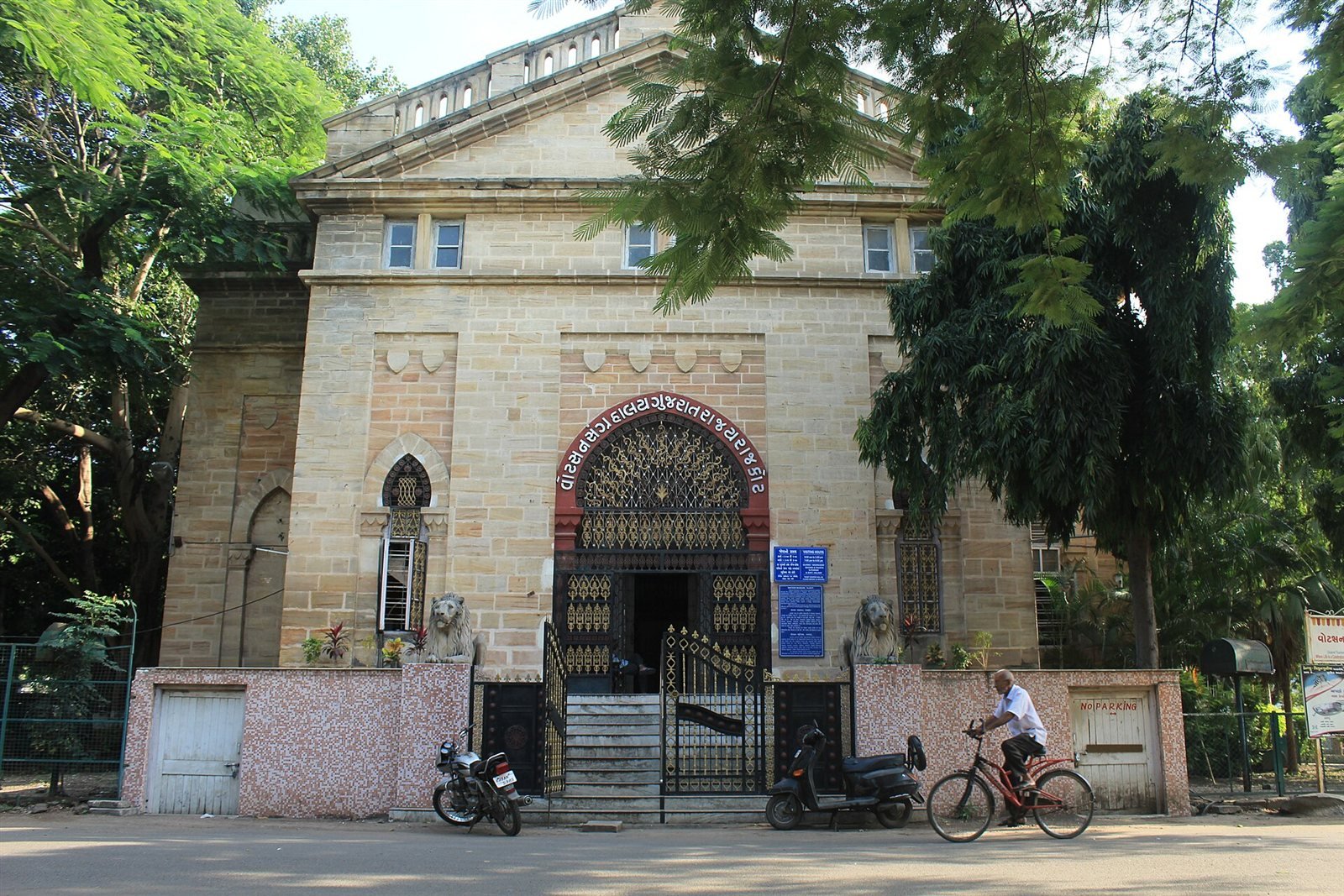
Art, science and royal history across Gujarat's great cities.
Textiles, design and the collections of Kutch
Ahmedabad is where the museums turn toward craft and modern design. The Calico Museum of Textiles is world-renowned for its collection of Indian fabric, from royal Mughal tents to religious temple hangings, shown by guided tour only in the leafy Sarabhai retreat and worth planning your trip around. Nearby, institutions linked to the National Institute of Design and the Lalbhai family's collections deepen the textile theme, while the Gandhi and Sardar Patel memorials at the Sabarmati Ashram tell the political history in the founder's own spartan riverside rooms, with his spinning wheel and letters on display.
Out west, Kutch keeps its own remarkable record. The Kutch Museum in Bhuj, the oldest museum in the state, displays ancient Kshatrapa inscriptions, tribal artefacts and the region's famous embroidery, while the restored Aina Mahal, or hall of mirrors, survives as a frozen piece of eighteenth-century courtly taste with its Venetian glass and clockwork. The newer Smritivan earthquake memorial museum reframes the 2001 Bhuj disaster through immersive, award-winning design. Taken together, the state's museums cover science, textile art, royal excess and hard modern history, and they rarely feel like a single template repeated from one town to the next, so it is worth building a couple of them into any longer itinerary.
Explore Museums & Palaces
Vadodara (Baroda): Complete Travel Guide
A Vadodara travel guide to royal Baroda: Laxmi Vilas Palace, the Gaekwad legacy, Sursagar…
Rajkot: Gandhi’s Boyhood City and the Heart of Saurashtra
A Rajkot travel guide to Gandhi's boyhood home, the Watson Museum, Kathiawadi food and…
Ahmedabad: The Complete City Travel Guide
An Ahmedabad travel guide to India's first UNESCO heritage city: the walled-city pols, Sabarmati…
Surat: Diamonds, Textiles and the Best Street Food in Gujarat
A Surat travel guide to the diamond-and-textile city's street food, riverfront, trading history and…
Gujarat's museums, and which are worth the detour
The state's museum collections are unusually strong, largely because dozens of princely courts spent generously on them before 1947 and their holdings survived intact. The Calico Museum of Textiles in Ahmedabad is the outstanding one and among the finest textile collections anywhere in the world, housed in a haveli complex in Shahibaug — but access is strictly limited to guided tours booked well in advance, and no photography is permitted, so plan around it rather than dropping in.
The Baroda Museum and Picture Gallery in Vadodara's Sayaji Baug carries the Gaekwads' collecting habits, from European painting and Mughal miniatures to an Egyptian mummy that remains the schoolchildren's favourite exhibit. The Watson Museum at Rajkot gathers Saurashtra's own story — Harappan material, temple sculpture, copperplate grants, Kathiawadi craft and the princely portrait gallery — in the colonial Jubilee Garden ensemble.
Older, smaller and more specialised
The Kutch Museum at Bhuj is the oldest in the state, founded in 1877, and strong on the region's folk culture and the Kshatrapa-era inscriptions; the Lakhota Museum occupies a round island fort in the middle of Jamnagar's Ranmal Lake. For crafts, the LLDC Museum at Ajrakhpur near Bhuj documents Kutch's textile traditions to an international standard, with the Shrujan and Kala Raksha collections nearby.
Two specialised collections reward the curious: Sanskar Kendra in Ahmedabad, a genuine Le Corbusier building housing one of the very few kite museums in the world, and the fossil park at Raiyoli near Balasinor, built over one of the largest dinosaur nesting sites known anywhere.
Most museums keep standard hours with modest tickets, close one day a week — often Monday or Wednesday — and shut on public holidays, so check before travelling. The princely palaces at Vadodara, Bhuj, Morbi and Mandvi function as museums in their own right and are covered separately.