Most travellers to Gujarat have heard of the Great Rann, the famous white salt desert of the north. Far fewer know its wilder, stranger cousin to the south-east: the Little Rann of Kutch, a vast, cracked expanse of saline mudflat that is home to one of the rarest large mammals in Asia. This is the last refuge on Earth of the khur, the Indian wild ass, and a safari across the Little Rann in search of it is one of the great off-beat wildlife experiences in India.
The Wild Ass Sanctuary, as it is officially known, covers some five thousand square kilometres of shimmering flats broken by low grassy islands called bets. It is not a place of dense jungle and hidden cats but of huge skies and open horizons, where herds of wild ass gallop across the salt and, in winter, tens of thousands of flamingos and cranes gather at the water's edge. If you want a wildlife experience unlike any other in the country, this is it.
A landscape like nowhere else
The Little Rann is one of the strangest landscapes in India. For much of the year it is a flat, pale desert of dried mud and salt crust, stretching to a horizon that wobbles in the heat, punctuated only by the grassy bets that rise a metre or two above the flats and shelter most of the wildlife. In the monsoon the whole basin floods into a shallow inland sea; as it dries through the cool months it becomes passable again, and the salt-pan workers return to scrape their harvest from the crust.
It is precisely this harshness that has protected the wild ass. Few animals can thrive in a place with so little fresh water and shade, and the khur has evolved to gallop enormous distances across the flats between the bets, grazing the seasonal grasses and drinking at scattered waterholes. Watching a herd break into a run across the open salt, kicking up a haze of white dust, is the defining image of a Little Rann safari.
The sanctuary sits within easy reach of the towns of Dhrangadhra and Zainabad on its northern edge, where a handful of dedicated eco-lodges and homestays have grown up around the wildlife. These are the classic bases for a safari, run by families and naturalists who have watched over the Rann for decades and know exactly where the herds and the flamingos are likely to be on any given morning.
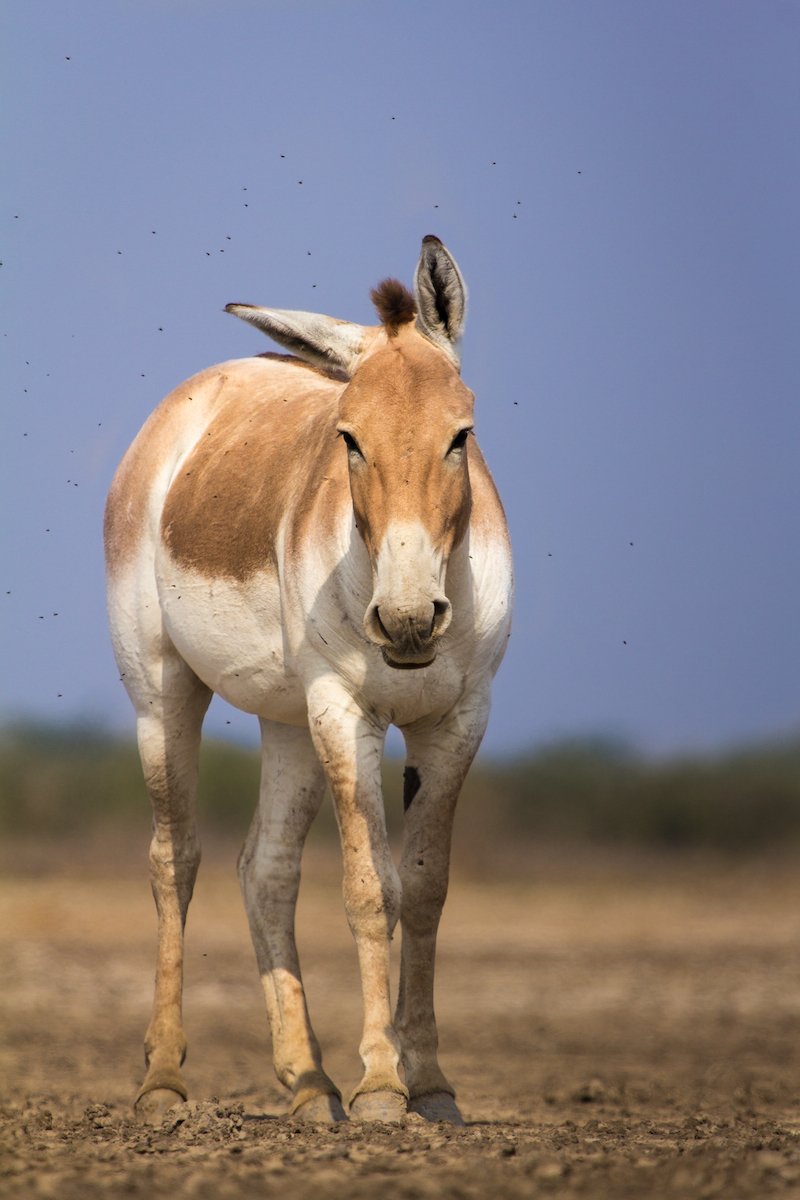
The khur, or Indian wild ass, survives in only one place on Earth: the saline flats of the Little Rann of Kutch.
The khur: back from the brink
The Indian wild ass is a genuine conservation success story. A handsome, sandy-coloured animal with a dark mane and a stripe down its back, faster and sturdier than it looks, the khur once ranged widely across the deserts of the subcontinent. By the middle of the twentieth century, hunting and disease had crashed the population to only a few hundred animals, all confined to this one corner of Gujarat, and the species teetered on the edge of extinction.
Nowhere else on the planet will you see the khur in the wild — the Little Rann is its entire world
Decades of protection have turned that around. The population in and around the sanctuary has climbed back into the thousands, one of the clearest wins for wildlife conservation in India, and sightings on a morning safari are now all but guaranteed. You will typically see them in loose herds, the stallions patrolling the edges, and with a patient naturalist you can often approach close enough to watch them graze, spar and thunder off across the flats.
The wild ass shares the Rann with a surprising cast of desert wildlife: nilgai and chinkara and blackbuck on the bets, desert foxes and jackals and the occasional striped hyena, and a rich birdlife that includes larks, sandgrouse, harriers and, in the shallow waters, huge congregations of migratory birds. A single morning drive can turn up a dozen species you would struggle to see anywhere else.
Flamingos, cranes and a birder's winter
For birdwatchers the Little Rann in winter is close to paradise. As the floodwaters shrink into shallow lagoons, they draw astonishing numbers of waterbirds: greater and lesser flamingos in pink rafts thousands strong, demoiselle and common cranes, pelicans, storks and countless ducks and waders. The nearby Nal Sarovar wetland and the coastal creeks amplify the spectacle, and a dawn drive to a flooded patch of the Rann can put you among more birds than you have ever seen in one place.
The flamingos are the headline act. In good years they gather in their tens of thousands, wading and feeding across the mirror-flat water so that the whole horizon turns rose-pink at first light. Combined with the wild ass on the dry flats nearby, it makes the Little Rann one of the most rewarding two-in-one wildlife destinations in India — big mammals and big birds, all under the same enormous sky.
Planning a Little Rann safari
A Little Rann safari is a very different affair from a tiger or lion park. There are no fixed permit windows in the way Gir has, but the sanctuary is only comfortably accessible in the dry season, roughly October to March, when the flats are firm enough for the open 4x4 jeeps that lodges use. Drives usually run at dawn and late afternoon, when the light is soft, the animals active and the heat bearable, and a knowledgeable naturalist is worth far more here than a hurried tour.
Stay at one of the eco-lodges around Zainabad or Dhrangadhra and let them arrange the safaris; most also offer visits to the salt-workers' settlements and the nearby Rabari herding villages, adding a strong cultural thread to the wildlife. Two nights lets you do a couple of drives and still have time to sit quietly on a bet at sunset, which is one of the great pleasures of the place.
The Little Rann pairs well with the rest of a Gujarat trip. It sits roughly between Ahmedabad and the Kutch craft villages, so it slots naturally into a route heading west, and travellers doing the classic Ahmedabad–Kutch loop can fold in a night or two here without much detour. Combine it with a Gir lion safari and a Rann Utsav visit and you have covered the very best of Gujarat's wild side.
If you go
- Visit between October and March, when the flats are dry and firm; the sanctuary is largely inaccessible during and just after the monsoon.
- Base yourself at an eco-lodge or homestay around Zainabad or Dhrangadhra and let them run the dawn and afternoon jeep safaris with their own naturalists.
- Wild-ass sightings are near-guaranteed; for the flamingos and migratory birds, come in the depths of winter (December to February) when numbers peak.
- Carry sun protection, a hat, plenty of water and binoculars — the Rann is open, shadeless and bright, and the wildlife is often at a distance.
- Slot it into an Ahmedabad–Kutch route; two nights is ideal, and pairs beautifully with a Gir safari and the Kutch craft villages.
The Little Rann of Kutch is Gujarat's great wildlife secret: a shimmering salt desert that is the only home of the Indian wild ass and, in winter, a gathering ground for flamingos and cranes in their tens of thousands. It offers something no other Indian park can — a big, wild mammal saved from extinction, glimpsed galloping across an empty horizon. Skip the crowds, base yourself in a desert lodge, rise before dawn, and let one of the country's most unusual landscapes surprise you.