Nadiad has a nickname in Gujarati that does not translate neatly: Sakshar Bhumi, the land of the literate or the learned. It is not a tourism slogan. This unremarkable-looking town in Kheda district, seventy kilometres from Ahmedabad, produced or educated an improbable share of the people who shaped modern Gujarati literature, law and politics — and it did so while functioning primarily as a market town and a pilgrimage centre around a temple.
That temple, the Santram Mandir, is the reason most people come. Founded in the early nineteenth century around the figure of Santram Maharaj, it is one of the more distinctive religious institutions in Gujarat, running a substantial network of temples, schools, hospitals and social services from a base in the middle of town. Nadiad is a rewarding half-day for anyone interested in how a Gujarati town actually works.
The Santram Mandir
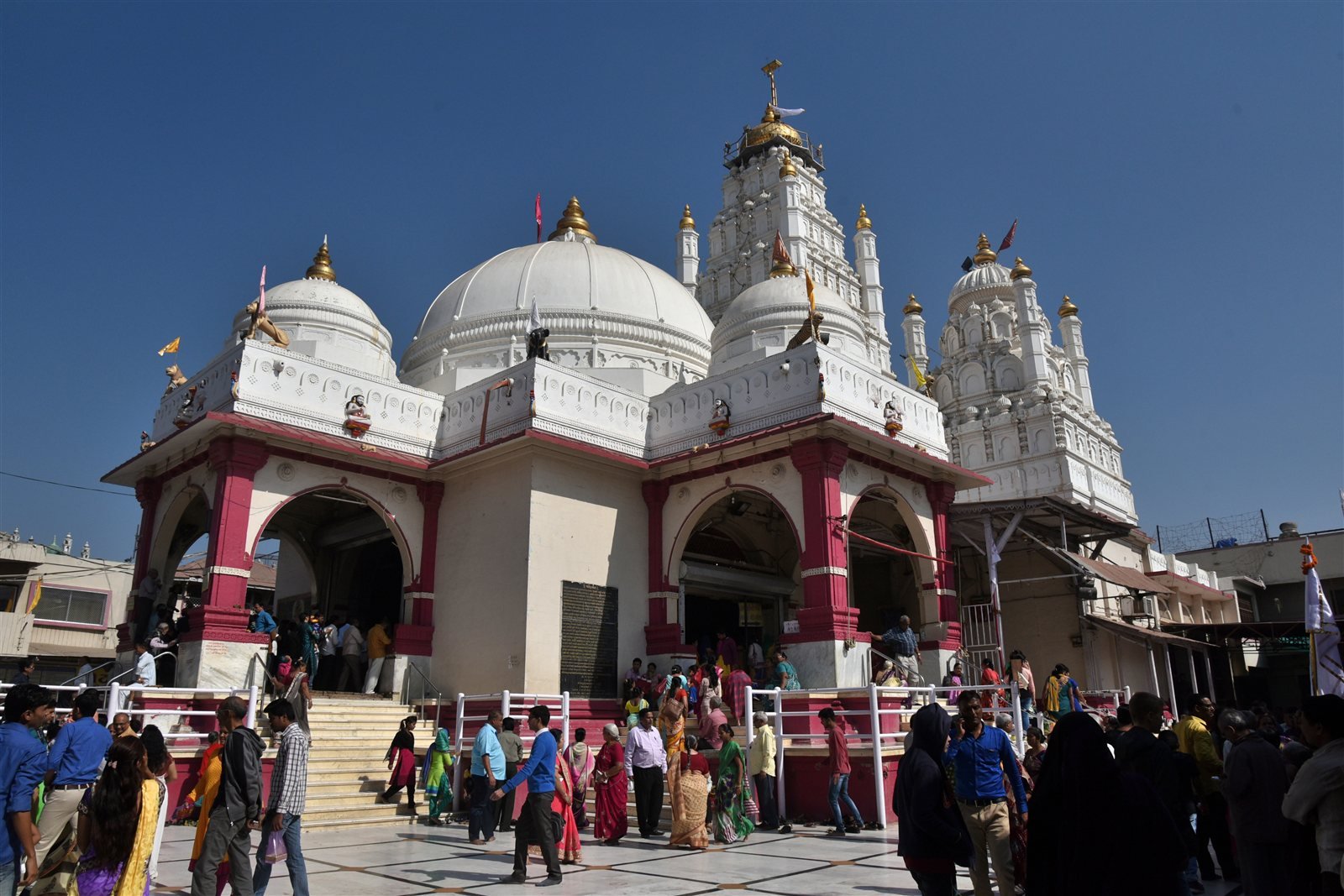
Santram Maharaj was a saint of the early nineteenth century whose tradition established itself at Nadiad, and the temple built around his seat has grown into the town's central institution. The complex is substantial and busy, with the main shrine, subsidiary temples, a large courtyard, dining and rest facilities for pilgrims, and the constant traffic of a working religious centre rather than a monument. Daily aarti is the moment to aim for.
What distinguishes the Santram tradition is the breadth of its social operation. The trust runs schools and colleges, hospitals and dispensaries, food distribution, and a network of affiliated temples across Gujarat, funded by devotee contributions and organised with considerable efficiency. This is a common pattern among Gujarati religious institutions — the Swaminarayan sampradayas do it on a larger scale — but Nadiad is a good place to see it up close because the town and the institution are so closely intertwined.
As a visitor, treat it as an active shrine. Shoes off, modest dress, no photography inside the sanctum, and awareness that the courtyard traffic consists of people with business here. The pilgrim dining hall will generally feed visitors a simple vegetarian meal for a nominal contribution, which is both a good lunch and the most direct way to experience how the place runs.

A nineteenth-century temple at the centre of a town that Gujarat calls the land of the literate.
Why they call it the land of the literate
The literary claim rests on specific people. Govardhanram Tripathi, author of Saraswatichandra — the four-volume novel published between 1887 and 1901 that is generally regarded as the first major novel in Gujarati and a foundational text of the language's modern literature — was from Nadiad. So was Manilal Dwivedi, the philosopher and poet. Indulal Yagnik, the political leader and writer, was born here. Several other significant Gujarati writers and reformers came from the town or the immediate district.
Saraswatichandra, the first great Gujarati novel, came out of this town — as did the lawyer who would become Sardar Patel
There is a political layer too. Vallabhbhai Patel — later Sardar Patel, the man who integrated the princely states into India — practised as a lawyer in Nadiad and Borsad before entering politics, and the Kheda district as a whole was the setting for the 1918 Kheda Satyagraha, Gandhi's early campaign over crop-failure revenue relief that helped establish satyagraha as a political method in Gujarat. This district was, in a real sense, one of the training grounds of the independence movement.
None of this is presented to visitors as a heritage trail; there is no literary museum or signposted route. It exists in the town's institutions, its schools, the names on buildings, and local knowledge. That is a limitation for a casual visitor and an opportunity for anyone prepared to ask questions — and the reason Nadiad is best done with a local guide or a well-informed acquaintance if you can arrange one.
What else to see
The other notable institution is the Hari Om Ashram, associated with Shri Mota, a twentieth-century saint whose tradition emphasised silence and meditation, and whose ashram at Nadiad is known for its silence rooms — small chambers where visitors can sit in complete quiet. It is an unusual and rather affecting thing to find in a busy market town, and it is open to visitors under the ashram's own arrangements.
Beyond that, Nadiad is a walking town: old lanes, carved wooden house fronts, a busy bazaar, tanks and small shrines, and the general texture of a prosperous Charotar market centre. Vaso, a village nearby, has a notable cluster of old havelis. The town is also known locally for its food, particularly farsan and sweets, and the bus stand and bazaar area is the place to eat.
Practicalities and the Charotar circuit
Nadiad is about 70 km from Ahmedabad and 45 km from Vadodara, on the main Mumbai–Delhi railway line with frequent express services — one of the easier towns in Gujarat to reach by train. Buses run constantly from both cities. The temple and bazaar are walkable from the station and bus stand, and autos cover the rest.
It belongs in a Charotar day or two. Dakor, with its great eighteenth-century Krishna temple and its enormous walking pilgrimage, is about 25 km away. Anand and the Amul dairy are 20 km south, with Karamsad and Sardar Patel's memorial nearby and Khambhat's agate bead workshops further west. The Batris Kotha Vav stepwell at Kapadvanj is within reach to the north. October to March is the comfortable season; accommodation in Nadiad is basic, and Ahmedabad or Vadodara are the sensible bases.
How a temple trust runs a town
It is worth pausing on what the Santram Mandir actually does, because it is a pattern found across Gujarat and rarely explained to visitors. The trust does not simply maintain a shrine. It runs schools and colleges, hospitals and dispensaries, hostels, food distribution and relief work, funded by devotee donations and managed with a competence that many state services in the same district would struggle to match. Affiliated temples extend the network across Gujarat.
This matters for understanding Gujarat generally. A great deal of the state's education, healthcare and welfare provision has historically been delivered by religious and community trusts — Swaminarayan sampradayas, Jain trusts, Bohra and Patidar community organisations, Santram and others — rather than by government alone, and the density of that voluntary infrastructure is one of the reasons the state's social indicators look the way they do. Standing in the Nadiad courtyard watching the food line, you are looking at a piece of that system working, and it explains more about the place than any monument would.
If you go
- Time your visit for aarti at the Santram Mandir, and eat at the pilgrim dining hall for a nominal contribution.
- Treat the temple as an active shrine: shoes off, modest dress, no photography in the sanctum.
- Ask about the Hari Om Ashram's silence rooms — an unusual and genuinely worthwhile stop.
- Take a local guide if you can; Nadiad's literary and political history exists in local knowledge, not signage.
- Combine with Dakor, Anand's Amul dairy, Karamsad and Khambhat for a full Charotar day or two.
Nadiad is a town that rewards curiosity rather than sightseeing. A busy nineteenth-century temple running schools and hospitals from the middle of a market town; the birthplace of the first great Gujarati novel; the district where Gandhi ran an early satyagraha and where Sardar Patel practised law; and an ashram with rooms built for sitting in silence. Come for the aarti, eat in the dining hall, ask questions, and give the Charotar around it a day.