
The single most affecting room in Ahmedabad contains a woven mat, a low wooden writing desk, a spinning wheel and almost nothing else. Hriday Kunj — the abode of the heart — was where Gandhi and Kasturba lived on the west bank of the Sabarmati from 1917 until 1930, and it is preserved essentially as it was: bare tiled floors, whitewashed walls, a verandah, a few possessions behind glass.
Sabarmati Ashram is free, open every day, and takes between one and two hours. It is also, deliberately, one of the least impressive-looking major historical sites in India — there is no architecture to admire, no treasure, no spectacle. The plainness is the exhibit, and the reason it works is that you already know what was organised from these buildings.
What actually happened here
Gandhi established the ashram on this site in 1917, having returned from South Africa two years earlier, and it functioned for thirteen years as both the operational headquarters of a mass political movement and an experiment in how to live. Residents spun and wove, worked the land, cleaned their own latrines — a deliberate assault on caste prohibitions that caused real hostility in Ahmedabad at the time — ate communally, ran a school, and observed a set of vows covering truth, non-violence, celibacy, non-possession and the removal of untouchability.
That combination is the thing to grasp. The ashram was not a retreat from politics; it was the instrument of it. The non-cooperation movement, the campaigns around khadi and the boycott of foreign cloth, the interventions in labour disputes in Ahmedabad's mills, the Kheda satyagraha over revenue relief, and finally the salt satyagraha were all planned and coordinated from this compound, by people who spent the rest of their day spinning cotton and sweeping floors.
The most consequential departure came on 12 March 1930. Gandhi left the ashram with seventy-eight chosen companions to walk roughly 385 km to the coast at Dandi, where on 6 April he picked up a lump of natural salt and broke the salt laws. He had vowed not to return to Sabarmati until India was independent, and he never lived here again. The ashram was abandoned as a residence and later disbanded under government pressure, before being restored as a memorial after independence.
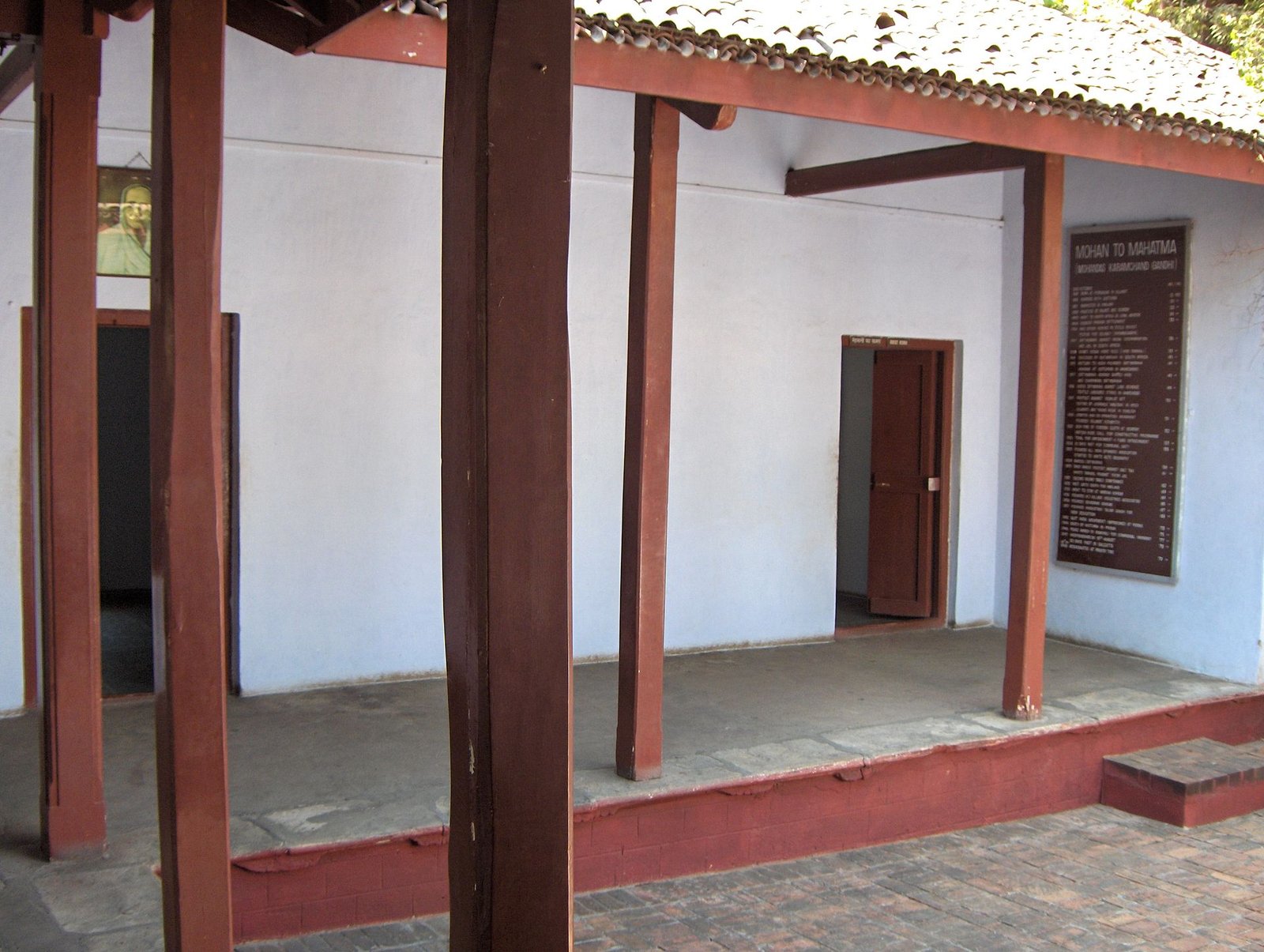
A mat, a low writing desk and a spinning wheel. A mass movement was organised from this room.
The museum, and a building worth noticing
Alongside Hriday Kunj stands the Gandhi Sangrahalaya, the ashram's museum, and it deserves attention for two reasons. The first is its content: an extensive archive of letters, photographs, manuscripts and documents, with galleries covering Gandhi's life and the movement, and a research collection used by scholars. It is not a flashy museum and it does not need to be.
He left on 12 March 1930 vowing not to return until India was free. He never lived here again
The second reason is the building itself. It was designed by Charles Correa in the early 1960s, one of his earliest major commissions, and it is a landmark of modern Indian architecture — a low, modular structure of brick, stone and tile arranged as a grid of pavilions around courtyards and water, with a deliberately unmonumental character that responds directly to the ashram's ethos. Architects come to Ahmedabad specifically to see it. Most visitors walk through without noticing, which is a shame.
The wider compound holds other residence buildings, including Vinoba Kutir and Magan Niwas, along with quiet gardens and the riverbank. It is a genuinely calm place, particularly in the early morning before the school groups arrive, and there is no pressure to move through it quickly. A large redevelopment and expansion of the ashram precinct has been under way in recent years, which has affected parts of the surroundings — worth a check before you go if you have specific expectations.
How to visit
Come in the morning. The ashram opens early, entry is free, it is open daily, and the first hours are cooler and much quieter than the rest of the day — school parties and tour groups arrive steadily from mid-morning onwards. Allow an hour for the essentials and two if you want to read properly in the museum; it is not a half-day site, and trying to make it one is a mistake.
Spend real time in Hriday Kunj rather than treating it as a photograph. The room is bare and there is nothing to look at, which is precisely the reason to stand in it for a few minutes with what you know about it. Then give the Correa building its due as architecture, walk the compound, and go out onto the riverfront promenade that now runs alongside.
The other end of the story
Sabarmati only completes itself if you connect it to Dandi. The memorial at Dandi in Navsari district, opened in 2019, marks where the march ended — with bronze statues of Gandhi and all eighty marchers, narrative installations covering the twenty-four days, and working solar salt pans where you can watch salt crystallise. The two sites are four hundred kilometres apart and they are a single story; seeing both is far more powerful than either alone.
Confusingly, the large multimedia museum called Dandi Kutir is not at Dandi but in Gandhinagar, next to Mahatma Mandir, about forty-five minutes from the ashram. Travellers regularly conflate the three. If your itinerary allows, the full sequence is Sabarmati Ashram, Dandi Kutir in Gandhinagar, and the Dandi memorial on the coast, and it makes one of the more coherent thematic routes in India. Closer at hand, Ahmedabad's old city — a UNESCO World Heritage Site — is across the river and is the other essential half of any visit here.
Ahmedabad, and the movement it funded
Gandhi chose Ahmedabad deliberately, and the reasons say a good deal about how the independence movement actually worked. It was a Gujarati-speaking city, which mattered to him; it had a long Jain and Vaishnav tradition of philanthropic giving that he expected would support an ashram; and it was the textile capital of western India, with a wealthy mill-owning class whose patronage funded a great deal of nationalist activity. Ambalal Sarabhai, one of the leading mill owners, is credited with quietly rescuing the ashram financially at an early and precarious moment.
The relationship ran both ways and it was not always comfortable. In 1918 Gandhi intervened in a dispute between Ahmedabad's mill workers and their employers — including Sarabhai, whose sister Anasuya was leading the workers — and undertook the first of his political fasts to hold the strike together. The settlement led to the founding of the Textile Labour Association. That a movement should be funded by industrialists and simultaneously organise their workforce is exactly the kind of contradiction Gandhi's Ahmedabad years are full of, and it is far more interesting than the sanitised version.
If you go
- Go early. It is free and open daily, and dramatically quieter before the school groups arrive.
- Stand in Hriday Kunj for a few minutes rather than photographing it and moving on; the bareness is the exhibit.
- Give the Charles Correa museum building attention as architecture, not just as an archive.
- Note that Dandi Kutir is in Gandhinagar and the Salt March memorial is at Dandi, 400 km away — three different places.
- Combine with the Ahmedabad heritage walk across the river, which is the city's other essential experience.
Sabarmati Ashram is an hour that reframes the rest of Ahmedabad. Come early, walk into a tiled room containing a mat, a desk and a spinning wheel, and hold in your head that a movement against an empire was run from it and that the walk to the sea began in this compound. Then look properly at Correa's museum, walk out along the river, and cross to the old city to see what Gandhi's Ahmedabad actually looked like.
More stories
Practical details, timings and nearby places are on our Sabarmati Ashram destination page.