In the sanctum of one of the most important goddess temples in western India, there is no idol. Pilgrims queue for hours, the marble halls fill and empty, offerings are made and aarti is sung, and what they are all facing is a small triangular gold-plated plaque inscribed with a geometric diagram — the Vishwa Yantra. Ambaji is a major Shakti Peeth, drawing millions of visitors a year to a small town in the Aravalli foothills near the Rajasthan border, and its central object of worship is a piece of sacred geometry rather than a figure.
That absence is what makes Ambaji distinctive among Gujarat's temples, and it also explains something about the tradition it belongs to. The Shakti Peeths are sites associated with the goddess in her raw, elemental form, and at Ambaji the emphasis falls on the yantra, the seat and the power rather than on a personified image. Whether you come as a pilgrim or as a traveller, it is worth understanding before you join the queue.
A seat of the goddess, without an image
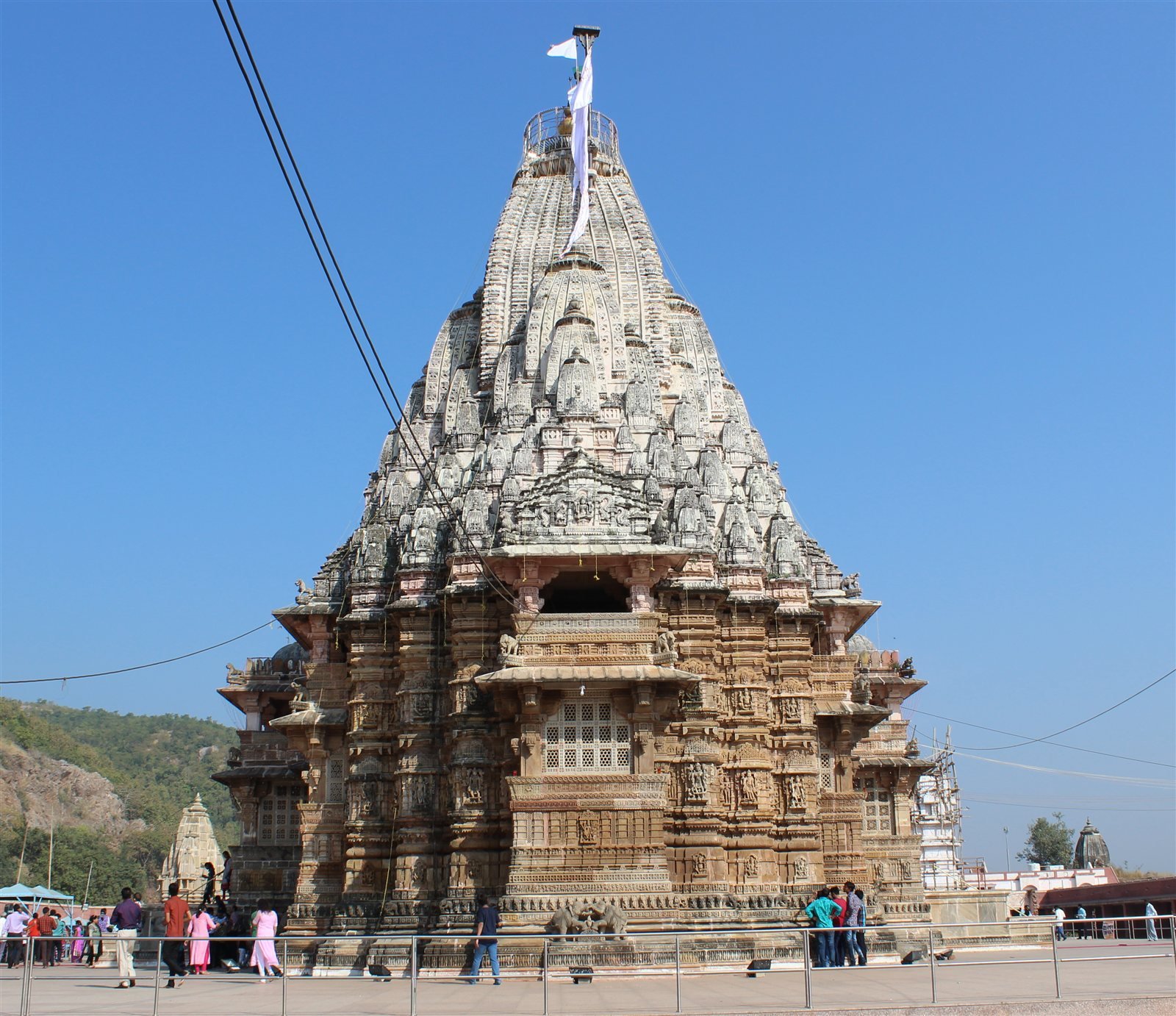
Ambaji is counted among the fifty-one Shakti Peeths — the network of sites across the subcontinent linked by the myth of Sati, whose body parts are said to have fallen to earth at each. Ambaji's association is with the heart. The temple has been an important pilgrimage centre for many centuries, and the present structure is a large white marble complex, extensively rebuilt and expanded in the modern period, with a gold-topped spire, wide courtyards and the infrastructure required to move very large numbers of people through a small sanctum.
The sanctum contains the Vishwa Yantra — a triangular inscribed diagram, traditionally described as gold-plated, with fifty-one syllables corresponding to the fifty-one Peeths. It is dressed and adorned so that, from a distance and in the low light, it reads as a figure of the goddess: a sari, ornaments, a crown and a silver frame arranged around the yantra. Devotees see Amba; there is no carved image beneath the cloth. The temple explicitly discourages photography of the sanctum, and this is respected strictly.
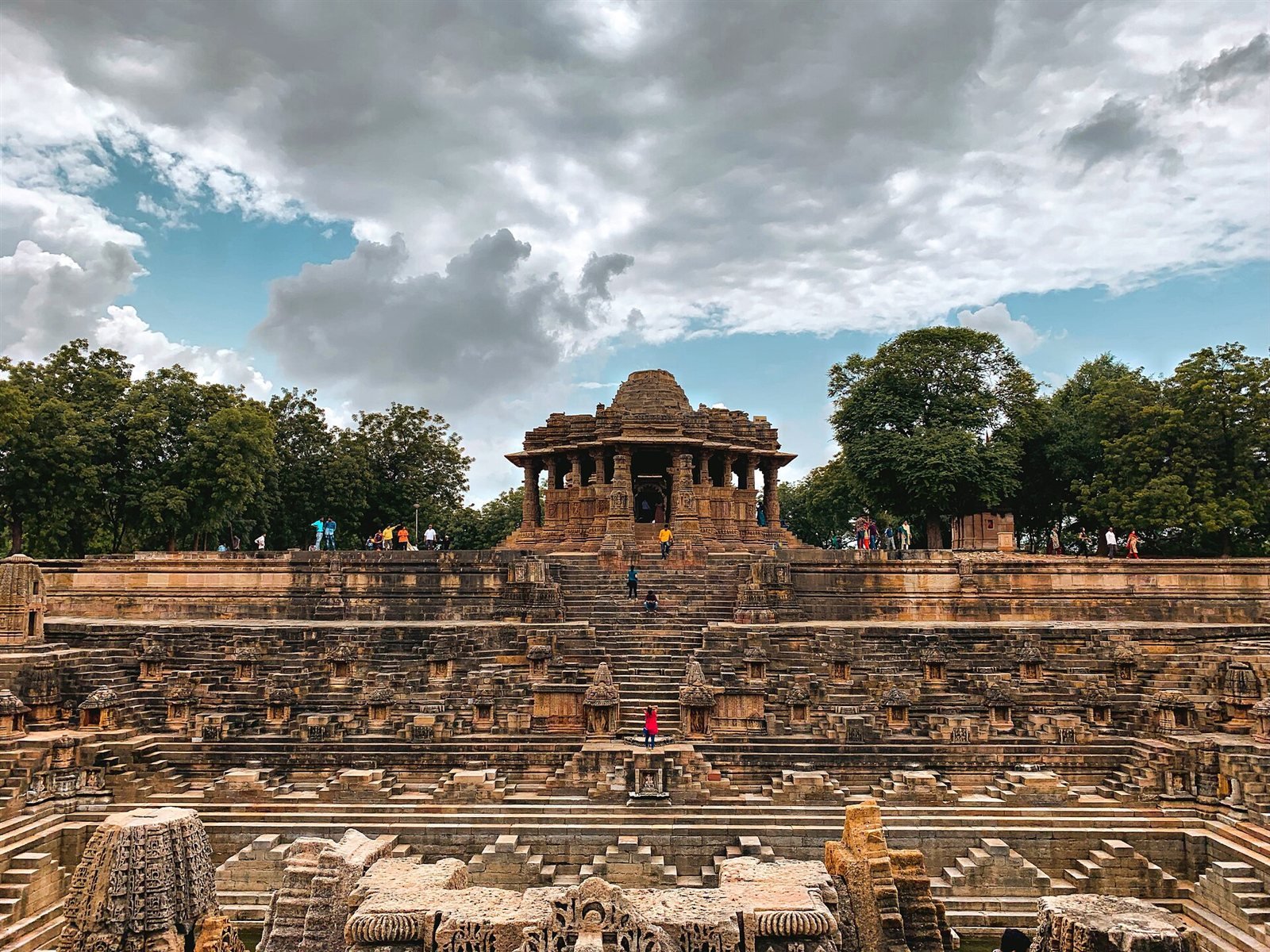
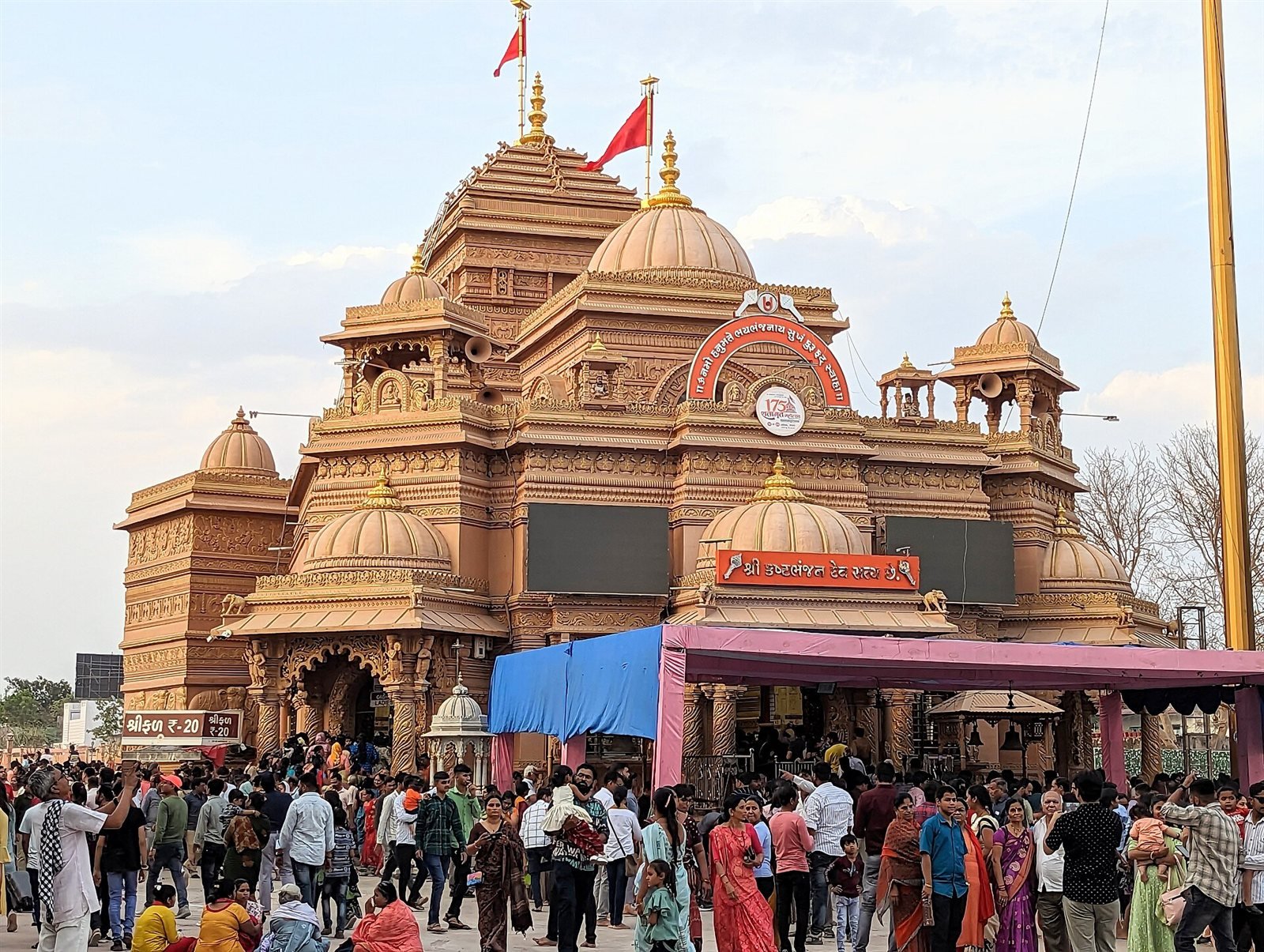
The wider complex is busy, well-organised and unambiguously modern in its facilities, with queue management, cloakrooms, prasad counters and crowd barriers. That efficiency is necessary — on major dates the numbers are enormous — but it does mean Ambaji feels more like a great functioning pilgrimage machine than a quiet historical monument. Visitors looking for architecture rather than devotion will find more of it at Taranga or Modhera.
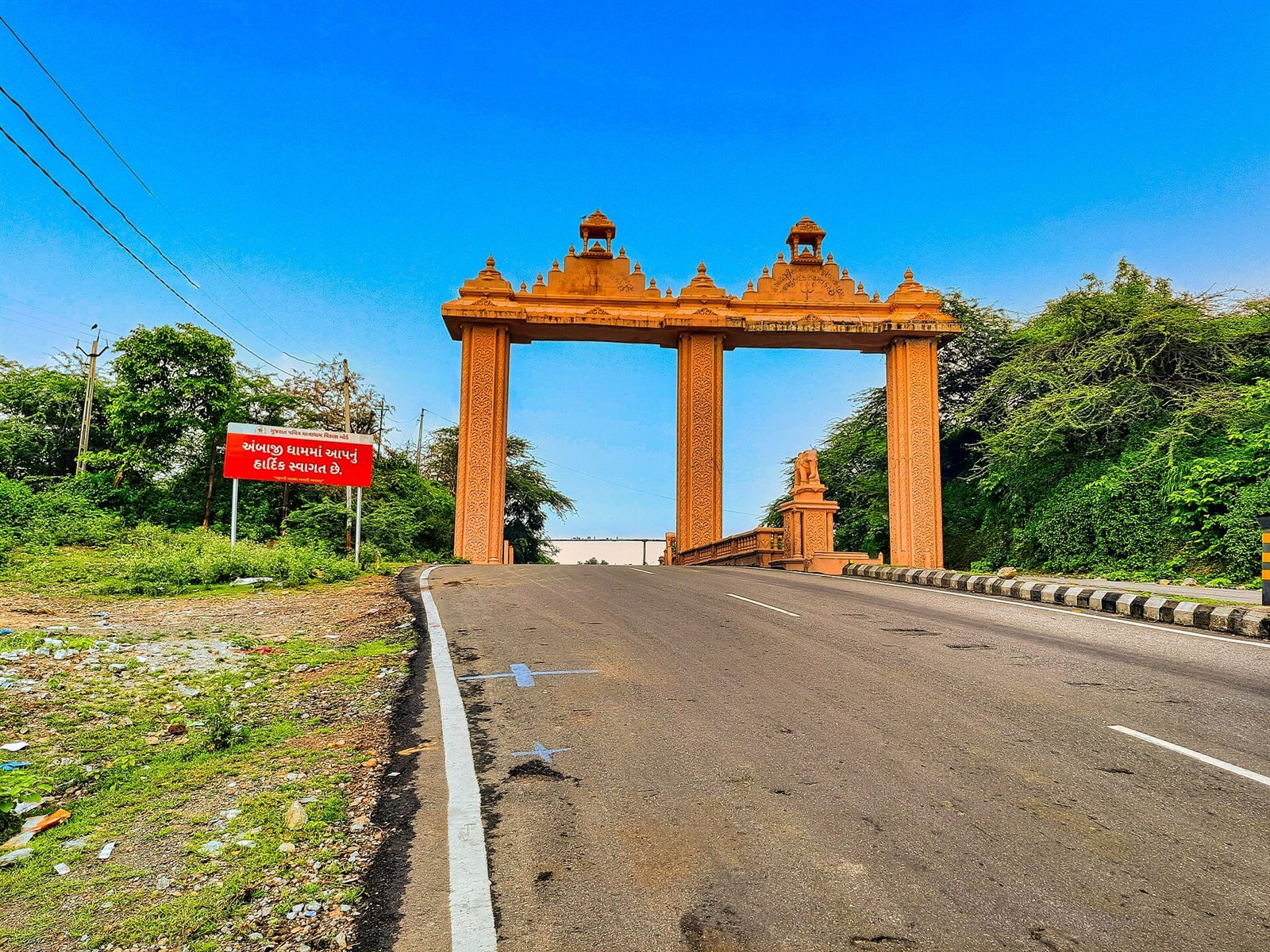
One of the great Shakti Peeths — and there is no image of the goddess in the sanctum.
Gabbar Hill, and the original seat
About four or five kilometres from the main temple rises Gabbar Hill, and tradition holds this to be the goddess's original abode — the older, rawer site, from which worship later moved down to the town. Most pilgrims go to both, and for many the hill is the more affecting half of the visit. A long flight of steps climbs to the shrine at the top, and there is a ropeway for those who would rather ride, which most people do at least one way.
The temple in town has the crowds and the marble; the hill above it has the older shrine, the wind and the view into Rajasthan
At the summit there is a small shrine, a perpetual flame, footprint markings venerated as the goddess's, and a view that runs north into Rajasthan and west across the Aravalli foothills. Evenings are the moment: the light goes long and gold over the hills, the aarti is sung, and the whole thing is considerably more atmospheric than the queue below. The hill also carries a scatter of subsidiary shrines and a small cave, and the walk between them is pleasant in the cool months.
Ambaji's temple economy is built on white marble, and it is worth knowing why the town looks the way it does: this region, around Ambaji and Danta, is one of India's significant marble-producing areas, and quarrying is a major local industry. That is both the reason the temple could be built in marble on this scale and the reason the surrounding hills are visibly scarred in places. It is a working landscape, not a pristine one.
Bhadarvi Poonam, and the walking pilgrimage
Once a year Ambaji stops being a busy temple and becomes something on a different scale entirely. Bhadarvi Poonam, the full moon of the Bhadrapada month — usually falling in late August or September — is the great Ambaji mela, and the numbers are extraordinary: figures in the millions are routinely reported over the four or five days of the fair. A very large proportion of those pilgrims walk, in organised sanghs, along the highways from Ahmedabad, Palanpur, Mehsana and further, carrying flags and singing, with volunteer camps set up along the routes to feed and shelter them.
If you want to see one of the biggest religious gatherings in western India, this is it, and the walking pilgrimage in the days beforehand is a genuinely moving thing to witness even from the roadside. If you want to see the temple, come at almost any other time. During the mela, accommodation for a hundred kilometres around is gone, roads are jammed or closed to ordinary traffic, and darshan queues run for many hours. Navratri in autumn is also very busy, with garba performed in the temple precinct, and the Chaitra full moon draws large crowds too.
Practicalities, and using Ambaji as a base
Ambaji is in Banaskantha district, roughly 180 km north of Ahmedabad and about 60 km from Palanpur, close to the Rajasthan border. The nearest railheads are Palanpur and Abu Road, both well connected, and buses run constantly from Ahmedabad, Mehsana, Palanpur and Abu Road. Accommodation in town is plentiful but pilgrim-oriented — dharamshalas, trust guesthouses and simple hotels — and there is a Gujarat Tourism property; standards are functional rather than comfortable.
The town's position makes it a useful hinge in a longer trip. Mount Abu, Rajasthan's only hill station and home to the Dilwara Jain temples, is around 45 km north. Kumbhalgarh and Ranakpur are a longer drive into Rajasthan. South, you have Balaram's forest palace and the Balaram-Ambaji sanctuary, Taranga Hill's Jain temples, and the whole north Gujarat heritage cluster of Vadnagar, Sidhpur, Patan and Modhera. October to March is the comfortable season; the summer here is severe, and the monsoon, while green, brings the Bhadarvi Poonam crush.
If you go
- Understand before you queue that the sanctum holds an inscribed yantra, not an image, and that photographing it is not permitted.
- Do Gabbar Hill as well as the main temple, and go up in the late afternoon for the light, the aarti and the view into Rajasthan.
- Avoid Bhadarvi Poonam (late August or September) unless the mela itself is the point — roads, rooms and queues are overwhelmed.
- Expect pilgrim-standard accommodation in town; if you want comfort, stay at Balaram or push on to Mount Abu.
- Use Ambaji as a hinge between north Gujarat's heritage circuit and Mount Abu, 45 km north.
Ambaji is one of the great Shakti Peeths and it is worth visiting for two things that sit oddly together: an enormous, efficient, marble pilgrimage complex whose sanctum contains a geometric diagram rather than a goddess, and a hill four kilometres away where the older shrine looks out over the Aravallis at sunset with the wind in it. Come in the cool months, avoid the Bhadarvi Poonam crush unless you want it, do the hill in the evening, and treat the town as the gateway between north Gujarat and Mount Abu.