Gujarat has three great Jain hills. Shatrunjaya at Palitana has nine hundred temples and a river of pilgrims on the steps before dawn. Girnar at Junagadh has a ten-thousand-step climb and a mountain's worth of shrines. And then there is Taranga, in the Aravalli foothills of north Gujarat, which has one of the finest single Jain temples in India, a scatter of others around it, and — on most days of the year — hardly anybody at all.
The main temple, dedicated to Ajitnath, the second Tirthankara, was built in 1121 and it is a masterpiece of Solanki-period architecture: white marble, a tall spire, a hall of carved pillars, and a colossal seated image of Ajitnath in the sanctum. It sits on a granite hill scattered with boulders and dry forest, with views out across north Gujarat towards Rajasthan. If you are travelling the Modhera–Patan–Vadnagar circuit, it is the least-known and possibly the most rewarding stop on it.
A king, a monk, and a temple in 1121
The Ajitnath temple was commissioned by Kumarapala, the Solanki king of Gujarat, in the early twelfth century, and tradition holds that he built it at the urging of Hemachandracharya — the polymath Jain monk, scholar and grammarian who was the dominant intellectual figure at the Solanki court and is credited with turning Kumarapala towards Jainism. That combination of royal resources and a formidable religious adviser produced a building of unusual confidence.
It is large. The temple rises on a high plinth with a tall curvilinear shikhara, an enclosed hall and a series of subsidiary shrines around the courtyard, and the whole thing is faced in white marble that has weathered to a warm cream. The exterior carries the dense horizontal banding of sculpture typical of the period — deities, dancers, musicians, elephants, geometric friezes — while the interior hall has the carved pillars, brackets and corbelled ceiling that Solanki masons executed better than anyone.
In the sanctum is the reason it exists: a seated image of Ajitnath, well over two metres tall, in white marble. It is a genuinely imposing object, and the sanctum is dim and cool and quiet in a way that the great pilgrimage sites rarely manage. The temple belongs to the Svetambara tradition and is an active place of worship, so the usual courtesies apply — shoes off, leather left outside, photography restricted in the sanctum, and modest dress.
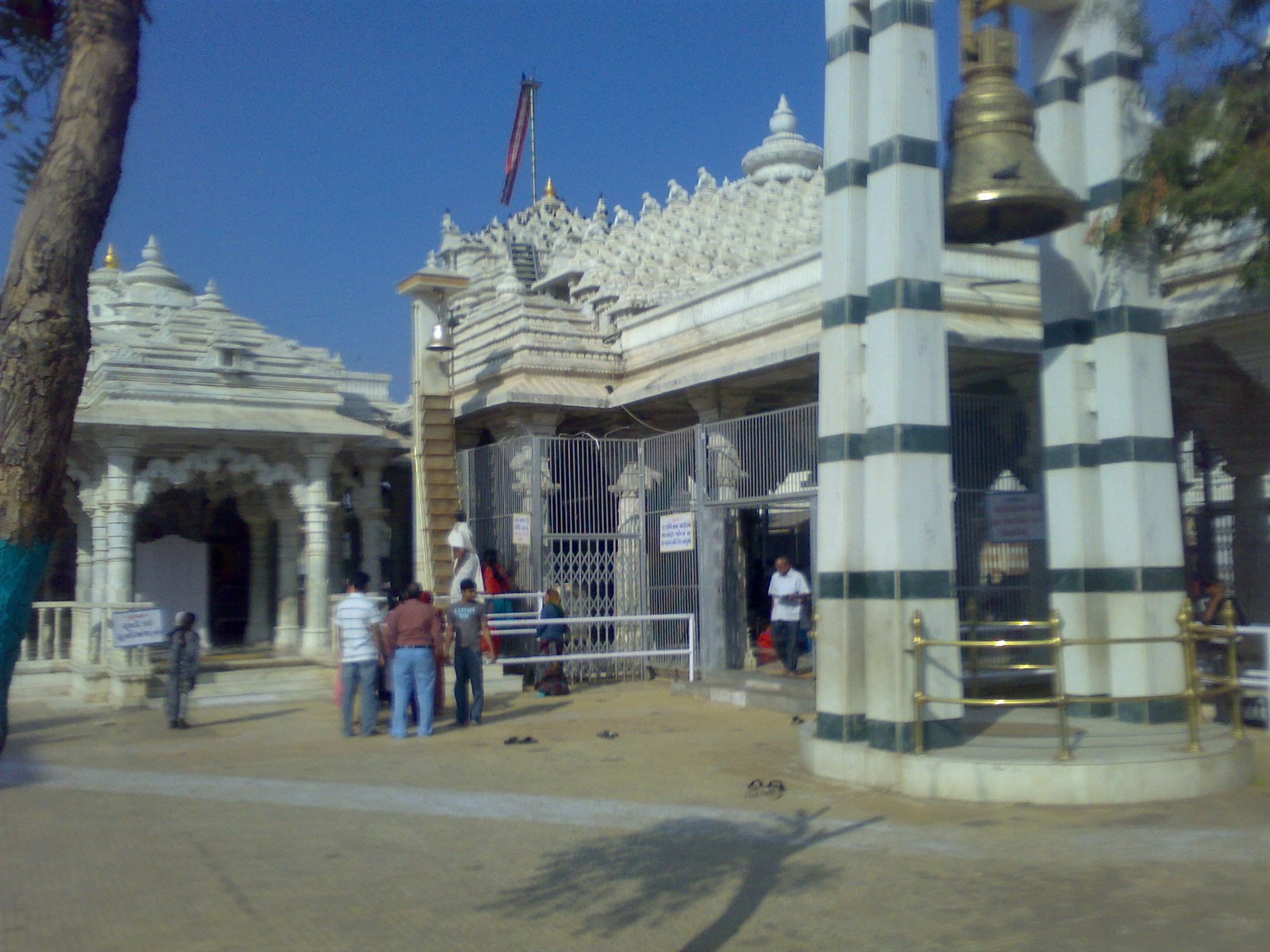
A twelfth-century marble temple on a granite hill, with almost nobody on the steps.
The hill, and the other traditions on it
Taranga is not a single temple but a hill with several claims on it, and that layering is part of the pleasure. Alongside the main Svetambara complex there are Digambar Jain temples — the two main Jain sects both hold the hill sacred — and a set of ancient rock-cut caves associated with the goddesses Taranmata and Dharanmata, from whom the hill takes its name. Those caves are generally understood to have Buddhist origins, which would make Taranga another site, like Vadnagar and Dev ni Mori, in the largely forgotten Buddhist geography of north Gujarat.
Buddhist caves, Digambar and Svetambara temples and a hilltop goddess shrine, all on the same granite outcrop
Jain tradition also associates the hill with the liberation of a great many ascetics, which is the basis of its sanctity. There are smaller shrines, footprint memorials and viewpoints scattered across the slopes, and the granite boulder landscape between them — dry, sparse, strewn with enormous rounded rocks — is attractive in its own right. Walking between the sites takes an hour or two at an easy pace, and it is the kind of place where the walk matters as much as the destinations.
The contrast with Palitana and Girnar is worth stating plainly, because it is the main argument for coming. At Shatrunjaya you climb three and a half thousand steps in a crowd; at Girnar, ten thousand. At Taranga, a road runs most of the way up and the final approach is short. You can be in front of a twelfth-century masterpiece within a few minutes of parking, in near silence, on an ordinary weekday. For travellers who want the architecture without the endurance test, this is the one.
When it is busy, and when it is empty
Taranga's quietness is real but it is not constant. It is an active pilgrimage site with dharamshalas and a bhojanshala run for pilgrims, and it fills up on Jain festival dates — Mahavir Jayanti in spring, the Kartik and Chaitra full moons, Paryushan in late monsoon — and during organised pilgrimage tours, when coach parties arrive together. On those days the complex is busy and the atmosphere is completely different, which some visitors will prefer.
For solitude, aim for an ordinary weekday morning outside festival periods. The temples generally open early and close around dusk with a midday closure common at Jain sites, so check timings locally rather than assuming; arriving at eleven and finding the sanctum shut is a common and avoidable disappointment. Pilgrim dining halls will usually feed visitors a simple strictly vegetarian meal for a nominal contribution, which is both convenient and the best food for miles.
Getting there and what to combine it with
Taranga Hill is in Mehsana district near Kheralu, roughly 55 km north of Mehsana and about 130 km from Ahmedabad — two and a half to three hours by road. There is a small railway station at Taranga Hill on a branch line, but services are sparse; buses run from Mehsana, Visnagar and Kheralu, and a hired car is much the most practical way to include it in a wider route.
That route is the obvious one for north Gujarat: Modhera's Sun Temple, Rani ki Vav and the patola weavers at Patan, Vadnagar's torana and excavations, Sidhpur's Bohra streets, and Taranga's Jain temples, with Ambaji and the road to Mount Abu continuing north. Two full days based in Mehsana or Patan covers it comfortably. October to March is the season; the hill is exposed and April to June is hot, while the monsoon turns the boulder landscape briefly and beautifully green if you do not mind the humidity. Accommodation on the hill is pilgrim dharamshalas; for hotels, stay in Mehsana or Palanpur.
If you go
- Check the temple's opening and midday-closure timings locally before setting out — arriving to a shut sanctum is the usual mistake.
- Leave leather outside, remove shoes, dress modestly and avoid photographing inside the sanctum.
- Walk beyond the main temple to the Digambar shrines and the Taranmata caves; the boulder landscape between them is half the appeal.
- Go on an ordinary weekday for near-solitude, or on a Jain festival date if you want the full pilgrimage atmosphere.
- Eat at the pilgrim bhojanshala — simple, strictly vegetarian, and much the best option in the area.
Taranga is the answer for anyone who wants Jain temple architecture at its twelfth-century best without three and a half thousand steps. A marble temple built by a Solanki king on the advice of the greatest scholar-monk of his age, a two-metre image of Ajitnath in a cool dim sanctum, Digambar shrines and Buddhist-origin caves scattered across a granite hill, and a road that takes you most of the way up. Come on a weekday in the cool months, check the timings, and give the hill a couple of hours on foot.