
Region
Kutch, western Gujarat
Best time
The cooler winter months
Ideal duration
One to three days
Good for
Craft lovers, shoppers, cultural travellers
The craft villages of Kutch are a scattering of small settlements where weaving, embroidery, block printing, bell-making, leatherwork and pottery are still practised as everyday livelihoods. Rather than one site, this is a network of hamlets spread across the district, each associated with particular communities and their signature techniques. Visiting them is a way to meet makers in their own homes and workshops, watch skills that have travelled through families, and buy directly from the people who create the work.
What makes this region special is how alive the traditions remain. You might see mirror-work embroidery, tie-dye bandhani, natural-dye printing or intricate metal bells taking shape in front of you. Many artisans welcome respectful visitors and are happy to explain their craft. Because the villages are dispersed and some are remote, a little planning and often a local guide or driver goes a long way toward a rewarding trip.
What to see and do in the craft villages
Move between hamlets known for different specialities, from embroidery and weaving to block printing, pottery and metal bells. Spend time in workshops rather than rushing, and let artisans show you their process. Buying directly supports the makers and usually means better pieces and fairer prices than a city shop.
Ask before photographing people or their work, and be mindful that these are working homes, not a museum. Many travellers pair village visits with a stay in Kutch and build in time for the wider desert landscape. If a craft particularly draws you, seek out the village most associated with it for the deepest experience.
Craft Villages
How to get there
Most craft villages are reached from Bhuj, the district hub, which connects to the rest of Gujarat by road and rail. From Bhuj you branch out by car or hired vehicle, as the hamlets lie at varying distances across Kutch and public transport can be limited. A local driver or guide who knows the routes makes the day far smoother and helps with introductions. Distances add up, so plan a realistic loop.
Best time to visit the craft villages
The cooler winter stretch is by far the most pleasant, which is also when the wider Kutch festival season draws visitors. Days are mild and travel between villages is comfortable. The summer heat is harsh and the monsoon can complicate rural roads, so the winter half of the year is the natural choice.
Good to know
- Carry cash, as many artisans cannot take cards.
- Always ask permission before taking photos of people or products.
- Hire a local guide or driver to reach dispersed hamlets efficiently.
- Buy directly from makers to support them and get authentic pieces.
Frequently asked questions
Which crafts can I see in Kutch?
Embroidery, bandhani tie-dye, block printing, weaving, pottery, leatherwork and metal bell-making are among the best known, spread across different villages.
Do I need a guide?
It is not mandatory, but a local guide or driver helps you navigate the scattered villages and connect respectfully with artisans.
Can I buy directly from artisans?
Yes, and it is encouraged. Direct purchases support the makers and often get you finer work than intermediary shops.
A district that works with its hands
Kutch holds India's densest concentration of living craft, and it lives in villages — each with its own hereditary skill, its own community, and usually its own reason for being where it is. The geography is walkable in a few days from Bhuj: Bhujodi, ten minutes out, weaves the Vankar community's woollen shawls on pit looms; Nirona keeps three crafts in one village — Rogan painting in the Khatri family's single surviving workshop, copper-coated bells, and lacquered woodwork; Zura hammers the herders' bells; Ludiya and the Banni hamlets carry mud-mirror work on their bhunga walls; and Ajrakhpur, resettled after the 2001 earthquake, block-prints ajrakh in its full sixteen-stage indigo-and-madder sequence.
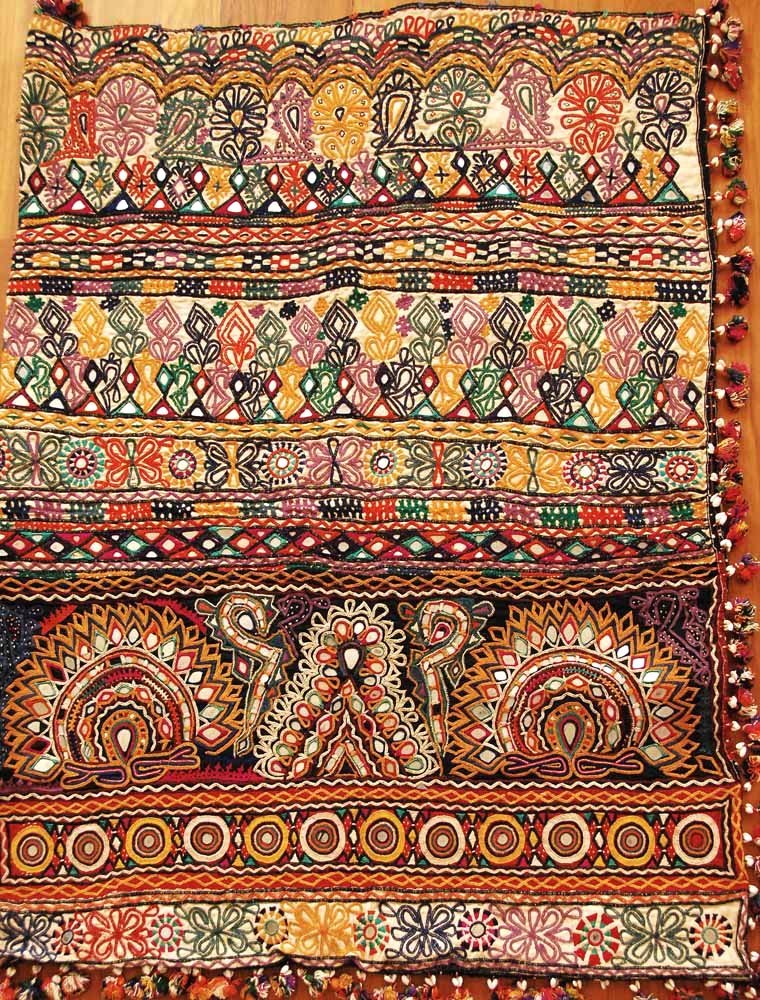
The embroidery map is finer still. Each community stitches its signature — Rabari chain work dense with mirrors, Ahir circles, Sodha and Meghwal styles from the border villages — and the Kala Raksha and Shrujan trusts, with museums near Bhuj, document the lot and sell work that pays the stitchers fairly.
Visiting well
The villages are homes and workplaces, not exhibits: arrive in working hours, ask before photographing people, and buy from the maker's own hand — the difference between a bazaar copy and a signed piece funds the next generation's training. Most workshops welcome visitors without appointment; Nirona's Rogan painters and the bell-makers give demonstrations that explain the craft better than any label. Homestays at Hodka and the Banni villages put the evening's music with the day's craft.
Practical notes
Base at Bhuj and loop the villages by hired car or rickshaw over one to two days — Bhujodi and Ajrakhpur east, Nirona, Zura and the Banni string north toward the White Rann. October to February is the season, when workshops run at full production for the Rann Utsav trade; the summer months slow the villages, and the monsoon quiets them almost entirely. Carry cash — card machines remain rare — and leave luggage room for the shawl you will not resist.