
Gujarat is one of India's great craft states — the double-ikat Patola of Patan, bandhani tie-dye, Ajrakh block-print and the mirror-work embroidery of Kutch.
These guides show you the crafts, the villages and how to buy authentically from the makers.
The living tradition of Gujarat handicrafts
Gujarat handicrafts are among the richest in India, kept alive by artisan families who often trace their craft back through many generations of the same household. The crown jewel is Patan Patola, a double-ikat silk woven in only a handful of homes in the town of Patan, where both the warp and the weft threads are tie-dyed to an exact plan before weaving so the finished pattern appears identically on both faces of the cloth. A single sari can take four to six months of painstaking work, and the price reflects it; a genuine double-ikat Patola is a family heirloom passed down the generations, not a casual souvenir.
Tie-dye reaches everyone else through bandhani, the technique of pinching and knotting many thousands of tiny points across the fabric before dyeing so they resist the colour and bloom into dotted patterns of red, yellow, green and black. Kutch and Jamnagar are the heartlands of the craft, and the fingertips of skilled bandhani artists are often permanently marked and grooved from years of tying those knots by hand. From elaborate bridal odhnis to everyday dupattas worn to the market, it is the most visible craft in the whole state and by far the easiest to buy well without overspending.
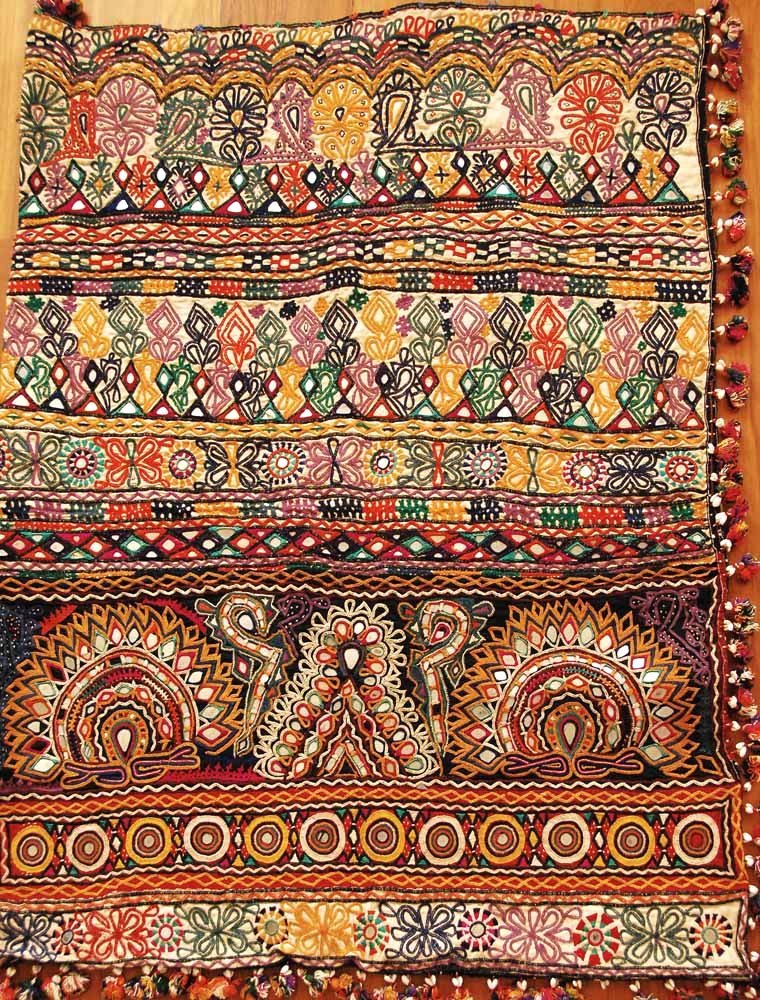
Patola, bandhani, Kutch embroidery and block-print by hand.
Kutch embroidery, Ajrakh and buying from artisans
Kutch is a craft world entirely of its own. Its embroidery splinters into a dozen distinct community styles, from the mirror-heavy work of the Rabari herders to the fine chain-stitch of the Ahir and the geometric, counted-thread suf work, each village stitching its own recognisable signature. Alongside it, Ajrakh block-printing lays down deep indigo and madder-red geometry through a long resist-and-dye process that can run to sixteen separate stages, while the rare Rogan art of Nirona is painted freehand with a metal stylus and a fine thread of thickened, boiled castor oil by just one or two remaining families who guard the technique closely.
Buying authentically matters, both for your money and for the makers who depend on it. The surest route is to go straight to the source: the artisan villages around Bhuj such as Nirona, Ajrakhpur and Bhujodi, where you can watch the work happen at the loom or the print table and buy directly from the family, or else trust established cooperatives and the Geographical Indication tags that certify a genuine Patola or Ajrakh. Prices are higher than the machine-made copies stacked in city bazaars, but the difference goes straight to the artisan, and that is exactly what keeps these fragile crafts breathing into the next generation.
Explore Handicrafts
Crafts and Textiles of Gujarat: A Buyer’s Guide
A Gujarat textiles guide to Patan Patola, Bandhani, Kutch embroidery, Ajrakh and Rogan art…
Surat: Where the World’s Diamonds and Fabrics Are Made
A first-person Surat guide to the city that cuts the world's diamonds and weaves…
Threads of Gujarat: Patola, Bandhani & Beyond
Gujarat textiles run from Patan's double-ikat patola to Kutchi bandhani tie-dye and mashru. A…
Gujarat's crafts, and where they are made
Gujarat is among India's two or three great craft states, and its traditions are geographically specific — each belongs to particular communities in particular places, and seeing them at source is the difference between shopping and understanding.
Patan holds the double-ikat patola, where warp and weft are each tie-dyed to the finished pattern before a thread is woven, so the design reads identically on both faces; a handful of families still make it and a single sari can take months. Kutch carries the densest concentration: Ajrakhpur's sixteen-stage indigo and madder block-printing, Bhujodi's pit-loom shawl weaving, Nirona's copper bells, lacquered wood and the Rogan painting kept alive by one family, and across the Banni villages a dozen distinct embroidery grammars, each a community's signature.
Jamnagar is the traditional home of bandhani tie-dye, where thousands of tiny points are tied by fingernail before dyeing; Patan and Mandvi weave mashru, the satin-faced cotton-and-silk cloth; and Sankheda near Vadodara turns and lacquers its distinctive furniture in ochre and maroon.
Buying well
The single most useful habit is to buy from the maker or from a trust that pays them properly. The LLDC crafts museum at Ajrakhpur, Shrujan and Kala Raksha near Bhuj, and the state's Garvi Gurjari emporia all sell documented work at fair prices, and the craft villages themselves welcome visitors during working hours.
Learn one or two authenticity checks before spending seriously: real patola shows the same pattern on both sides with slightly feathered edges where the dyed threads meet; genuine bandhani retains the tiny tied knots until first washed; hand-blocked ajrakh shows minute registration variations that a printed imitation never does. October to February is the working season, when workshops run at full production for the Rann Utsav trade.
Planning it in detail? See our Gujarat crafts and textiles guide.