
Region
Palitana, Bhavnagar district
Best time
November to February
Ideal duration
Half to full day
Good for
Pilgrims, hikers, architecture lovers
Shatrunjaya Summit is the top of the sacred hill that rises above the town of Palitana, reached by a long stone stairway lined with hundreds of Jain temples. For followers of Jainism it is among the holiest places anywhere, and the climb is undertaken as an act of devotion. When you reach the crest you find a dense cluster of white marble shrines packed along the ridgeline, an extraordinary sight after the effort of the ascent.
The climb involves a great many steps, so pace yourself and start early to beat the heat. Dolis, or carrying chairs, are available for those who cannot manage the walk, though arrangements and costs vary and should be checked on the day. The summit rewards you with cool air, panoramic views and a hushed, reverent atmosphere.
What to see and do
Walk the ridge and take in the tightly grouped temple compounds, or tuks, each with carved gateways, spires and courtyards. The craftsmanship in marble is remarkable, and the way the shrines crowd the skyline is unlike anywhere else.
Give yourself time at the top to rest, look out over the plains toward Bhavnagar, and observe the quiet rituals of pilgrims. Remember that the temples generally close by evening and no one stays on the hill overnight, so plan your descent accordingly.
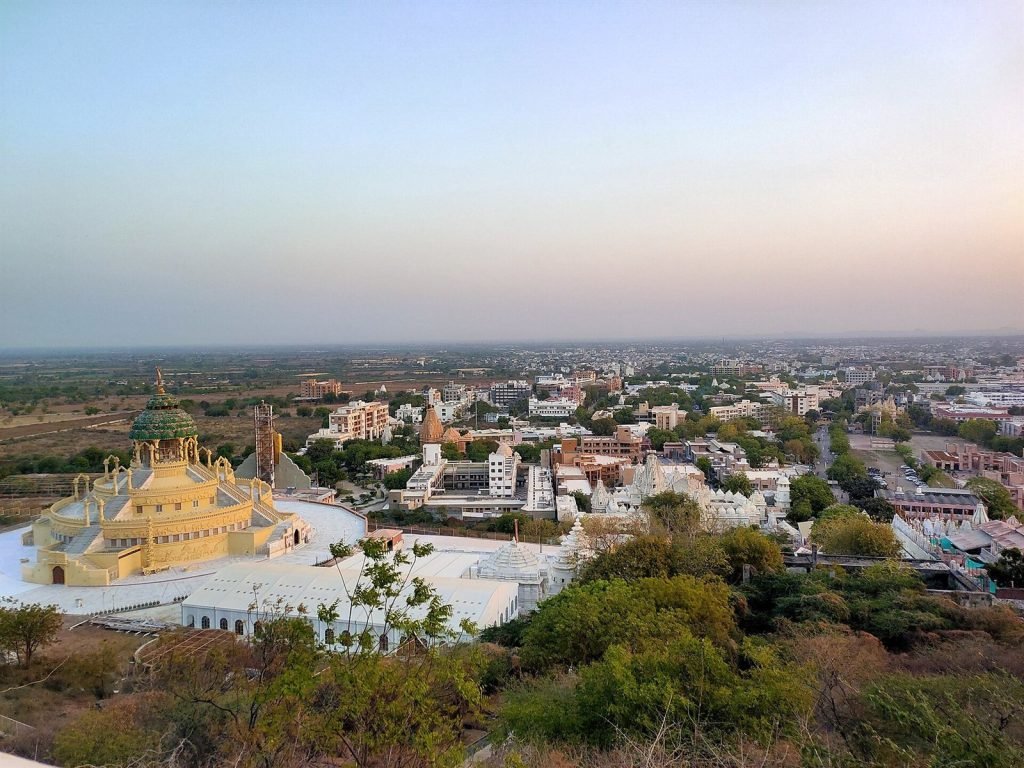
Shatrunjaya Summit
How to get there
The base of the climb sits at Palitana town, which is reached by road from Bhavnagar, the nearest city with rail and air links. From Bhavnagar you can take a bus or taxi to Palitana, then a short ride to the foot of the steps. From there the summit is on foot up the stairway, or by hired doli for those who need assistance.
Best time to visit Shatrunjaya Summit
The winter months of November to February make the long climb far more bearable, with cooler mornings and clearer views. Start before dawn to reach the top while it is still cool and to avoid the midday sun. Avoid the peak of summer and the monsoon, when heat, haze or slippery steps make the ascent harder.
Good to know
- Begin the climb very early to avoid heat and crowds.
- Carry water and light snacks, though remember food rules on the sacred hill.
- Wear sturdy, comfortable footwear that is easy to remove at shrines.
- Plan to be off the summit before it closes for the evening.
Frequently asked questions
How many steps are there to the top?
The stairway runs to several thousand steps, so it is a demanding climb best started at dawn.
Can I be carried up if I cannot walk?
Doli carrying chairs are usually available at the base, with charges agreed on the day.
Can I stay overnight at the summit?
No, the temples close in the evening and pilgrims descend, as no one remains on the hill overnight.
The marble city at the top
Shatrunjaya's summit is not a temple but a city of them: somewhere near nine hundred shrines crowd the twin peaks and the saddle between, gathered into nine walled compounds — the tuks — each a fortress of marble courts, spires and gates. Jain tradition ranks this the holiest of all its mountains: Adinath, the first Tirthankara, is held to have preached here, and the merit of pilgrimage to the summit is counted beyond any other shrine's.
The Adishwar (Adinath) temple in the largest tuk is the goal of every climber — sixteenth-century in its present form, on a site rebuilt through nearly a millennium of raids and restorations. Around it the compounds of the great merchant patrons — Motisha, the Chaumukhji with its four-faced image, Vimal Vasahi's line of successors — each reward wandering, and the crowds thin sharply beyond the main processional route.
Rules of the summit
The mountain's sanctity is enforced in ways visitors must know before climbing. No one — pilgrim, priest or tourist — remains on the summit overnight; everyone descends by evening, for the peak belongs to the gods after dark. Nothing is eaten on the mountain, leather goes no further than the base, and modest dress is expected throughout. Photography of the courts and skyline is generally accepted; the images themselves and worship in progress are not for cameras.
The summit views are the climb's secular reward: the Shetrunji river silvering the plain, Palitana town at the mountain's foot, and on clear winter days the Gulf of Khambhat's haze on the horizon.
Reaching it
There is one way up — roughly 3,500 stone steps from Palitana's base, two to three hours for most climbers, with doli chairs carried by licensed porters for those who need them. Predawn starts are universal in the pilgrim seasons: the stair is unshaded, the summit temples open with the morning, and the descent is best made before the afternoon heat.
November to February is the season; the mountain effectively closes to ascent during the monsoon's height. The great pilgrim occasions — the Kartik Purnima opening day above all, when tens of thousands climb — are extraordinary to join and slow to move in; ordinary winter weekdays give the marble city in near solitude.