
Region
Ahmedabad
Best time
October to March
Ideal duration
30 to 45 minutes
Good for
Architecture, photography, heritage
The Sidi Saiyyed Jali is among Ahmedabad's most celebrated pieces of stone craftsmanship, a delicate latticework window carved with an intertwining tree-and-vine motif. Part of the historic Sidi Saiyyed Mosque, the jali has become an unofficial emblem of the city, admired for the way it turns solid stone into something that looks almost woven.
Even a short visit leaves an impression. The sidi saiyyed jali is best appreciated up close, where you can trace the flowing curves and see how light filters through the pattern. Set in the busy heart of the city, it is a quick but memorable stop that fits neatly into any Ahmedabad heritage itinerary.
What to see and do at the Sidi Saiyyed Jali
The star attraction is the intricately carved lattice window itself, so take your time studying the tree-of-life design and photographing the way sunlight passes through it. The surrounding mosque provides the historic context for this famed piece of artistry.
Because the site is compact and central, it pairs well with nearby old-city landmarks. Observe local customs when visiting the mosque, dress modestly, and be mindful that it remains an active place of worship as well as a heritage attraction.
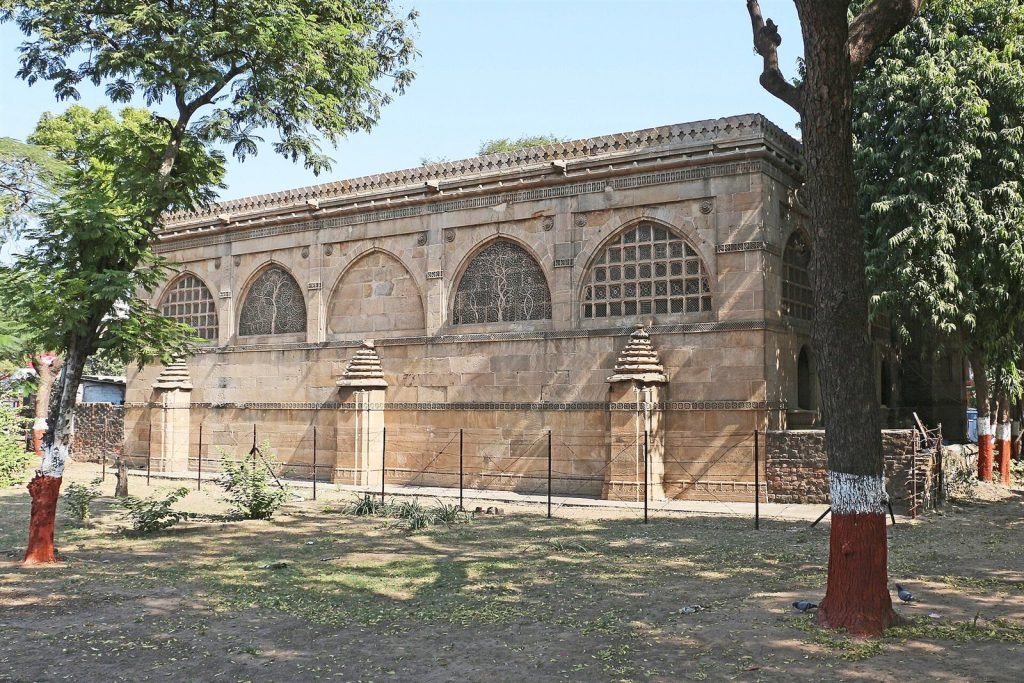
Sidi Saiyyed Jali
How to get there
The mosque sits in central Ahmedabad and is very easy to reach by auto-rickshaw, taxi or app cab. Its central position makes it a convenient starting or ending point for a heritage walk through the city.
Best time to visit
October to March is the most comfortable season. Daylight hours let you see the lattice at its best, as the changing angle of the sun brings the carved pattern to life.
Good to know
- Get close to appreciate the fine carving.
- Photograph the lattice with light behind it.
- Dress modestly at this active mosque.
- Combine with nearby central heritage sites.
Frequently asked questions
What is the Sidi Saiyyed Jali?
It is a famous carved stone lattice window at the Sidi Saiyyed Mosque in Ahmedabad, depicting an intricate tree-and-vine design.
Why is it so well known?
Its exquisite craftsmanship has made it an enduring symbol of Ahmedabad, widely reproduced and admired.
How long does a visit take?
Only about half an hour, which makes it an easy addition to a city heritage tour.
The jali that became a city's signature
The mosque was built in 1572-73, in the last years of the Gujarat Sultanate, by Sidi Saiyyed — a nobleman in the court of the final sultan, Muzaffar Shah III. Within a few years the sultanate had fallen to the Mughals, which makes this one of the last significant buildings of an independent Gujarat.
It is a modest mosque and nobody comes for its size. They come for ten stone lattice screens, and above all for the two on the western wall. Those two carry the tree of life: a palm rising out of the ground with creepers winding through and around it, the whole design cut from a single slab of stone in a way that looks woven rather than carved.
Why it is technically remarkable
Stone jalis are common across Indian architecture. What sets these apart is that the design is not geometric. Geometry can be laid out on a grid and repeated; an organic, asymmetrical tangle of branches and tendrils cannot. Every intersection had to be solved individually, in stone, with no margin for a mistake — one wrong cut and the slab is finished.
The result reads as filigree. Standing inside with the light coming through, the screen throws a moving pattern of leaves across the floor, and the sense that the stone has thickness at all more or less disappears.
The emblem
The tree-of-life jali has become the visual shorthand for Ahmedabad. It is the emblem of the Indian Institute of Management Ahmedabad, it appears on city signage and civic material, and it is reproduced on more souvenirs than anyone has counted. It also formed part of the case for Ahmedabad's inscription as India's first UNESCO World Heritage City.
Worth knowing before you arrive: the two celebrated jalis are on the western wall, and the arch that is most photographed is a different one. Look for the pair, not the single.
Visiting
The mosque sits on a traffic island near Lal Darwaza, surrounded on all sides by one of the busiest junctions in the city. The contrast is jarring and is part of the experience — you cross through traffic and then step into something very quiet.
It remains a working mosque. Entry is free. Visitors are generally welcome in the courtyard and outer area to see the screens, but access to the prayer hall is restricted, and restrictions apply to women in particular; ask rather than assume, and dress modestly. Avoid Friday afternoons and the five prayer times.
Come mid-morning or in the late afternoon, when low sun comes through the western screens and casts the pattern inside. Midday light is flat and the jalis lose most of their effect. Allow twenty minutes, and combine it with the Jama Masjid, Bhadra Fort and the Teen Darwaza, all within a short walk, or with a morning Heritage Walk through the pols.