
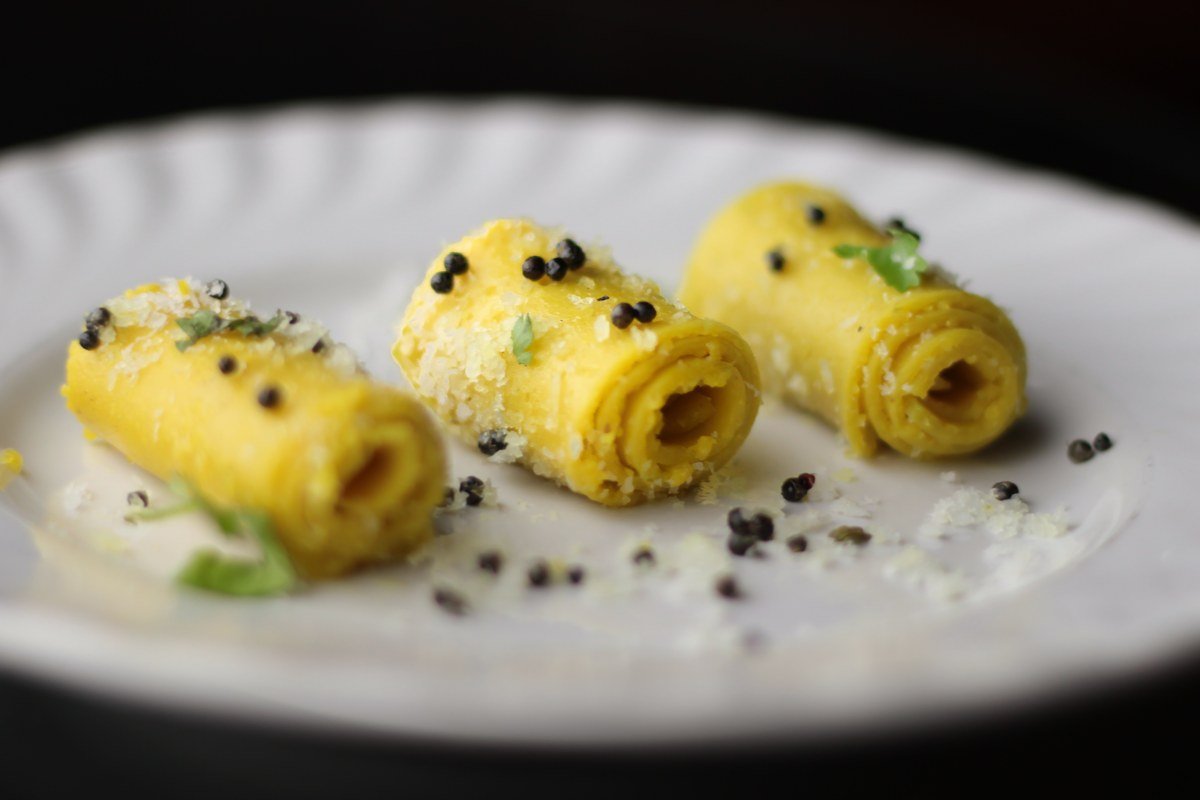
About Khandvi
Khandvi is a small marvel of technique: a batter of gram flour and buttermilk cooked into a thin, glossy sheet, then spread, rolled into tight bite-sized spirals and tempered with mustard seeds, sesame and curry leaves. The result is soft, silky and faintly tangy.
Getting the batter to the perfect spreadable consistency is the test of a good cook — too thick and it won’t roll, too thin and it won’t set. Done right, khandvi melts in the mouth and looks as elegant as it tastes.
Khandvi is the dish Gujarati cooks use to judge one another, because there is nowhere to hide. Gram flour is whisked with buttermilk, turmeric and salt into a thin batter and cooked over a low flame, stirred without pause, until it thickens to a paste that will set. Judging that moment is the whole skill: undercook it and the batter will not hold a roll, overcook it and it turns rubbery and refuses to spread.
The finished paste is spread in a thin sheet across the back of an oiled plate or a clean worktop while it is still hot, left for a minute to set, then cut into strips and rolled into tight cylinders. A tempering of mustard seeds, sesame and curry leaves goes over the top, with coconut and coriander scattered last. The result should be uniform, glossy rolls that hold their shape without a crease.
The story
Khandvi (also called patuli) is a classic of the Gujarati and Maharashtrian farsan repertoire, prized as a refined, light snack that shows off a cook’s skill with gram flour.
Key ingredients
How it's made
Cook the batter
Besan and buttermilk are cooked, stirring constantly, to a smooth paste.
Spread thin
The hot paste is spread paper-thin on a flat surface and cooled.
Roll
The set sheet is cut into strips and rolled into tight spirals.
Temper
Finished with a tadka of mustard, sesame, curry leaves and coconut.
How it tastes
Khandvi is savoury, faintly tangy from the buttermilk, and remarkable more for texture than for force of flavour. The rolls are silky and almost melting, thin enough to be translucent, and they carry the nutty warmth of sesame and the aroma of curry leaves from the tempering poured over them. Grated coconut and coriander add a fresh, cooling finish.
Where to eat it
Farsan shops sell khandvi by weight alongside dhokla and khaman, though it is made in smaller quantities because it is so much harder to get right. It is also very much a home dish, and the version made in a Gujarati kitchen by someone with practice is usually better than anything bought. Ahmedabad and Surat farsan houses are dependable places to try it first.
Worth seeking out
Classic Khandvi
Soft besan rolls with sesame tempering.
Patuli
A regional name and slightly firmer version.
Stuffed Khandvi
Rolled with a coconut or chutney filling.
Pairs well with
On the table
Khandvi belongs to the farsan tradition of light savoury snacks eaten between meals, and it turns up at tea time, on thalis, and at weddings and festive lunches where its neatness makes it a favourite for plated service. It is also popular as a starter, since it is light enough not to blunt an appetite for the meal that follows.
Foodie tips
Good to know
What is khandvi made of?
A cooked batter of gram flour (besan) and buttermilk, spread thin, set, and rolled into spirals, finished with a seed tempering.
Why is khandvi hard to make?
The batter must be cooked to exactly the right consistency and spread while hot — too thick or thin and it won't roll cleanly.
Is it spicy?
It's mild and silky, gently flavoured with ginger, green chilli and a sesame-mustard tempering.
Is khandvi healthy?
Yes — it's cooked rather than fried, light, and protein-rich from the gram flour and buttermilk.

WHERE TO STAY
Find your stay in Gujarat
Compare live prices across the big booking sites and reserve in a few taps. Booking happens securely on the partner's site — we may earn a small commission at no extra cost to you.
Book directly on our partner sites — tap a provider to see live Gujarat hotels & prices:
SHOP THE REGION
Bring home Gujarat — & travel essentials
Hand-picked crafts and trip gear, available on Amazon.