Best time
October to March
Ideal duration
2 to 4 days
Good for
Architecture, history, photography
Region
North and central Gujarat
A stepwell, or vav in Gujarati, is one of the most ingenious buildings the subcontinent ever produced. To reach water in a dry land, people dug not a simple shaft but a long descending corridor of steps, storey after storey, lined with carved stone. As you walk down, the air cools, the noise of the surface fades, and you arrive at a pool of water many metres below ground. Some are plain and practical; a few are among the finest carved structures in India.
Gujarat has the greatest concentration of the grand ones, built between roughly the 11th and 16th centuries by queens, merchants and rulers as acts of public generosity and religious merit. They were never just utilities. They were water temples, cool retreats, resting places on trade routes and, in the best cases, showcases of sculpture. This guide covers the ones worth travelling for and links them into a route you can drive in a few days.
Why Gujarat built downward
The logic is climate and geology. In a region of long dry seasons and deep groundwater, a vav let people reach water year-round while keeping it shaded and cool. The stepped design meant the community could descend to the water level even as it rose and fell through the year. Because building a stepwell was seen as a pious, charitable act, patrons poured money into carving them, turning function into art. Hindu and Jain imagery covers the older ones; the later Solanki and sultanate wells blend those traditions with Islamic geometry. Reading a vav means reading Gujarat's layered history in stone.
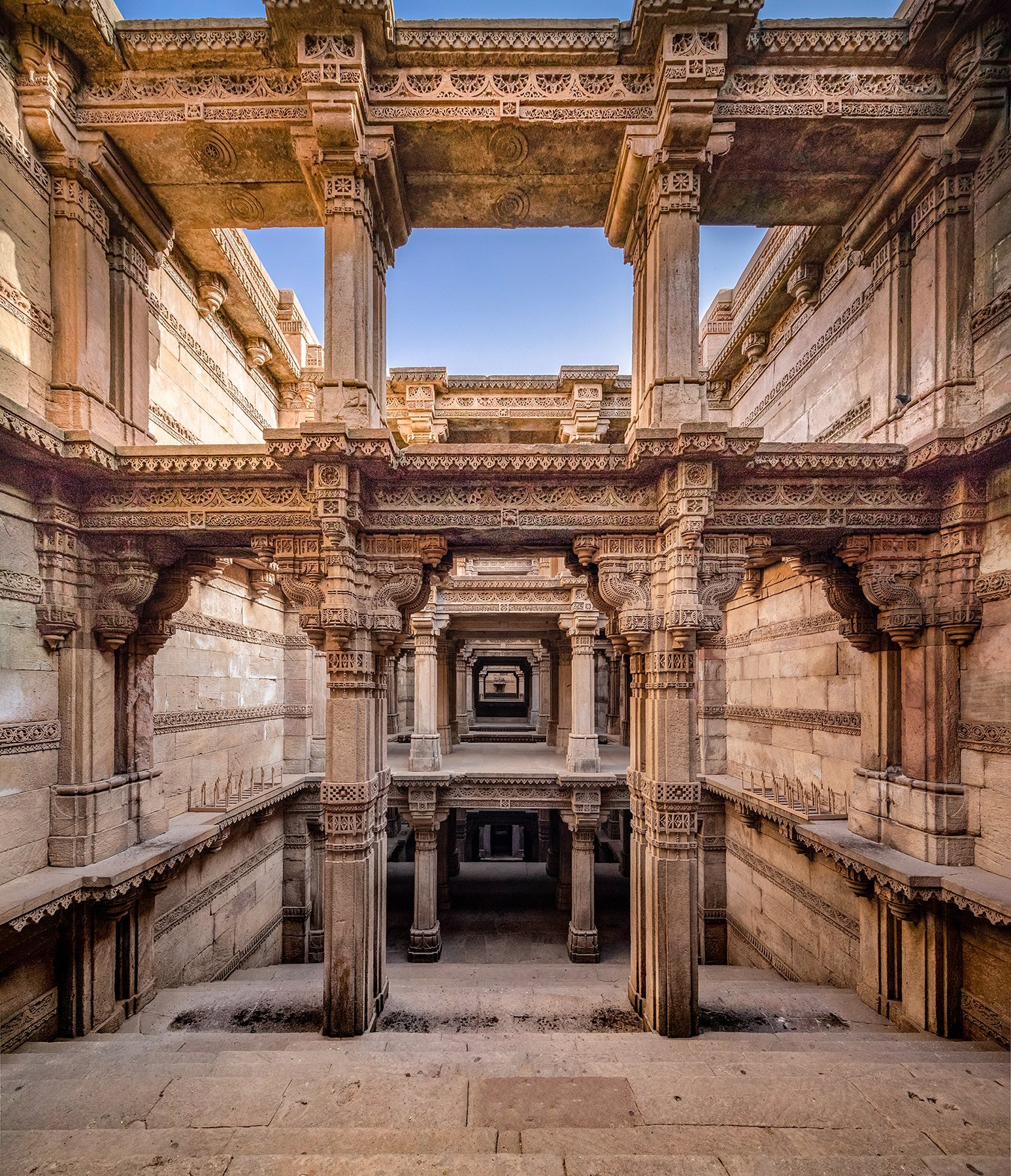
The Vikia Vav at Ghumli, a lesser-known stepwell that rewards travellers who venture into Saurashtra.
The stepwells worth travelling for
- Rani ki Vav, PatanThe masterpiece and a UNESCO World Heritage Site. Built in the 11th century as a memorial by a queen for her king, it descends seven storeys and is covered with more than 800 sculptures, including a celebrated series of Vishnu avatars. It even features on the Indian 100-rupee note. Unmissable.
- Adalaj StepwellThe most visited vav, just outside Ahmedabad. A five-storey octagonal well from the late 15th century, blending Hindu and Islamic motifs, with intricately carved pillars and platforms. Its accessibility and beauty make it the perfect introduction to the form.
- Dada Harir Stepwell, AhmedabadA sandstone well from the 1490s in the Asarwa area of Ahmedabad, built by a woman of the sultan's household. Five storeys deep with spiralling stairs and fine carving, and an easy stop within the city itself alongside its old mosque and tomb.
- Ghumli (Vikia Vav), SaurashtraA large, atmospheric and far less visited stepwell near the ruined town of Ghumli in the Barda hills. For travellers who want a vav without crowds, in wilder surroundings, this rewards the extra drive with scale and solitude.
- Helical stepwell, ChampanerWithin the UNESCO site of Champaner-Pavagadh sits an unusual helical or spiral stepwell, where the stairs wind down in a corkscrew rather than straight flights. It is a rare design and pairs with the wider archaeological park of mosques, temples and forts.
How to get around
Most of the great stepwells cluster in north and central Gujarat within reach of Ahmedabad, which makes a car the natural way to string them together. Adalaj is barely 20 kilometres north of the city, an easy half-day. Dada Harir sits inside Ahmedabad. Patan, home of Rani ki Vav, is about 125 kilometres northwest, roughly two and a half hours, and pairs well with the Patan patola weaving workshops and the nearby Modhera Sun Temple. Champaner is around 150 kilometres east near Vadodara. Ghumli is far out in Saurashtra and suits those already exploring that peninsula. Trains reach Patan and Vadodara, but a hired car gives the flexibility these scattered sites need.
Where to base yourself
Ahmedabad is the obvious hub. From the city you can reach Adalaj, Dada Harir, Patan and Modhera, and even Champaner, on comfortable day trips, returning each evening to a full range of hotels and the old city's heritage stays. If you would rather break the journey, Vadodara makes a good second base for Champaner and the eastern sites. For Ghumli and the Saurashtra wells, fold them into a wider peninsula trip and stay near Jamnagar or Dwarka. There is no need to sleep beside the wells themselves; they are best visited as daytime stops from a comfortable city base.
Best time to visit
The cool months from October to March are ideal. Stepwells are shaded and pleasantly cool inside even in warm weather, but the walk between sites and the open upper courtyards are far more comfortable in winter. Aim for morning light, when the sun angles down into the wells and lights the carvings without the harsh midday glare. Avoid the peak of summer, when the surrounding towns are punishing, and the monsoon, when lower storeys of some wells can flood and become inaccessible.
Practical tips
- Go early. Morning light reaches deepest into the wells and the sites are cooler and quieter before tour groups arrive, especially at Adalaj and Rani ki Vav.
- Watch your footing. Steps can be uneven, worn and slippery, and railings are minimal. Wear proper shoes rather than flip-flops.
- Hire a local guide at Rani ki Vav or Adalaj. The iconography of the sculptures, from the Vishnu avatars to the water goddesses, is easy to miss without one.
- Combine wisely. Patan pairs with Modhera Sun Temple and patola weaving; Champaner's helical well sits within a whole archaeological park worth a full day.
- Photography is allowed but bring a wide lens or use panorama mode, since the depth and scale of a vav are hard to capture in a single narrow frame.
Frequently asked questions
What is a stepwell or vav?
A vav is a well reached by a long descending staircase rather than a rope and bucket, letting people walk down to the water. In Gujarat many were richly carved and served as cool retreats and water temples, not just utilities.
Which is the most famous stepwell in Gujarat?
Rani ki Vav in Patan, a UNESCO World Heritage Site from the 11th century with over 800 sculptures. It is considered the finest stepwell in India and appears on the 100-rupee note.
Can you visit Adalaj and Rani ki Vav in one trip?
Yes. Adalaj is just north of Ahmedabad and Rani ki Vav is about two and a half hours away in Patan, so both fit comfortably into a short two or three day stepwell circuit by road.
Why were stepwells built in Gujarat?
To reach and store groundwater in a dry climate while keeping it cool and shaded, and as charitable, religious acts by patrons. Their spiritual and social role led to the elaborate carving seen today.
Stepwells are architecture you experience by descending, storey by storey, out of the heat and into carved silence. Start with Rani ki Vav for the grandeur, add Adalaj and Dada Harir for the ease, and push out to Ghumli or Champaner for the wells few travellers reach. Together they tell the story of how Gujarat turned the simple need for water into some of India's most beautiful buildings.