Best time
October to March, early morning
From Ahmedabad
About 125 km, 2.5 hours
Status
UNESCO World Heritage Site, 2014
Time needed
One to two hours
Rani ki Vav at Patan is the finest stepwell ever built and one of the most remarkable buildings in India — seven storeys of carved sandstone descending into the ground, with over five hundred principal sculptures arranged across its tiers. It was commissioned in the eleventh century by Queen Udayamati of the Chaulukya dynasty in memory of King Bhimdev I, buried for centuries under the silt of a shifting river, excavated by the Archaeological Survey of India, and inscribed by UNESCO in 2014. It appears on the hundred-rupee note.
It is also entirely invisible until you are inside it, which changes how you should plan a visit: this is a building to descend slowly rather than photograph from a distance. This guide covers timings and tickets, when the light is right, what to look for on the way down, and how to combine Patan with Modhera into the best single day of heritage in Gujarat.
Why Rani ki Vav is exceptional
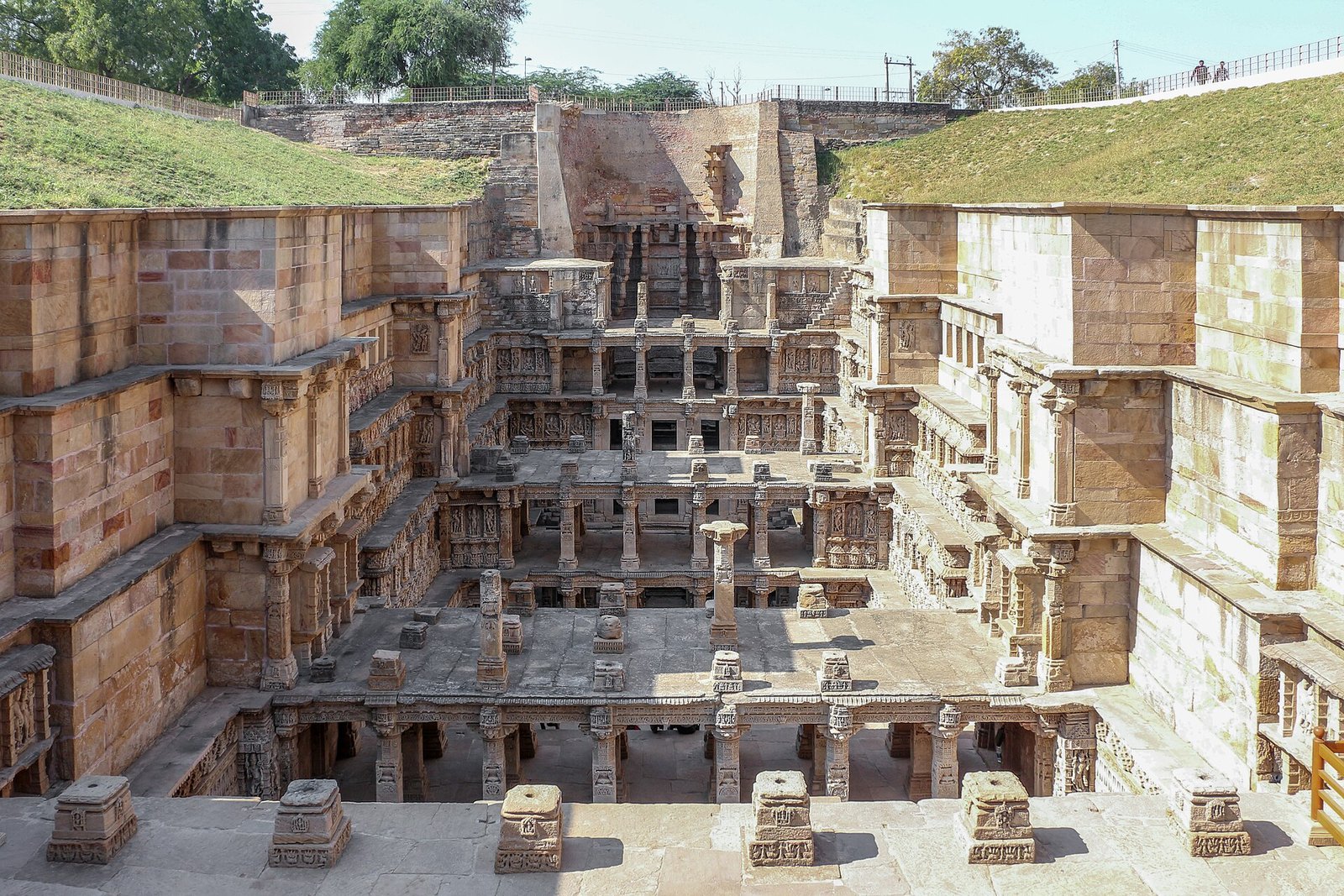
Because of the sculpture, and because of why it survived. The vav runs about 65 metres long and steps down through seven levels of pavilions to a well shaft, with more than five hundred major figures and many hundreds of minor ones organised as a religious programme rather than as decoration — Vishnu's ten avatars, Vishnu reclining, Shiva, Brahma, Ganesha, Surya, Mahishasuramardini, and registers of apsaras and nagakanyas engaged in ordinary human acts: applying kohl, dressing hair, holding a mirror, playing with a child.
That carving is unusually crisp for the eleventh century, and the reason is the burial. The Saraswati river shifted and flooded, and over the centuries the vav filled with silt, destroying the upper pavilions but sealing everything below from weather and from the iconoclasm that fell on temples across the region. What the ASI uncovered in the twentieth century, with the major work completed in the 1980s, was in far better condition than anyone had reason to expect. It was also declared India's cleanest iconic place in 2016, which anyone who has visited a major Indian monument will recognise as genuine praise.
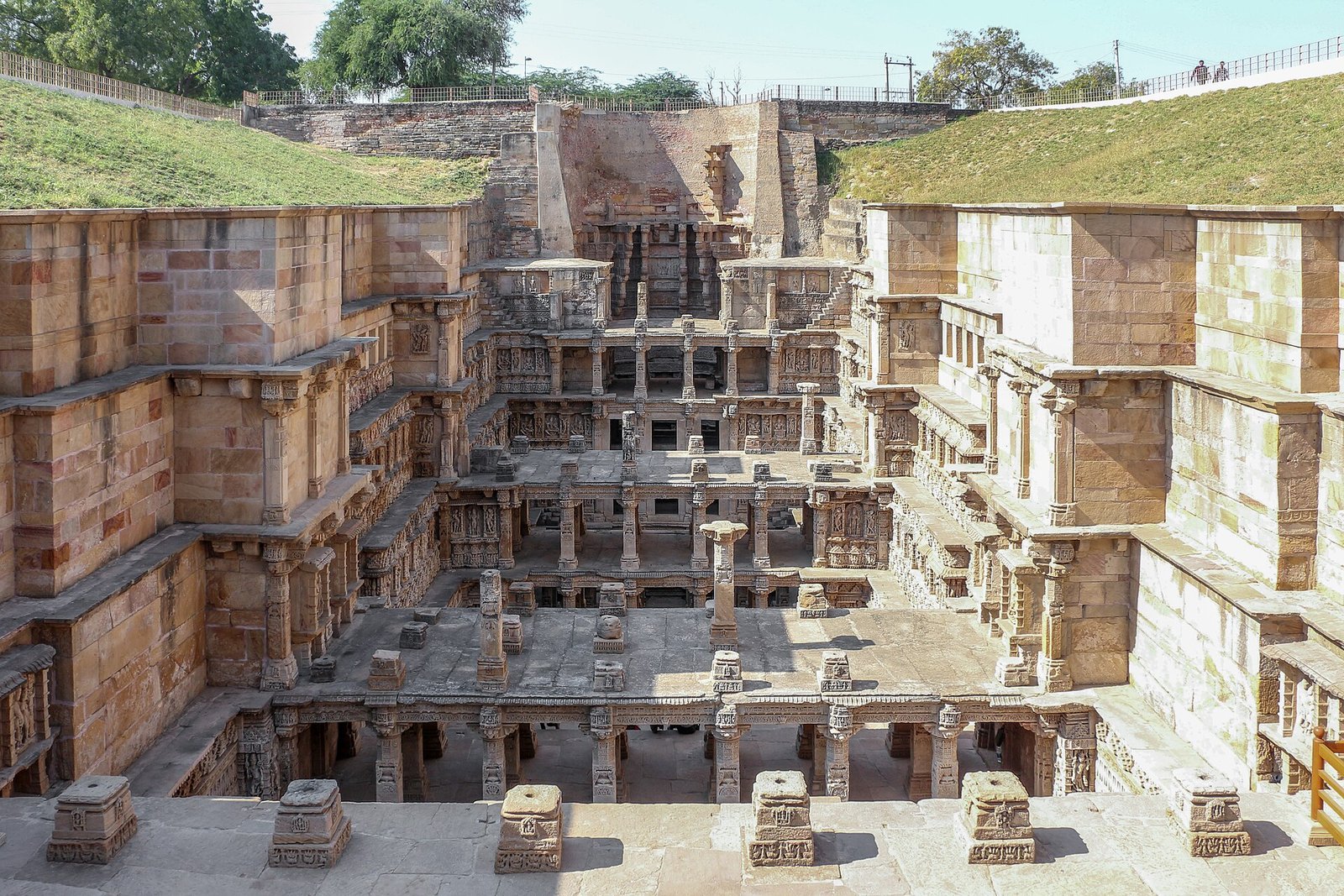
Seven levels down, and the best view is the one looking back up.
How to visit, step by step
- Arrive at opening timeSoft early light reaches down the tiers, the temperature underground is pleasant, and you may have the lower levels to yourself. Midday contrast between the lit top and dark bottom is very hard to photograph.
- Buy the ASI ticket at the gateRani ki Vav is an Archaeological Survey of India monument with separate Indian and foreign national rates, and there is a small camera charge in some seasons. Check the weekly closure day locally.
- Walk down slowly, level by levelThe building is designed as a sequence. Rushing to the bottom and back defeats it. Stop on each landing and look at the side galleries, not just straight ahead.
- Look for the marquee panelsThe Dasavatara sequence, Vishnu reclining on Sheshnag, and the apsara and nagakanya registers with their everyday gestures. These are the carvings people travel for.
- Look back up from the bottomSeven levels of pillars receding towards a bright rectangle of sky. It is the best single view in the monument and most visitors miss it because they are facing the well.
- Add the rest of PatanThe Patan Patola Heritage museum and a weaving family for double-ikat silk, plus the ruined eleventh-century Sahastralinga Talav water tank and the old town's Jain temples.
How to get there
Patan is about 125 km from Ahmedabad, a comfortable two and a half hours by road, and roughly 55 km from Mehsana. Patan has a railway station with services from Ahmedabad and Mehsana, and buses run frequently, so public transport is workable — but most visitors come by car because the near-obligatory pairing with Modhera, 35 km away, is awkward otherwise.
The nearest airport is Ahmedabad. Within Patan, the stepwell is a short auto-rickshaw ride from the town centre and station. If you are driving a north Gujarat circuit, Patan sits naturally with Modhera to the south, Sidhpur 25 km east, and Vadnagar and Taranga further round.
Where to stay
Patan has a modest range of hotels, and staying there has one clear advantage: you can be at the stepwell when it opens, which is the single best decision you can make about this visit. It also lets you spend an unhurried afternoon with the Patola weavers, which is worth doing properly rather than in twenty minutes.
Mehsana, 55 km south, has more choice of functional mid-range hotels and is the standard base for the wider circuit. Ahmedabad, two and a half hours away, has everything and works if you are prepared to leave very early. For the best bed in the region, Balaram Palace near Palanpur is about 90 km north. Many people do Modhera and Rani ki Vav as one long day from Ahmedabad, which works but means arriving at Patan in harsh midday light.
Best time to visit
October to March, and early in the day. The stepwell's interior stays cooler than the surface year-round, but you still have to cross open ground to reach it, and Patan's afternoons from April onwards are punishing. December and January give cold mornings, clear air and the softest light down the tiers.
Mornings matter more than months here. The vav is a deep, narrow, top-lit space, and the difference between eight in the morning and one in the afternoon is the difference between readable carving and a high-contrast mess. Late afternoon is a decent second option. The monsoon is atmospheric and the surrounding country is green, but overcast light in a dark stepwell means you will see less than you hoped.
Practical tips
- Be at the gate when it opens — for the light, the temperature and the near-solitude on the lower levels.
- Check the ASI weekly closure day and current ticket and camera charges before travelling.
- Look into the side galleries as you descend; the finest carving is off the central axis.
- From the lowest level, turn around and look up. Most visitors never do.
- Pair it with Modhera Sun Temple, 35 km away, and give Patan's Patola weavers a proper afternoon.
Frequently asked questions
Who built Rani ki Vav?
It was commissioned in the eleventh century by Queen Udayamati of the Chaulukya (Solanki) dynasty, in memory of her husband King Bhimdev I.
Why is Rani ki Vav so well preserved?
It was buried under silt from the shifting Saraswati river for centuries, which destroyed the upper pavilions but protected the sculpture below from weathering and iconoclasm.
How far is Rani ki Vav from Ahmedabad?
About 125 km, roughly two and a half hours by road. Modhera Sun Temple is 35 km from Patan and almost always visited on the same trip.
Is Rani ki Vav on the Indian currency?
Yes, it features on the hundred-rupee note. It has been a UNESCO World Heritage Site since 2014.
How long do you need at Rani ki Vav?
One to two hours for an unhurried descent. Add half a day for Patan's Patola weaving and Sahastralinga Talav.
Rani ki Vav rewards two decisions: arrive when it opens, and go down slowly. Do both and you get seven storeys of eleventh-century sculpture in soft top light, five hundred gods and apsaras arranged as a programme you descend through like a text, and — from the lowest step, looking back — the best view in Gujarat. Pair it with Modhera, stay in Patan, and give the Patola weavers your afternoon.