Something like four million people a year go to Kevadia in Narmada district to look at the Statue of Unity, the 182-metre figure of Sardar Patel that stands beside the Sardar Sarovar dam. Almost all of them arrive, photograph it, ride the lift, buy something and leave. Very few of them drive twenty minutes further into the hills behind it, which is a shame, because that is where the good part is.
Behind and around Kevadia lies the Shoolpaneshwar Wildlife Sanctuary — roughly six hundred square kilometres of hill forest running along the Narmada and up into the Satpura foothills, with sloth bears in it, a community-run eco-campsite, and a waterfall called Zarwani that after the monsoon becomes one of the loveliest places in Gujarat. It is the same day trip. It is a completely different experience.
The waterfall
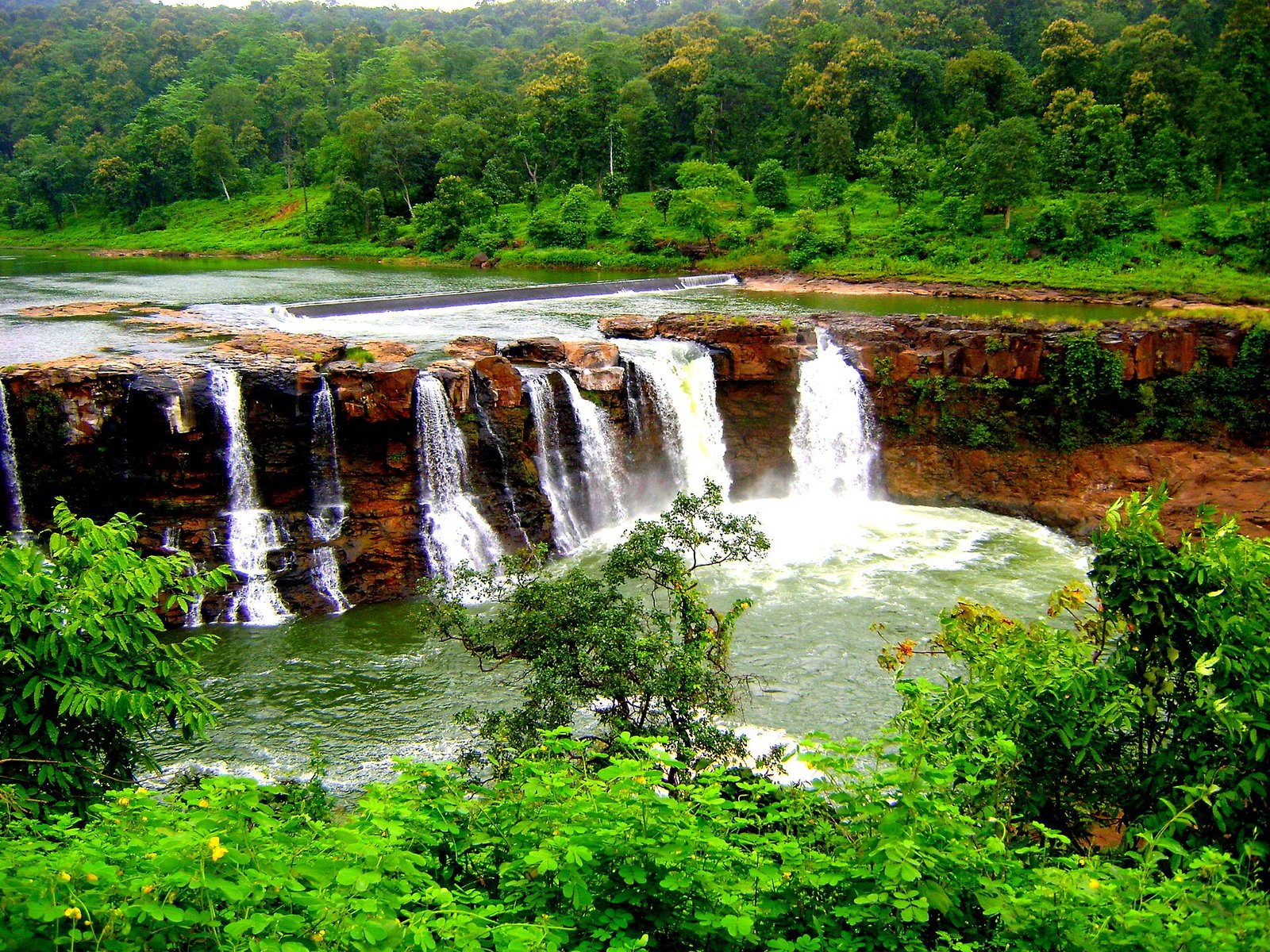
Zarwani is not a single sheer drop but a stepped cascade — water coming down through a series of ledges and pools in a natural amphitheatre of rock, hemmed in by trees. That structure is what makes it good to be at rather than merely to photograph: there are pools to sit beside, rock shelves to scramble over, and a sequence of levels rather than one viewpoint. In full flow after heavy rain it is loud and cold and thoroughly convincing.
Getting to it involves a short walk from the eco-campsite along a forest path, crossing the stream in places, on rock that is wet and can be genuinely slippery. This is not a paved viewing gallery. Footwear with grip matters, and so does a willingness to get your feet wet. In the peak of the monsoon the flow can be strong enough that the authorities restrict access on safety grounds, and that restriction should be respected — people have drowned at waterfalls across Gujarat and Maharashtra doing exactly the thing that seems fine until it is not.
The season is the crucial thing. Zarwani depends entirely on rain. From July, once the monsoon is properly established, through to about October, it runs well. By December it is reduced, and through the hot months it is a trickle or nothing. If the waterfall is the reason you are going, come between late July and mid-October — and specifically towards the end of that window, from about mid-September, when the water is still strong but the tracks have begun to dry and the leeches have thinned out.
A stepped cascade in a wooded amphitheatre, twenty minutes past the world's tallest statue.
Sleeping in the forest
The best thing about Zarwani is not the waterfall, it is the eco-campsite beside it. Run under the Gujarat forest department's eco-tourism programme in partnership with local communities, it offers simple tented and hut accommodation inside the sanctuary, with meals provided and local guides available. It is not luxurious. What it is, is quiet — properly quiet, in a way that the hotel strip at Kevadia twenty minutes away is emphatically not.
Twenty minutes from four million visitors a year, you can sleep in a tent inside a sloth bear forest and hear nothing at all
Staying overnight also unlocks the sanctuary, because the hours that matter for wildlife are the ones you cannot reach on a day trip from Kevadia. Dawn and dusk are when sloth bears move, when the birds are loudest, when leopard and hyena are conceivably about. Shoolpaneshwar holds one of Gujarat's better sloth bear populations, along with leopard, striped hyena, four-horned antelope, barking deer and pangolin, and while sightings are entirely a matter of luck, being in the forest at the right hour at least gives luck something to work with.
Book ahead. The campsite is small, it is popular with Ahmedabad and Vadodara weekenders in the monsoon-green season, and it is administered by the forest department rather than by an online booking engine, which means a phone call and some patience. Weekends from August to October are the busiest period by a wide margin; midweek in late September is close to perfect.
The sanctuary around it
Zarwani is one corner of something much larger. Shoolpaneshwar takes its name from an ancient Shiva shrine and covers hill forest, river gorge and reservoir backwater along the Narmada, continuing east into Madhya Pradesh as a contiguous ecosystem. There are tribal villages inside and around it, forest roads that go a long way into the hills, smaller streams and cascades, and stretches where you will not see another vehicle for an hour.
It is not organised as a safari destination and it would be misleading to describe it as one. There are no jeep fleets, no fixed circuits, no sighting economy. Access to particular zones is controlled by the forest department and varies, and the interior tracks can be rough or seasonally impassable. What that means practically is: talk to the forest department, take a local guide, set your expectations towards forest and birds rather than mammals, and treat any sloth bear as an extraordinary bonus.
Doing it alongside Kevadia
The geography makes this easy. Kevadia is roughly 90 km from Vadodara, which has an airport and a major railway station, and Kevadia now has its own station with direct services. Bharuch and Ankleshwar, on the main Mumbai–Delhi corridor, are 70 to 80 km away. The roads around Kevadia have been substantially upgraded to carry Statue of Unity traffic, so getting there is straightforward; a hired car is essential once you are in the area.
The sensible itinerary gives each half its own time. Do the Statue of Unity, the dam viewpoint and whichever of the Kevadia attractions you actually want — the Valley of Flowers, the jungle safari park, the cactus garden — on one afternoon, then move into the forest for the night and give the following morning to Zarwani and the sanctuary. Add Rajpipla, the old princely capital about 30 km away, and Garudeshwar's ghats on the Narmada, and you have a genuinely varied two or three days out of what most people treat as a half-day photo stop.
If you go
- Come between late July and mid-October for water, with mid-September onwards the best compromise of flow, drying tracks and fewer leeches.
- Book the forest department eco-campsite well ahead, especially for monsoon-season weekends, and expect a phone call rather than an app.
- Wear shoes with grip and accept wet feet; the approach crosses the stream on slippery rock.
- Respect any access restriction on the falls in heavy flow — this is a genuine safety issue, not officiousness.
- Stay overnight to get dawn and dusk in the sanctuary, and take a local guide for the forest roads.
Zarwani is the answer to the most common complaint about Narmada district — that there is nothing to do there except look up at a statue. Twenty minutes past the crowds, a stepped waterfall runs through a wooded amphitheatre in a six-hundred-square-kilometre sloth bear forest, and you can sleep beside it in a tent for very little money. Come in late September, book the campsite ahead, bring shoes with grip, and give the forest a dawn.