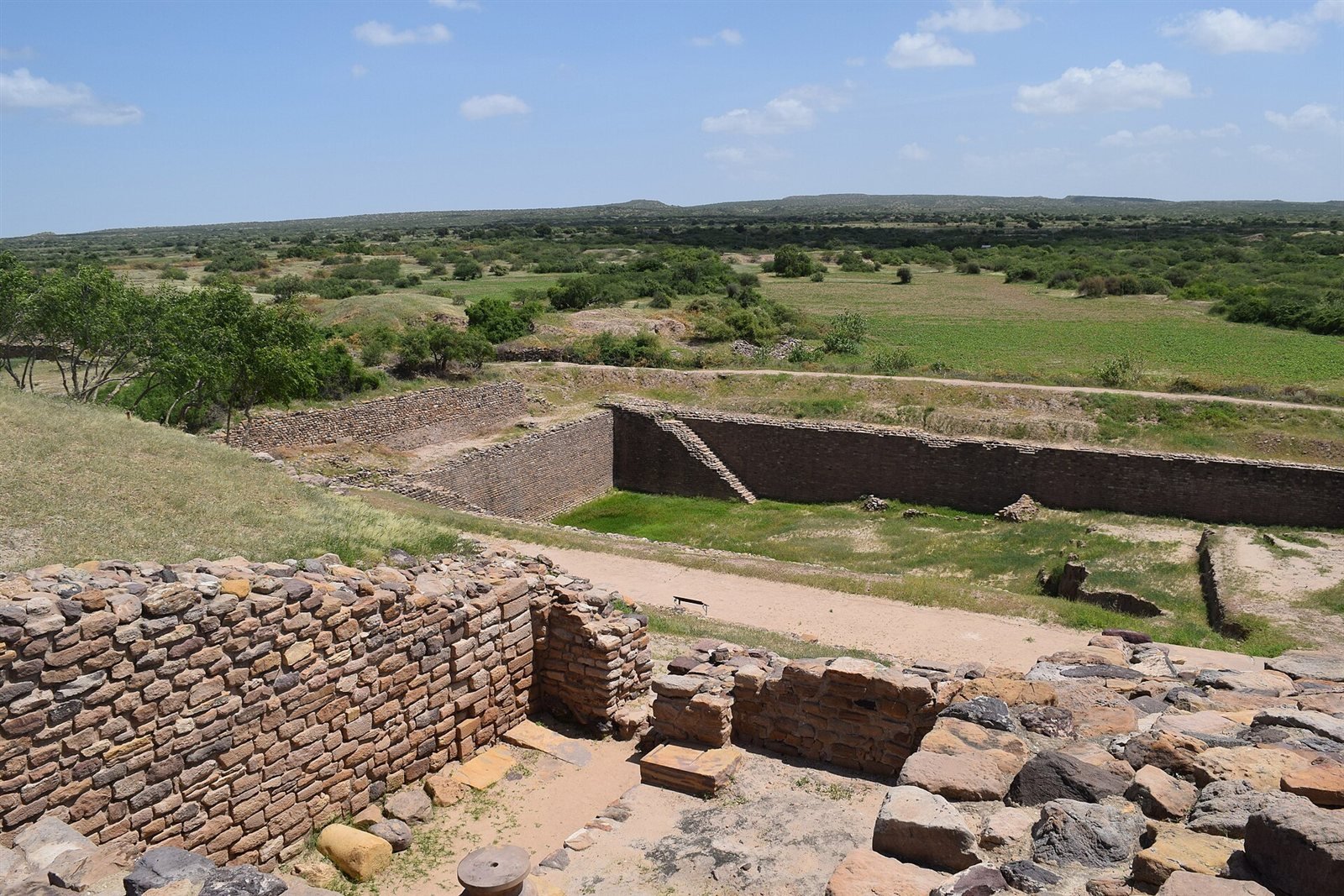
An hour and a half south-west of Ahmedabad, past the sugarcane and the salt flats of the Bhal, the road runs out at a village called Saragwala and you find yourself looking at a rectangle of baked brick the size of two football pitches. It is sunk into the earth, its walls still true after four and a half thousand years, and if the archaeologist who dug it was right, ships once tied up here to load cotton and carnelian for the Persian Gulf. Lothal is the smallest of the great Harappan cities and, in its quiet way, the most astonishing.
Where Dholavira impresses by scale and Mohenjo-daro by uniformity, Lothal is about trade. This was a workshop and a warehouse town, a place of bead-makers and weights and measures and stamped seals, plugged into a maritime network that reached Mesopotamia. It is also the most accessible Harappan site in India — close enough to Ahmedabad for a comfortable day trip — and it is about to become a great deal better known, because a vast National Maritime Heritage Complex is rising beside the ruins.
The argument about a rectangle of brick
The dock is what everyone comes for. It is a trapezoidal basin roughly 214 metres long and 36 metres wide, lined throughout with kiln-fired brick, with an inlet channel at one end and what looks convincingly like a spillway with a sluice at the other. S. R. Rao, who excavated Lothal for the Archaeological Survey of India between 1955 and 1960, interpreted it as a tidal dockyard: boats entering on the high tide from a former channel of the Sabarmati, the sluice holding the water in as the tide dropped, so vessels could stay afloat and be unloaded onto the adjacent warehouse platform.
Not everyone agrees, and it is worth knowing that. A minority of archaeologists have argued the basin is an irrigation reservoir or a water tank, pointing out that the sea is now some twenty kilometres away and that a dock this far inland would need a reliable navigable channel. The counter-argument is the brick lining — nobody fires that many bricks to waterproof a farm tank — plus the warehouse, the seals and the sheer weight of imported and exported material found on site. The consensus still leans strongly towards Rao, and standing on the rim, looking at the inlet and the spillway, it is not hard to see why.
Either way, the debate is part of the pleasure of the place. Lothal is not a site that hands you a finished story; it hands you a very large, very deliberate structure and a set of arguments about what people were doing here when the pyramids at Giza were already old.
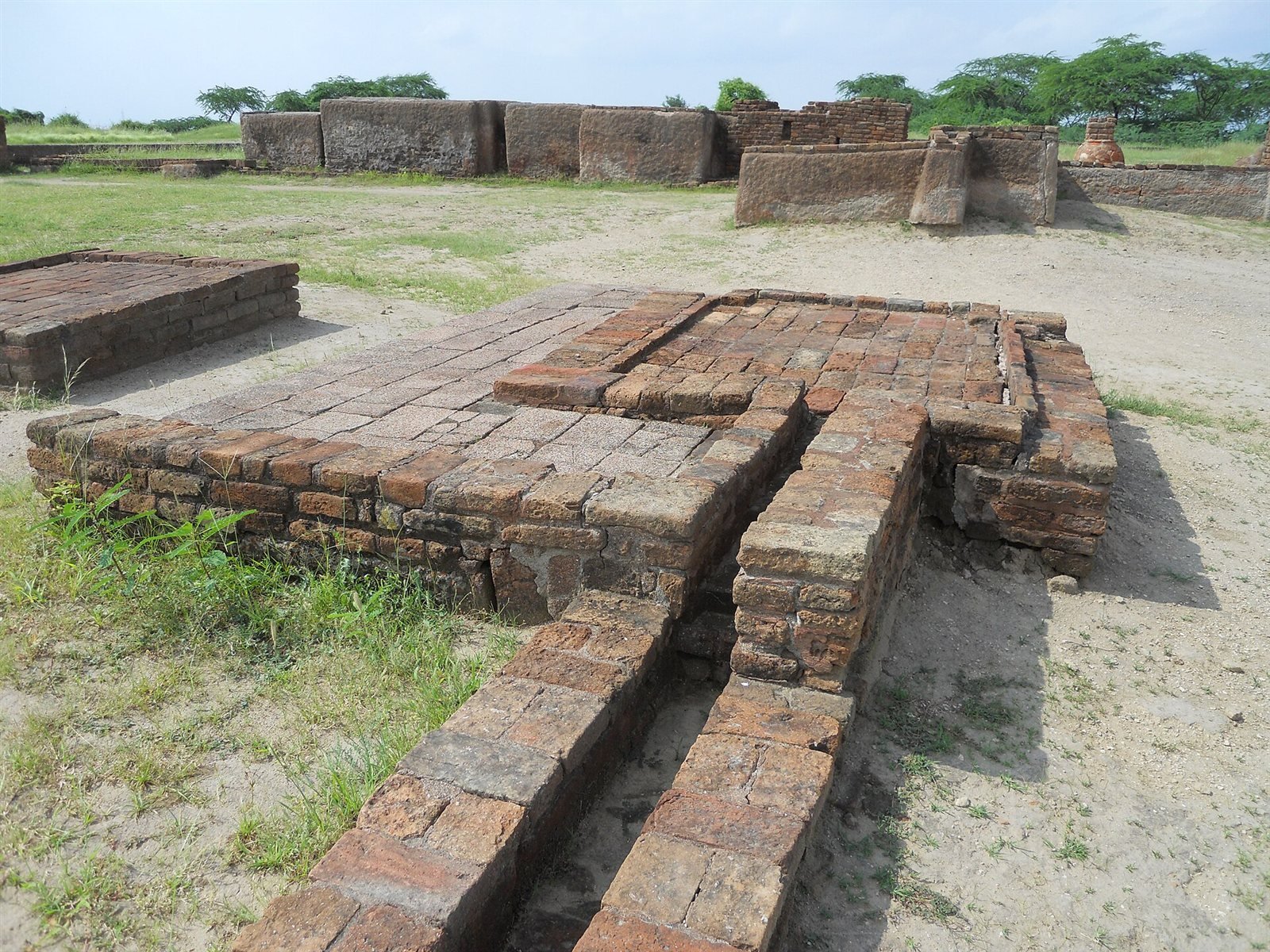
The great brick basin at Lothal — read by its excavator as the earliest known dock in the world.
A town that made beads for the world
Beside the basin sits a platform of mud-brick blocks separated by narrow channels — the warehouse, where goods waiting for shipment were stacked clear of flood water. Sixty-five clay sealings were found here, several of them still carrying the impressions of the reed matting and cord that had once been wrapped around bales. They are, in effect, four-thousand-year-old shipping labels, and they are the strongest single piece of evidence that this was a place where cargo was checked, sealed and dispatched.
Sixty-five clay sealings still marked with the print of the cord that tied the bales — four-thousand-year-old shipping labels
Lothal's other industry was beads, and it was very good at it. Excavators uncovered a bead factory with furnaces, raw carnelian, agate and steatite, unfinished blanks and drills, and the extraordinary long barrel-shaped carnelian beads that turn up in royal graves at Ur in Mesopotamia. Making them required heat-treating the stone to bring out the red, then drilling a hole through several centimetres of quartz with a specialised stone drill bit — a technology the Harappans appear to have invented and more or less monopolised.
Add a copper-smith's workshop, a fine set of standardised stone weights, an ivory workshop and a Persian Gulf seal found on site, and the picture sharpens: a compact, specialised industrial town on the edge of a shallow sea, converting raw stone and metal into high-value goods and sending them west. It also had a proper Harappan drainage system, a bath, a warehouse, an acropolis for the administrators and a lower town for everyone else — the full urban package, at a tenth of the size of the big cities.
What survives, and what to expect
Be prepared: Lothal is a site for the imagination rather than the eye. What you see is a low, sunburnt grid of mud-brick foundations, knee-high walls, the great brick basin and a series of interpretive signs. There are no standing buildings, no carvings, no photogenic silhouette. Visitors who arrive expecting temple architecture come away puzzled; visitors who arrive having read a little about the Indus Valley come away thrilled. The difference is entirely in the preparation.
The ASI museum on site is small but genuinely important, and you should do it first rather than last. It holds beads, seals, weights, painted pottery, terracotta figures, a famous terracotta of a bird and the tools of the bead-drillers, and it puts the flat ground outside into three dimensions. An hour there followed by an hour outside is a much better visit than the reverse.
A day trip from Ahmedabad — and a big change coming
Lothal is around 80 km from Ahmedabad, an easy 90 minutes by road via Dholka, which makes it the one Harappan city you can see comfortably between breakfast and a late lunch. The classic pairing is with Utelia, a nearby village with a small palace, or with a swing further south to Velavadar's blackbuck grasslands. Go in the cool months, arrive early, and bring water and a hat, because the site is entirely exposed.
The larger news is that Lothal is being rebuilt around. The Government of India is developing a National Maritime Heritage Complex on land beside the ruins — museums, galleries, a recreated Harappan township and a maritime research institute — intended to become one of the country's major heritage attractions. Construction has been under way for several years. If you want to see Lothal as a quiet, dusty archaeological field with the wind moving over it and almost nobody else there, the window for that is closing.
If you go
- Visit between October and March, and start early — the site is completely shadeless and gets fierce by mid-morning from February onward.
- Do the ASI museum first. Lothal is low walls and foundations, and the museum is what turns them back into a working town.
- Read a page about the Indus Valley Civilisation before you go. This is a site that rewards context far more than it rewards a camera.
- Combine it with Utelia village or push on south to Velavadar Blackbuck National Park to make a full day out of Ahmedabad.
- Check the status of the National Maritime Heritage Complex before travelling, as construction nearby can affect access and the character of the visit.
Lothal will never be the most spectacular ruin in Gujarat. It is a field of low brick in a hot, flat landscape, and it asks you to do some of the work. But it is also the place where a Bronze Age civilisation built what may be the first dock in human history, where craftsmen drilled carnelian beads that ended up in Mesopotamian tombs, and where sixty-five lumps of clay still carry the imprint of the rope that tied the cargo. For 80 km out of Ahmedabad, there is nothing else in India quite like it.