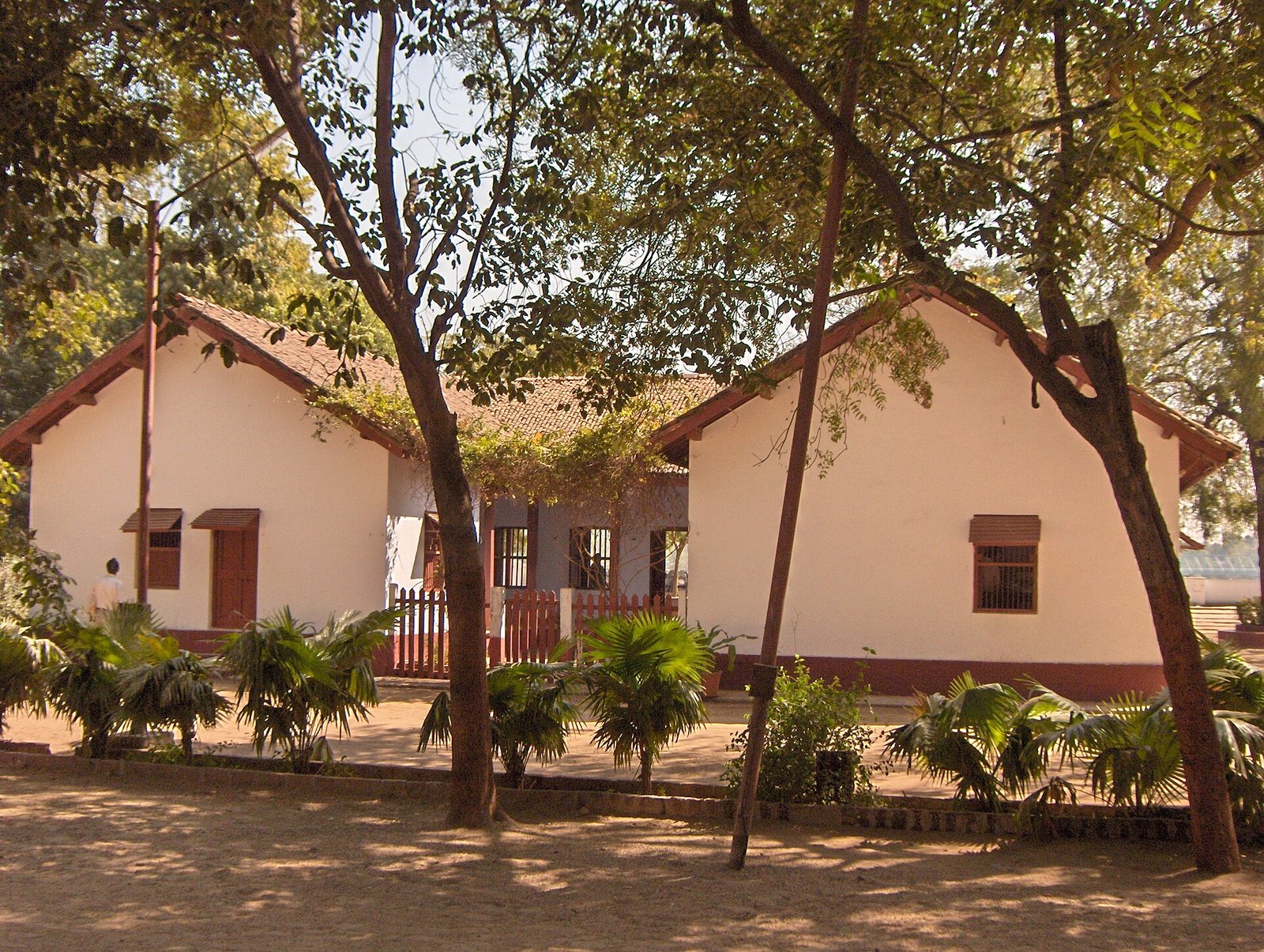
At about eight in the morning, a small group gathers at a temple in the old city of Ahmedabad and walks for two hours through lanes that get progressively narrower, into courtyards that open unexpectedly off them, past carved wooden house fronts and communal bird feeders, and finally out into the enormous courtyard of a fifteenth-century mosque. It is the best two hours available anywhere in Gujarat and it costs very little.
The Ahmedabad heritage walk has been running for decades, and it exists because the walled city is not a collection of monuments but a working urban fabric that is almost impossible to read without a guide. In 2017 that fabric was inscribed by UNESCO as the Historic City of Ahmedabad, India's first World Heritage City, and the citation was for exactly this: not individual buildings but a six-hundred-year-old living settlement pattern.
What a pol actually is
The walled city is organised into pols — dense residential clusters, each entered through a gateway, containing anything from a few houses to several hundred, arranged along internal lanes around shared courtyards and a common well or water source. They were organised by caste, community, trade or sect, and they functioned as self-governing units with their own management, gates that closed at night, and a strong sense of collective identity.
The design is defensive and social at once. A pol typically has one main gateway and a limited number of narrow exits, some of them deliberately concealed — connecting doors between houses and secret passages between pols, which allowed residents to move across the quarter and escape during riots or attacks without entering the street. Guides will show you these, and they are the detail that visitors remember.
The houses themselves are the other revelation. The old Ahmedabadi haveli is timber-framed with elaborately carved wooden brackets, columns, balconies and door frames, built around an internal courtyard or light well called a chowk that ventilates the whole structure — an entirely rational response to a hot dry climate, worked out over centuries and executed with enormous decorative confidence. Many are decayed; some have been beautifully restored, and a few operate as heritage hotels or homestays.
Carved timber, shared courtyards, secret connecting doors and bird feeders — the pol is the unit of the old city.
Chabutro, and what the walk shows you
The most charming feature of the pols is the chabutro — a communal bird feeder, raised on a carved column with a platform and a small roof, standing in a courtyard or at a junction, where grain is put out daily. They are a Jain and Hindu institution rooted in the principle of feeding other creatures, they are often beautifully made, and they are still in use. A pol without a chabutro is unusual.
Concealed doors between houses, so a whole quarter could move without entering the street
A standard walk threads a route of some twenty stops through the pols between a temple and the Jama Masjid, taking in Hindu temples, Jain derasars, mosques and dargahs within a few hundred metres of each other — which is itself one of the points being made, since the old city's communities have historically lived in close proximity. There are carved facades, courtyards, wells, a few restored houses, occasional glimpses inside, and a running commentary on how the whole system worked.
The walk typically ends at the Jama Masjid, completed in the fifteenth century under Ahmed Shah, the sultan who founded the city — a vast hypostyle hall with hundreds of carved pillars, a broad courtyard and a facade of real quality, built partly with material from earlier temple structures, as was common. From there you are a few minutes from Manek Chowk, the Teen Darwaza gateway and Bhadra Fort, all of which repay a further hour.
Practicalities of doing it
Walks generally start early in the morning, run for around two hours, and are conducted in English and Gujarati by trained guides; the long-running official walk is organised through the municipal corporation and starts from Swaminarayan Mandir at Kalupur, and a number of independent operators run alternatives and specialist variants. Book ahead where you can, particularly in the winter season, and check the current start point and timing rather than relying on old information.
Wear comfortable shoes, carry water, and dress modestly — you will be entering temples and a major mosque, so shoulders and knees covered and shoes removable. Photography of buildings is fine; photography into courtyards and homes is not, and asking before photographing residents is basic decency in what is a densely inhabited residential area. Guides handle this well and following their lead is the simplest approach.
What to do with the rest of the day
The walk is a beginning rather than a complete visit. Sidi Saiyyed's Mosque, with the celebrated stone jali of an intertwined tree that has become Ahmedabad's emblem, is a short distance away. Dada Harir Vav at Asarwa is a five-storey stepwell contemporary with Adalaj, considerably quieter, and inside the city. The Calico Museum of Textiles holds one of the great textile collections in the world and requires advance booking and adherence to strict visiting arrangements.
Across the river, Sabarmati Ashram is free, open daily and best in the morning. Beyond it, Ahmedabad has the Correa museum at the ashram, Le Corbusier's Mill Owners' Association Building and Sanskar Kendra, and Louis Kahn's IIM campus — an extraordinary concentration of twentieth-century architecture. And Manek Chowk turns into a night food market after the jewellers close, which is the correct way to end the day. October to March is the season; the old city is walked, and April to June is punishing.
What the UNESCO listing actually protects
The 2017 inscription was unusual, and understanding why explains what you are looking at. Most World Heritage listings protect monuments — a temple, a fort, an archaeological site — with a buffer zone around them. Ahmedabad was inscribed as a historic city, which means the protected property is the urban fabric itself: the street pattern, the pol structure, the relationship between residential clusters and religious buildings, and the vernacular timber architecture, not merely the Jama Masjid and Bhadra Fort.
That is much harder to manage. A monument can be conserved; a city has to keep working, which means residents who need bathrooms, wiring, parking and money. Many pol houses are subdivided, decayed or empty as families move to the western suburbs; timber conservation is expensive and skilled carpenters are scarce; and the pressure to replace a collapsing haveli with a concrete building is constant and entirely understandable. There are grant schemes, restoration projects and a municipal heritage cell working on it, and there is also visible loss. Walking the pols now means seeing both, and the walk is more honest for it.
If you go
- Book the walk ahead and confirm the current start point and time; most run early in the morning.
- Dress for temples and a mosque — covered shoulders and knees, and shoes you can slip off repeatedly.
- Never photograph into courtyards or homes; ask before photographing residents. This is a lived-in neighbourhood.
- Look for the chabutro bird feeders and ask your guide to show you the concealed doors between pols.
- Stay on afterwards for Sidi Saiyyed, Dada Harir Vav and Manek Chowk's night food market.
The Ahmedabad heritage walk is the single best-value two hours in Gujarat. It takes a six-hundred-year-old walled city that looks, from the outside, like ordinary crowded lanes, and shows you the system underneath it — gated residential pols, shared courtyards, carved timber havelis built around light wells, communal bird feeders, and concealed doors so a whole quarter could move without touching the street. Book it, walk it early, and give the rest of the day to the city it explains.