
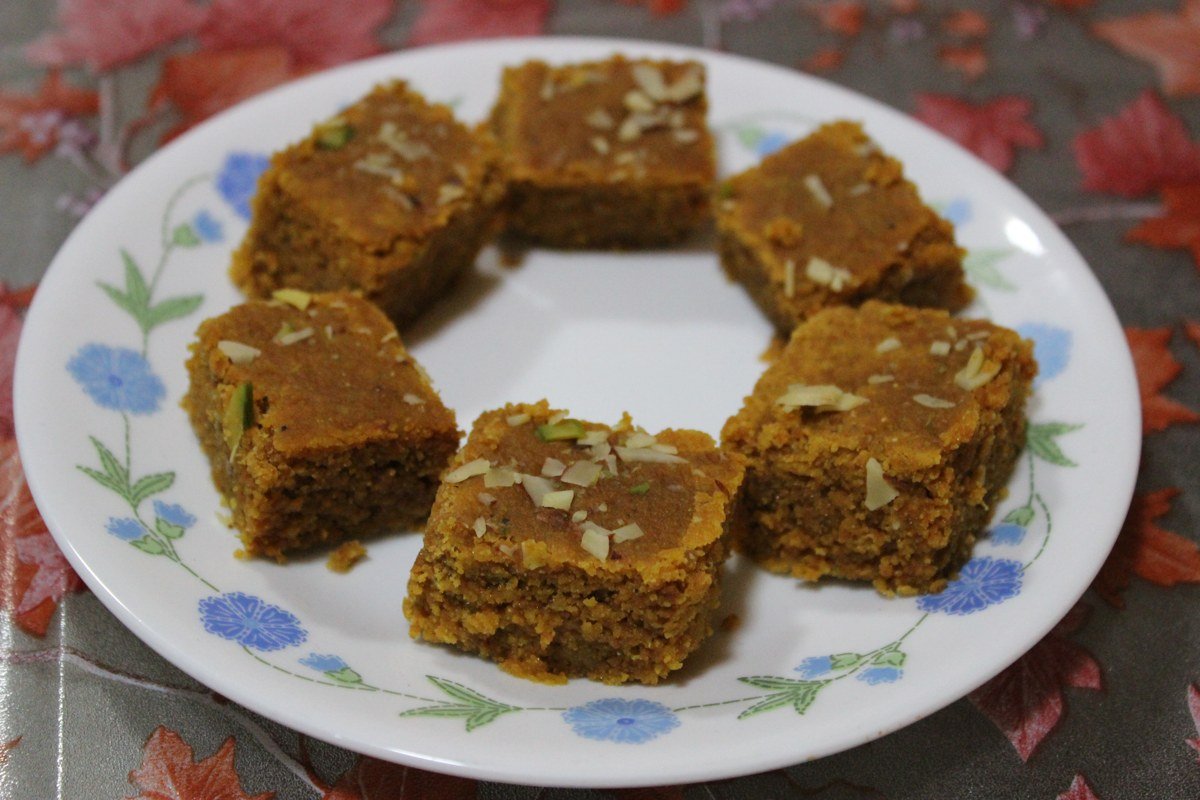
About Mohanthal
Mohanthal is a beloved Gujarati (and Rajasthani) sweet made by slow-roasting gram flour in ghee until nutty and golden, then binding it with sugar syrup, mawa, cardamom and saffron, and setting it into firm, fudgy diamonds topped with slivered almonds and pistachios.
The slow roasting gives mohanthal its characteristic slightly grainy, melt-in-the-mouth texture and deep, ghee-rich flavour. It’s a staple of festivals, weddings and temple prasad.
Mohanthal is one of the most technically demanding Gujarati sweets, and everything rests on a step called dhabo. Coarse gram flour is first rubbed with warm ghee and a little milk until it clumps, then passed through a sieve — this creates the tiny granules that give the finished sweet its characteristic grain. Skip it and the result is a smooth besan barfi, which is a perfectly good sweet but not mohanthal.
The prepared flour is then roasted in a generous quantity of ghee over a low flame, stirred continuously for a long stretch, until it darkens to a deep gold and releases a nutty aroma that is the cook’s signal to proceed. A sugar syrup brought to the correct thread consistency is beaten in, along with cardamom and saffron, and the mixture is poured into a tray, studded with nuts and left to set before being cut into squares or diamonds.
The story
Mohanthal is an old temple and festival sweet, its name linked to ‘Mohan’ (a name of Krishna). The patience required to roast the besan correctly makes it a point of pride for sweet-makers and home cooks alike.
Key ingredients
How it's made
Roast the besan
Gram flour is slow-roasted in ghee until golden and aromatic.
Make syrup
A one-string sugar syrup is prepared.
Combine
Syrup, mawa, cardamom and saffron are mixed into the besan.
Set & cut
Spread in a tray, garnished with nuts, set firm and cut into diamonds.
How it tastes
Mohanthal is rich, nutty and fudge-like, carrying the toasted aroma of gram flour cooked patiently in ghee. Properly made it has a faintly granular texture — the danedar quality Gujarati cooks prize — rather than the smooth density of a plain barfi, and it should melt slowly rather than dissolve. Cardamom and saffron run through it, with almonds and pistachios pressed into the top.
Where to eat it
Sweet shops across Gujarat and Rajasthan make mohanthal, especially in the run-up to Diwali, and the good ones are judged on how well they have developed the grain. It is also a major temple sweet, prepared in large quantities as prasad — the Swaminarayan temples in particular are closely associated with it, and many devotees regard the temple version as the standard.
For anyone attempting it at home, the two failure points are both matters of judgement rather than ingredients. The roast must go far enough that the gram flour smells distinctly nutty and has darkened several shades, since an under-roasted batch tastes raw and pasty however much ghee has gone in. The sugar syrup must reach the correct thread consistency before it meets the flour: too thin and the mohanthal never sets, too thick and it turns hard and brittle instead of yielding. Both are learned by repetition, which is why many families buy it from a shop they trust rather than risking a large batch of expensive ingredients.
Worth seeking out
Classic Mohanthal
Firm, grainy besan fudge with nuts.
Magas
A closely related, sometimes softer besan sweet.
Mawa Mohanthal
Extra-rich with more reduced milk.
Pairs well with
On the table
Mohanthal is festival food above all, made in quantity for Diwali, distributed as prasad at temples, and given as a gift between households during celebration seasons. It keeps well for a week or more without refrigeration, which is part of why it became the sweet families make in bulk and share rather than one prepared for a single sitting.
If you liked this, try Lapsi and Sukhdi from the same family.
Foodie tips
Good to know
What is mohanthal?
A rich Gujarati sweet of gram flour slow-roasted in ghee, bound with sugar syrup, mawa and cardamom, and set into fudgy diamonds.
What gives mohanthal its texture?
Slow-roasting the besan in ghee (sometimes with a coarse-grain technique) gives the characteristic slightly grainy, melting texture.
How is mohanthal different from magas?
They're close cousins; magas is often softer and lighter, while mohanthal is firmer and richer, though recipes vary by region.
When is mohanthal eaten?
At festivals (especially Diwali), weddings and as temple prasad, and any time as a rich treat.
Related dishes
 Surti Ghari
Rich ghee-soaked sweet Explore →
Surti Ghari
Rich ghee-soaked sweet Explore →
 Sukhdi
Jaggery & wheat energy squares Explore →
Sukhdi
Jaggery & wheat energy squares Explore →
 Ghughra
Crisp sweet-or-savoury stuffed pastry Explore →
Ghughra
Crisp sweet-or-savoury stuffed pastry Explore →
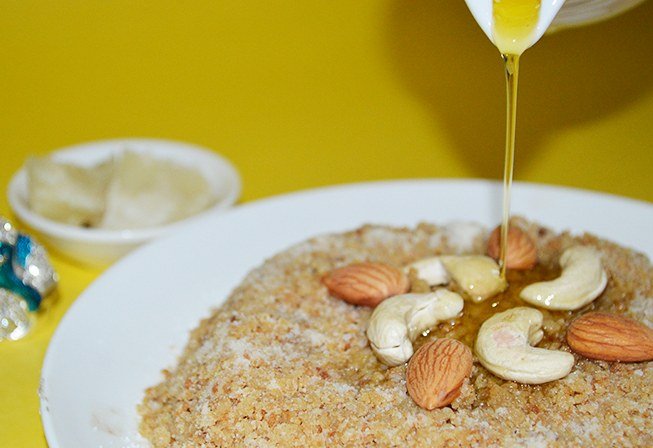 Lapsi
Home › Food › Lapsi SWEETS Lapsi Toasted broken wheat cooked in ghee and jaggery — the auspicious sweet for new beginnings. AT A GLANCE TYPE Broken-wheat sweet CATEGORY Sweets REGION All Gujarat TASTE Sweet • Nutty • Warming DIET Vegetarian BEST TIME Auspicious days SERVE Dessert GOOD FOR Celebrations — WHAT IT IS About […] Explore →
Lapsi
Home › Food › Lapsi SWEETS Lapsi Toasted broken wheat cooked in ghee and jaggery — the auspicious sweet for new beginnings. AT A GLANCE TYPE Broken-wheat sweet CATEGORY Sweets REGION All Gujarat TASTE Sweet • Nutty • Warming DIET Vegetarian BEST TIME Auspicious days SERVE Dessert GOOD FOR Celebrations — WHAT IT IS About […] Explore →
WHERE TO STAY
Find your stay in Gujarat
Compare live prices across the big booking sites and reserve in a few taps. Booking happens securely on the partner's site — we may earn a small commission at no extra cost to you.
Book directly on our partner sites — tap a provider to see live Gujarat hotels & prices:
SHOP THE REGION
Bring home Gujarat — & travel essentials
Hand-picked crafts and trip gear, available on Amazon.