Home › Chhota Udaipur › Pithora Wall Art
TRIBAL ART · RATHWA · LIVING TRADITIONOne of India's most extraordinary living art traditions — the Pithora murals of the Rathwa Adivasi of Chhota Udaipur: large-scale ceremonial wall paintings depicting the deity-king Babo Pithoro, his white horse, and the full court of the tribal cosmos, created in a sacred ceremony that marks the home as a place of blessing.
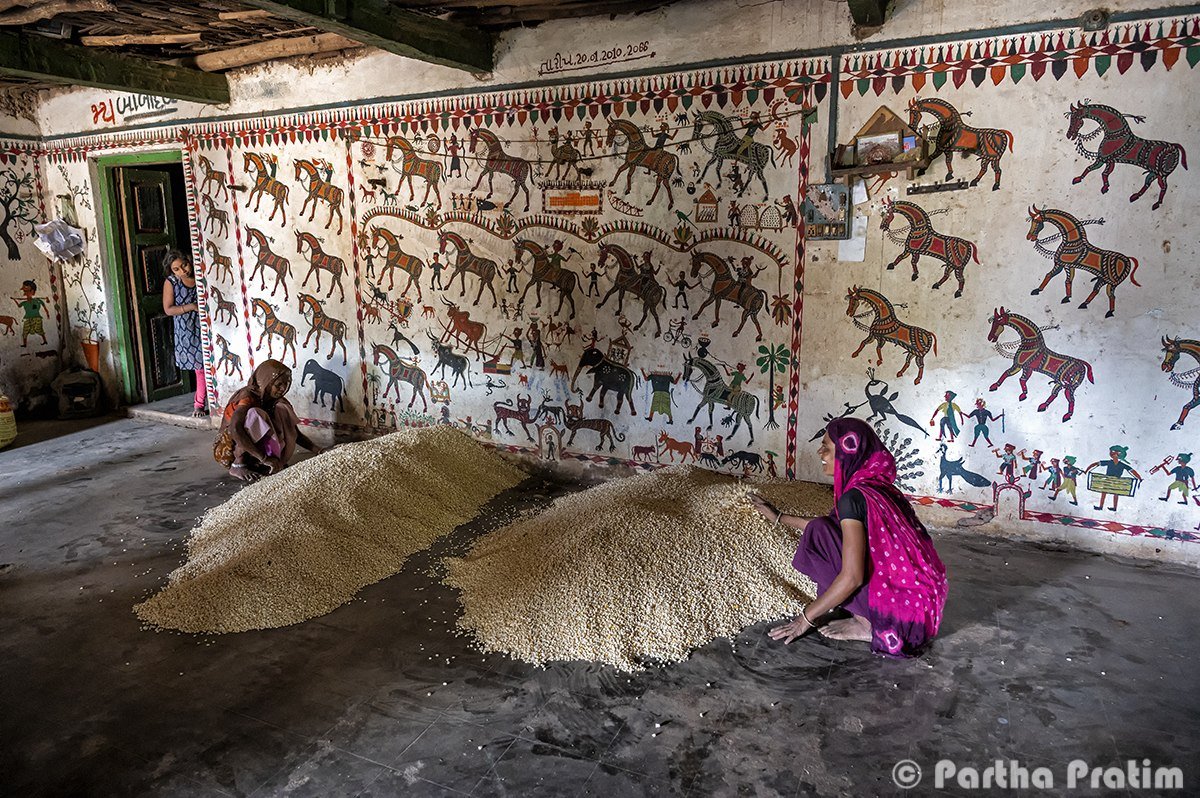
Pithora wall art is the defining visual tradition of the Rathwa Adivasi of Chhota Udaipur district — a ceremonial mural painting that covers the inner walls of a tribal home, commissioned in specific circumstances (illness in the family, a wedding, a vow fulfilled) from a specialist artist called a lakhara, who paints in a single ritual ceremony.
The central figure of every Pithora mural is Babo Pithoro, the supreme deity of the Rathwa — depicted on a white horse, leading a procession of his brother, wife, courtiers, celestial animals, the sun, moon, and a cosmos of sacred beings. Each painting is a complete cosmological map, narrated in a specific visual language that has been passed down through generations of lakhara artists.
The colours of the original tradition were derived from natural mineral pigments: red from sindoor, yellow from turmeric, white from lime, black from charcoal. Contemporary paintings often use acrylic, but the compositional vocabulary and the narrative grammar remain intact. The best place to see Pithora murals is in the villages of the Kawant and Naswadi talukas — but always with a guide and explicit community permission. The mural, once painted, becomes a sacred object in the home.
Pithora mural art — Chhota Udaipur. Source: Wikimedia Commons.
Pithora mural, Chhota Udaipur. Wikimedia Commons.
Rathwa mural tradition begins.
Sacred artist-ritualist.
Illness, wedding, vow.
Active — with acrylic adaptations.
Still commissioned.
Pithoro on horseback.
A complete world.
Ritual, not decoration.
Extraordinary imagery.
Village tradition.
PITHORA ARTBabo Pithoro.
Essential.
The lakhara's work.
On the white horse.
Sun, moon, animals.
What prompted it?
Sacred object.
Pithora mural detail. Wikimedia Commons.
A Pithora mural fills three walls of a room in a single continuous composition. Babo Pithoro always appears at the centre of the main wall, mounted on a white horse; his brother on a black horse rides beside him.
The painting includes the sun and moon in the upper field, a village with trees, animals and ritual objects in the lower field, and the full divine court of Pithoro’s universe filling every remaining space. The lakhara artist works from memory — the composition is learned, not sketched — completing the mural in a ritual session that is itself a form of worship. (Village visits require a guide; photograph only with explicit permission.)
More places to visit across the district are gathered in our Chhota Udaipur travel guide.
Ceremonial murals covering three interior walls
Central figure: Babo Pithoro on a white horse
Original pigments: sindoor, turmeric, lime, charcoal
Painted in one session by a specialist lakhara artist
Best conditions and festivals.
Lush and green; monsoon mood.
Hot; early morning best.
⏰ October to February is ideal — festivals and clear skies.
Vadodara airport (~100 km).
Bodeli / Chhota Udaipur.
NH-56 from Vadodara.
PERMISSION FIRST
Always seek the host family's explicit permission before raising a camera.
The central Babo Pithoro on his white horse, the sun and moon, and the crowded divine court.
Capture the natural pigments — sindoor red, turmeric yellow, lime white — in soft daylight.
Remember the mural is a sacred object, not decoration; keep your visit quiet and unstaged.
HILLSRolling green country on the MP border
HERITAGEA graceful old royal palace
A Shiva temple on the Narmada’s banks
A town where furniture becomes art — Sankheda has been producing lacquer-turned wooden furniture for generations,…
A bustling market town of the belt
A forested viewpoint over the hills
THALIComfort home cooking.
TRIBALForest produce & millet.
BAJRATribal staple.
Expect simple, hearty tribal fare — bajra roti, forest produce and Adivasi forest honey.
Yes — with a guide in the tribal villages.
Babo Pithoro on a white horse, with his divine court.
Only with explicit community permission.
Kawant, Naswadi and surrounding villages.
Yes — an active, living tradition.
The specialist ritual artist who paints Pithora murals.
Old Parsi coastal settlements

Bhavnagar’s white-marble crown — the hilltop Takhteshwar Mahadev temple, a serene Shiva shrine with sweeping views…
NATUREPelicans, flamingos & cranes in winter
DAMA mighty reservoir on the Mahi river
FORESTA jungle valley of ruined medieval temples
LAKEA restored medieval lake & lakefront plaza
WHERE TO STAY
Compare live prices across the big booking sites and reserve in a few taps. Booking happens securely on the partner's site — we may earn a small commission at no extra cost to you.
Book directly on our partner sites — tap a provider to see live Gujarat hotels & prices:
SHOP THE REGION
Hand-picked crafts and trip gear, available on Amazon.
Published 24 June 2026 · Updated 24 August 2026
We’re an independent group of writers and travellers documenting every corner of Gujarat — one place, plate and festival at a time.
Search Gujarat Explorer
Find places, food, festivals and travel guides across Gujarat
Press Enter to search — or Esc to close
Plan Your Trip
Gujarat Explorer is an independent travel guide. We’re happy to help you shape an itinerary and point you to the right places, stays and experiences across Gujarat.
Book a Cab