Pavagadh is two things stacked on top of each other, and most visitors only properly engage with one of them. Below, spread across the plain, are the ruins of Champaner — a sixteenth-century capital of the Gujarat sultanate, with mosques and gateways and stepwells of extraordinary quality, inscribed by UNESCO in 2004. Above, on the summit of an eight-hundred-metre hill, is the temple of Kalika Mata, one of the most visited Shakti shrines in western India and a place of very serious pilgrimage.
The pilgrims come for the goddess and generally give the ruins a nod on the way past. Heritage visitors come for the ruins and are often surprised by the scale of the crowd on the hill. Doing both properly, in the right order and at the right time of day, is the difference between a superb day out and a hot, queue-bound slog.
The hill, and the two ways up
Pavagadh is a volcanic plug — a plug of hard rock left standing after softer surroundings eroded — which is why it rises so abruptly out of flat country and why it made such an obvious fortress. It was held by Rajput chieftains, taken by Mahmud Begada, the Sultan of Gujarat, in 1484, and it was he who moved his capital to Champaner at its foot and built the great mosques there. Fortifications, gateways and cisterns from that long military history survive at various levels of the hill.
There are two ways to the top. The traditional route is on foot, up a long stepped path from the base through the fortified levels, past shrines and stalls and rest points, which takes a couple of hours at an unhurried pace and is what a great many pilgrims still do. The alternative is the ropeway, which lifts you from Manchi part-way up to near the summit, leaving a final stretch of steps — a couple of hundred or so — to the temple itself. Most visitors take the ropeway at least one way.
The ropeway is the pressure point. On weekends, during Navratri, at the Chaitra full moon and on other major dates, queues for it can run to several hours in both directions, and the summit becomes extremely crowded. Weekday mornings outside festival periods are a completely different experience. If you have any flexibility at all in your dates, use it on this.

A Shakti Peeth on an eight-hundred-metre volcanic plug, above a ruined sultanate capital.
Kalika Mata, and a spire five hundred years empty
The summit temple is dedicated to Kalika Mata and is counted among the Shakti Peeths, which places it in the same network as Ambaji in north Gujarat. It is an ancient and continuously important shrine, and the volume of devotion is the dominant fact of any visit — this is not a monument with visitors but a working pilgrimage site with a very large flow of people, particularly during Navratri, when the whole hill is given over to it.
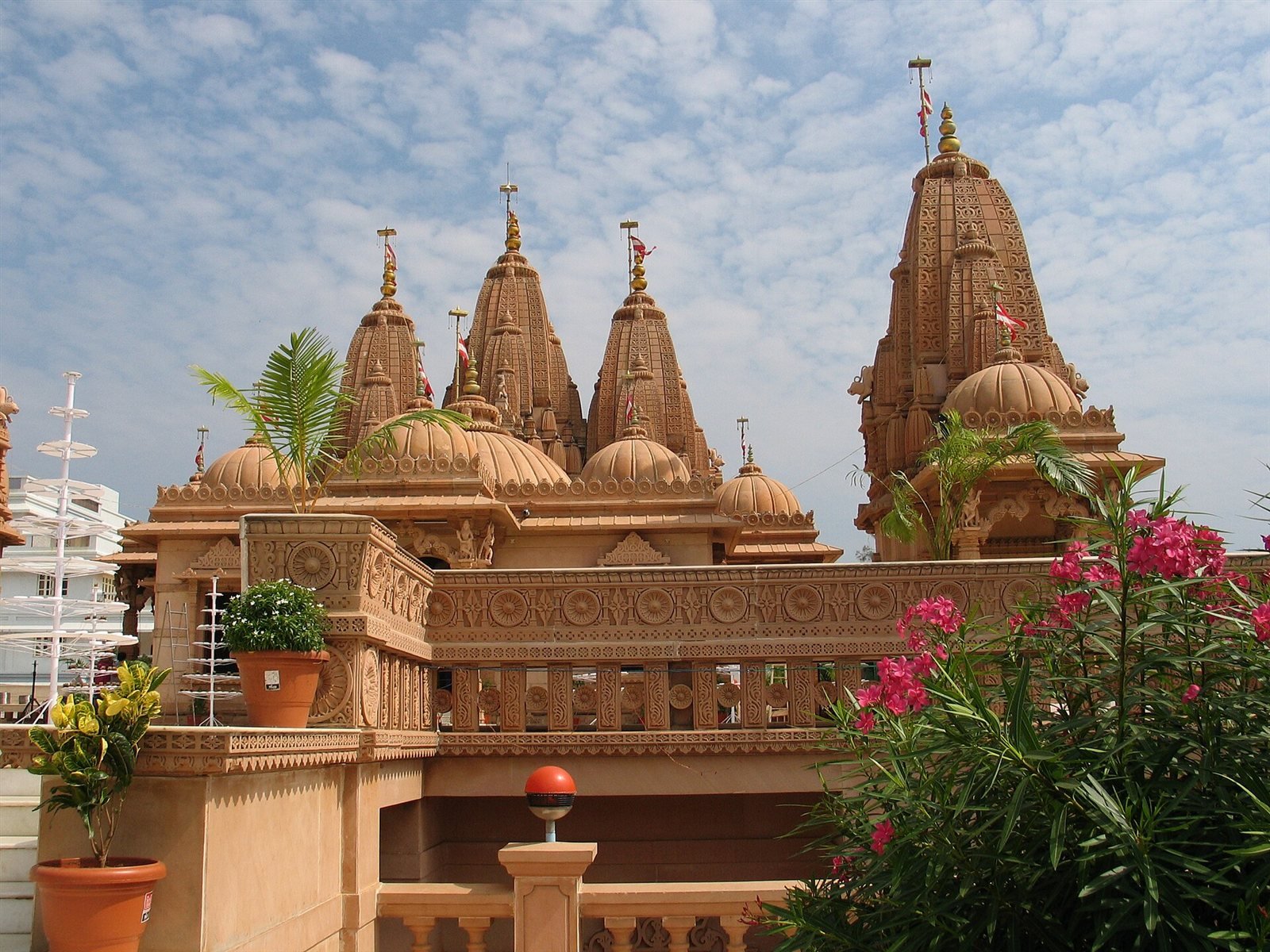
The temple stood for five centuries without its spire. In 2022 a new shikhara was completed and a flag was hoisted on it for the first time since the fifteenth century
The temple's structure carries a specific history. Its original spire was destroyed in the medieval period, and for centuries the shrine of Kalika Mata stood without one, with a dargah associated with the Sufi saint Sadanshah occupying the upper level of the structure — an arrangement that lasted, and was contested, for a very long time. Following an agreement and a redevelopment programme, the dargah was relocated and a new shikhara was constructed, completed in 2022, with a flag hoisted on the temple for the first time in around five hundred years.
The redevelopment has substantially changed the summit: new platforms, wider circulation, improved facilities and much greater capacity for the crowds. Whatever your view of the history, the practical effect for a visitor is that the summit is now easier to move around than it was, and considerably less atmospheric than the old cramped arrangement. Behave as at any active shrine — shoes off, modest dress, photography restricted near the sanctum, and patience in the queue.
Champaner below, which deserves better
The ruins on the plain are, architecturally, the more remarkable half and they get a fraction of the attention. The Jama Masjid at Champaner is one of the finest mosques in India — a broad hypostyle hall with a superb carved facade, twin minarets, a stepped entrance and the distinctive fusion of Gujarati temple carving traditions with Islamic form that makes the region's sultanate architecture so extraordinary. The Kevada Masjid, Nagina Masjid, Lila Gumbaj and the Sahar ki Masjid are all worth time.
Beyond the mosques there are stepwells, gateways, granaries, the remains of the royal enclosure and a scatter of Hindu and Jain temples on the hill, spread across a considerable area of scrub and farmland. It rewards a vehicle and a couple of hours, and it is much quieter than the hill. An ASI ticket covers the main monuments, and morning light is far better than midday for the carving. Doing Champaner properly and Pavagadh briskly is a defensible way to spend the day, and the opposite of what most people do.
Practicalities
Champaner-Pavagadh is about 50 km from Vadodara, roughly an hour and a quarter by road via Halol, and Vadodara is the gateway with an airport, a major railway station on the Mumbai–Delhi line, and plenty of hotels. Buses and taxis run from Vadodara and Halol. Most visitors come as a day trip from Vadodara or Ahmedabad, which is 150 km away.
October to March is the season — the hill climb and the open ruins are both hard work in the heat, and April to June should be avoided if possible. Navratri in autumn and the Chaitra full moon in spring bring enormous crowds; so do weekends year-round. There is limited accommodation at Halol and in the Champaner area, and rather better options at Jambughoda 25 km away, whose teak forest is the ideal afternoon counterweight to a crowded hill. Vadodara remains the comfortable base.
If you go
- Go on a weekday outside Navratri and the Chaitra full moon, or expect ropeway queues measured in hours.
- Do Champaner's mosques in the early morning light, then the hill — the carving at the Jama Masjid is the best thing here.
- Take the ropeway at least one way, and remember there are still a couple of hundred steps to the temple after it.
- Treat the summit as an active pilgrimage site: shoes off, modest dress, restricted photography, patience.
- Retreat to Jambughoda's forest, 25 km away, for the afternoon — the best possible antidote to the summit crowd.
Pavagadh gives you a Shakti Peeth on a volcanic plug, reached by ropeway or by two hours of steps, with a spire completed in 2022 after five centuries without one — and below it a ruined sultanate capital containing one of the finest mosques in India, which almost nobody looks at properly. Come on a weekday in the cool months, do Champaner first while the light is good, take the ropeway up, and then disappear into the forest at Jambughoda for the afternoon.